


ASTM D3433: Adhesive Bonded Metal Cleavage Fracture Testing Services
Accredited ASTM D3433 adhesive bonded metal cleavage fracture testing from Infinita Lab, performed to the exact standard requirements - accurate, reproducible results with full documentation for compliance, R&D, and quality control programs.
TRUSTED BY


Get ASTM D3433 compliant results - request your adhesive bonded metal cleavage fracture testing quote
- Overview
- Scope, Applications, and Benefits
- Test Process
- Specifications
- Instrumentation
- Results and Deliverables
What Is ASTM D3433 Adhesive Bonded Metal Cleavage Fracture?
ASTM D3433 is the standard test method engineers and formulators use to measure the fracture strength in cleavage of adhesives bonded to metal substrates. It gives them a repeatable way to quantify how much energy a bonded joint can absorb before a crack starts working its way through the bond line. The method relies on cleavage-loaded specimens – typically double cantilever beam (DCB) or tapered double cantilever beam (TDCB) configurations – where two metal adherends are bonded together along part of their length, then pulled apart at the free ends in a testing machine. As the load climbs, a pre-existing crack or starter notch extends through the adhesive layer, and how that crack propagates, whether in a slow, stable pattern or a stop-start run-arrest pattern, gets recorded alongside the applied load and crack length.
From that data, the lab calculates the critical strain energy release rate, commonly reported as G_Ic for crack initiation and G_Ia for crack arrest, and together these values describe how resistant the adhesive bond really is to cleavage-type crack growth. Because the tapered geometry keeps specimen compliance largely independent of crack length, it simplifies the analysis and tends to improve repeatability of results between labs and operators.
Why does this matter? Cleavage and peel-type loading are among the most damaging ways a bonded joint can fail in service. A crack tip concentrates stress far more effectively than the same load spread evenly across a bond area, which is why fracture toughness, not just bulk strength, really determines durability. By quantifying resistance to cleavage-type crack growth, ASTM D3433 helps manufacturers compare adhesive systems, evaluate surface preparation and primers, screen materials for structural bonding applications, and build the justification needed for quality control and design acceptance criteria wherever bonded metal joints carry real structural loads.

Applications and Benefits of ASTM D3433 Adhesive Bonded Metal Cleavage Fracture Testing
Scope
ASTM D3433 defines a method to measure fracture strength in cleavage of adhesive-bonded metal joints using controlled loading to propagate cracks along the bond line.
- This test method lays out a standardized procedure for determining the fracture strength in cleavage of structural adhesives bonded between metal adherends.
- It’s aimed primarily at metal-to-metal bonded assemblies, though the underlying principles can be extended to other rigid adherend combinations when appropriate adjustments are made.
- Specimens take the form of double cantilever beam (DCB) or tapered double cantilever beam (TDCB) configurations, in which two metal beams are bonded along a controlled length and separated at a free end.
- Loading is applied in cleavage, or mode I tensile-opening, which concentrates stress at the tip of a pre-existing crack or bond-line flaw.
- Two crack behaviours are distinguished by the standard: flat crack extension, where growth is slow and stable, and peaked crack extension, where the crack advances and arrests in a repeating run-stop pattern.
- Results are expressed as the critical strain energy release rate at crack initiation, G_Ic, and, where applicable, at crack arrest, G_Ia.
- Careful control over specimen preparation is required throughout, including surface treatment, adhesive application, cure schedule, and bond-line thickness, since these variables strongly influence fracture behaviour.
- Conditioning specimens before testing, and in some cases testing under a specific environmental exposure, can be worked into to evaluate durability alongside baseline cleavage strength.
- Peel testing of flexible adherends and lap-shear strength fall outside this procedure’s scope; separate ASTM standards cover those.
- Adhesive formulators, designers of bonded structures, and quality laboratories needing comparative, reproducible cleavage fracture data are the intended users.
Applications
- Aerospace structural bonding qualification, including skins, doublers, and bonded panel edge closures
- Automotive body and chassis adhesive bonding evaluation
- Comparative screening of adhesive formulations during research and development
- Surface treatment and primer effectiveness evaluation on metal adherends
- Quality control and acceptance testing for bonded metal assemblies
- Durability and environmental exposure studies on structural adhesive joints
- General industrial design validation for bonded metal joint applications
Benefits
- Delivers quantitative fracture toughness data rather than a simple pass-or-fail result
- Distinguishes between crack initiation and crack arrest behaviour, giving a fuller picture of bond performance
- Tapered specimen geometry keeps compliance largely independent of crack length, which improves repeatability
- Makes direct, apples-to-apples comparison possible between different adhesive systems and surface preparation methods
- Supports the development of design and manufacturing acceptance criteria
- Draws on a long-established, widely recognized standard that’s familiar across the adhesive and bonded-structure industries
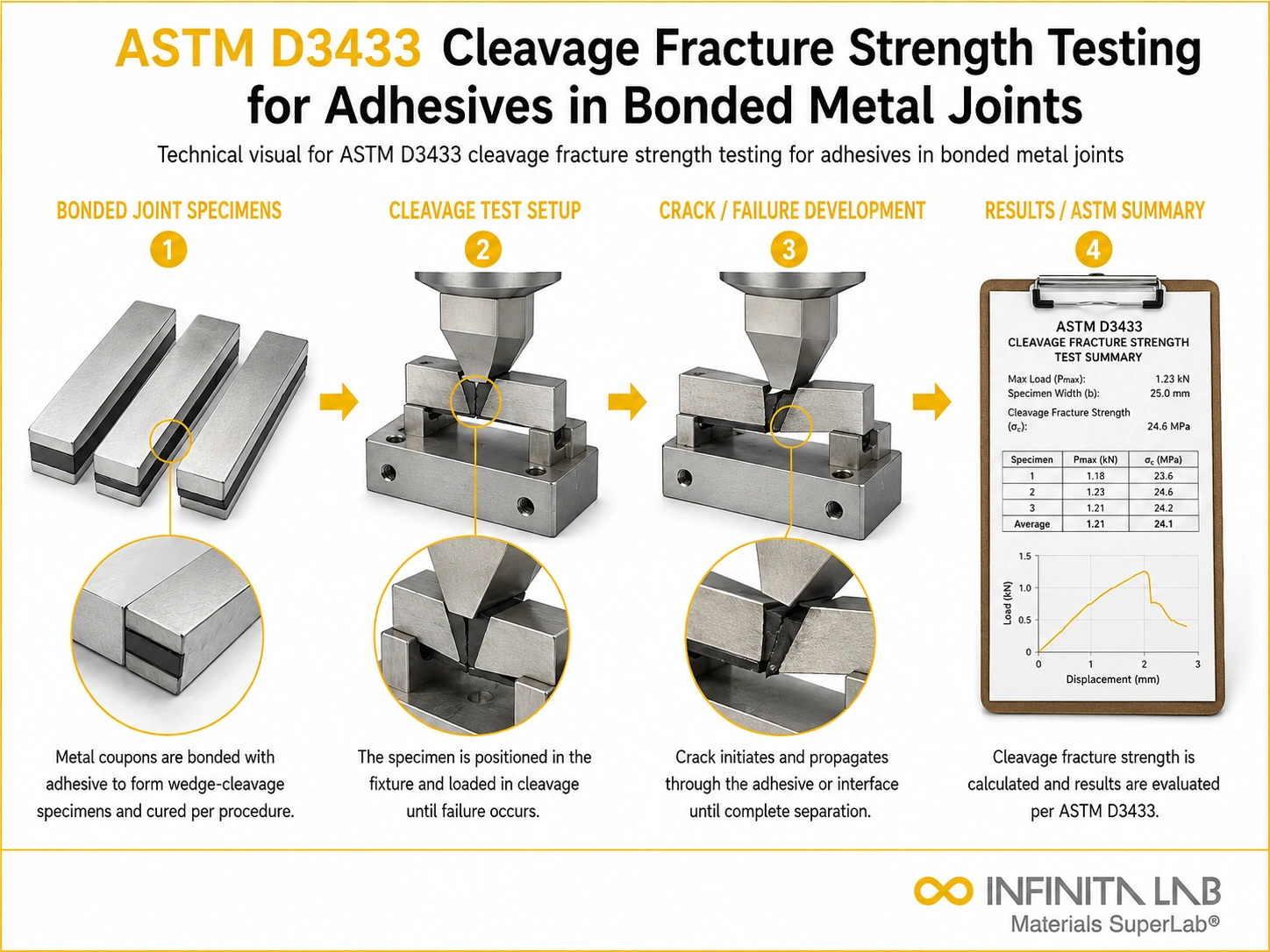
Our ASTM D3433 Testing Procedure
Specimen Preparation
Metal adherends are bonded with adhesive and pre-cracked if required.
1Fixture Setup
Specimen is mounted in a test fixture designed for cleavage loading.
2Load Application
Tensile opening force is applied at a controlled rate to propagate the crack.
3Fracture Measurement
Load and displacement are recorded to determine fracture strength.
4ASTM D3433 Test Parameters and Requirements
| Parameter | Details |
|---|---|
| Material Type | Adhesive-bonded metal joints |
| Loading Mode | Tensile opening (cleavage) |
| Measurement | Fracture strength or energy |
| Units | N/mm or J/m² |
| Fixture | Cleavage test fixture |
| Output | Crack propagation resistance |
| Failure Mode | Adhesive or cohesive fracture |


- Universal Testing Machine – applies a controlled tensile cleavage load to the bonded specimen and records the resulting force and displacement.
- Cleavage/Pin Loading Fixtures – the grips and pins that transfer load to the free ends of the DCB or TDCB beams, keeping the setup in a pure mode I opening configuration.
- Traveling Optical Microscope or Crack Monitoring System – follows the crack tip’s position along the bond line as the test progresses.
- Load Cell – measures applied force with precision throughout the test, feeding directly into the fracture toughness calculations.
- Extensometer or Displacement Transducer – captures crosshead or beam-opening displacement for compliance-based analysis.
- Environmental Chamber – holds specimens at controlled temperature and humidity whenever durability testing accompanies baseline cleavage evaluation.
- Data Acquisition System – continuously logs load, displacement, and crack-length data, all of which feed into the G_Ic and G_Ia calculations.
Equipment and Instrumentation Used for ASTM D3433 Testing
What You Receive: Test Report, Data, and Certification
- A detailed test report covering specimen geometry, materials, and preparation methods
- Critical strain energy release rate values, G_Ic and, where applicable, G_Ia, for each specimen tested
- Load-displacement and crack-length data and plots that illustrate crack initiation and propagation behaviour
- A classification of the crack extension pattern observed during testing, flat or peaked
- Photographic documentation of the fracture surfaces and failure mode, whether adhesive or cohesive
- A statistical summary, including mean and range, across replicate specimens for comparative evaluation
ASTM D3433 Adhesive Bonded Metal Cleavage Fracture FAQs
ASTM D3433 is used to evaluate the fracture strength of adhesive bonds in metal joints under cleavage loading. It helps determine resistance to crack initiation and propagation, ensuring bonded structures can withstand tensile opening forces without sudden failure during service.
Cleavage loading represents a critical failure mode where joints open under tensile stress. Testing ensures adhesives can resist crack growth, improving structural reliability and preventing catastrophic failure in bonded assemblies subjected to opening forces.
Unlike lap shear or peel tests, ASTM D3433 focuses on fracture behavior under cleavage loading. It specifically evaluates crack growth resistance, which is critical for structural applications where failure can propagate rapidly.
Failure modes include adhesive failure at the interface, cohesive failure within the adhesive, or substrate failure. Each mode provides valuable information about bond quality and material performance.
By evaluating fracture resistance, the test helps design stronger adhesive bonds, reducing failure risk and enhancing long-term performance in demanding applications.
A cleavage test evaluates an adhesive joint’s resistance to cleavage forces that pull the bonded surfaces apart from one edge. A controlled load is applied to the joint, and the force or failure behaviour is measured to assess adhesive performance.
Why Choose Infinita Lab for Adhesive Bonded Metal Cleavage Fracture Testing
When your Adhesive Bonded Metal Cleavage Fracture results have to hold up - for compliance, a customer audit, or an engineering decision - ASTM D3433 accuracy and an unbiased third-party report matter more than price. Infinita Lab routes your ASTM D3433 adhesive bonded metal cleavage fracture testing to ISO/IEC 17025-accredited U.S. partner labs with hands-on method experience, so you get defensible data, transparent reporting, and turnaround times built around your project deadline - not ours.

Need ASTM D3433 Adhesive Bonded Metal Cleavage Fracture Testing You Can Rely On?
Send query us at hello@infinitalab.com or call us at (888) 878-3090 to learn more about our services and how we can support you.



Request a Quote
Submit your material details and receive testing procedures, pricing, and turnaround time within 24 hours.
 Quick Turnaround and Hasslefree process
 Confidentiality Guarantee
 Free, No-obligation Consultation
 100% Customer Satisfaction
