


ASTM D2911: Plastic Bottle Dimensional Tolerance Testing Services
Accredited ASTM D2911 plastic bottle dimensional tolerance testing from Infinita Lab, performed to the exact standard requirements - accurate, reproducible results with full documentation for compliance, R&D, and quality control programs.
TRUSTED BY


Get ASTM D2911 compliant results - request your plastic bottle dimensional tolerance testing quote
- Overview
- Scope, Applications, and Benefits
- Test Process
- Specifications
- Instrumentation
- Results and Deliverables
What Is ASTM D2911 Plastic Bottle Dimensional Tolerance?
ASTM D2911/D2911M, Standard Specification for Dimensions and Tolerances for Plastic Bottles, is a specification, not a test method, and remains active in its D2911/D2911M-16(2023) edition. It covers the thread configuration and finish dimensions for plastic bottles with screw-type closures, with a maximum capacity of 18.9 L (5 gal) and a maximum bottle dimension of 305 mm (12 in.). It also includes tolerances for bottle capacity and body dimensions. One document, then, governs both the neck that mates with the closure and the overall envelope of the container. ASTM Subcommittee D20.19 maintains it, and no ISO equivalent exists, making it a key reference for packaging supply chains that follow North American conventions.
The finish is the part of the bottle that engages the closure. The specification defines its critical dimensions: thread outside diameter, neck diameter, inside diameter, finish height, and sealing-surface geometry. These follow the long-established industry finish conventions, where a designation such as 28-410 pairs a nominal neck diameter with a thread style. Because the document is a specification, it states what a conforming bottle must look like. The measurement procedures it contains for capacity, body dimensions, and finish dimensions demonstrate conformance. Values appear in SI and inch-pound units, and each system is treated as a separate standard, so figures must never be mixed between them. Sampling and retest provisions are normally agreed between purchaser and seller. Taken together, the provisions give bottle makers, brand owners, and closure suppliers a common dimensional language that supports interchangeability, reliable sealing, and smooth operation on filling and capping lines.

Applications and Benefits of ASTM D2911 Plastic Bottle Dimensional Tolerance Testing
Scope
ASTM D2911 outlines dimensional requirements and allowable tolerances for plastic bottles to ensure compatibility with closures, filling systems, and packaging processes.
- ASTM D2911/D2911M is a specification that defines the dimensions and tolerances a plastic bottle must meet, rather than a test method that measures a material property.
- Thread configuration and dimensions of bottle finishes designed for screw-type closures fall within its coverage.
- It applies to bottles with a maximum capacity of 18.9 L (5 gal) and a maximum bottle dimension of 305 mm (12 in.).
- Tolerances for bottle capacity and for body dimensions such as height and width sit alongside the finish requirements.
- Finish requirements address the neck geometry that engages the closure, including thread outside diameter, neck diameter, inside diameter, and finish height.
- Designations such as 28-410, which combine a nominal diameter with a thread style, reflect the industry neck-finish conventions behind the finish dimensions.
- Procedures for measuring bottle capacity, body dimensions, and finish dimensions are included so that conformance can be demonstrated.
- Both SI and inch-pound values appear. Each system is to be regarded separately as the standard.
- D2911/D2911M-16(2023) is the current edition. It replaced the 2016 edition, which ASTM now lists as historical.
- No known ISO equivalent exists, so international programs often pair the document with customer drawings and closure supplier specifications.
Applications
- Qualifying new blow-molded or injection-molded bottles against the finish dimensions required by a chosen closure.
- Incoming inspection of bottles from converters before they reach a filling and capping line.
- First-article and tooling approval of new molds, where finish and body dimensions must be confirmed.
- Troubleshooting leakage, loose caps, or cross-threading by checking whether the finish conforms to the specification.
- Overflow capacity and body dimension checks for pharmaceutical, nutraceutical, food, and household chemical packaging.
- Supplier audits, plus dispute resolution between bottle manufacturers, brand owners, and closure suppliers.
Benefits
- Confirms that bottle finishes and closures from different suppliers are dimensionally compatible.
- A lower risk of leaks, cap back-off, and sealing failures caused by out-of-tolerance necks.
- Supports smooth running on automated filling, capping, and labeling equipment.
- Objective, documented evidence for supplier qualification and quality agreements.
- Helps catch tooling wear and process drift early through repeatable dimensional data.
- Brand owners get a defensible record when resolving conformance disputes with suppliers.
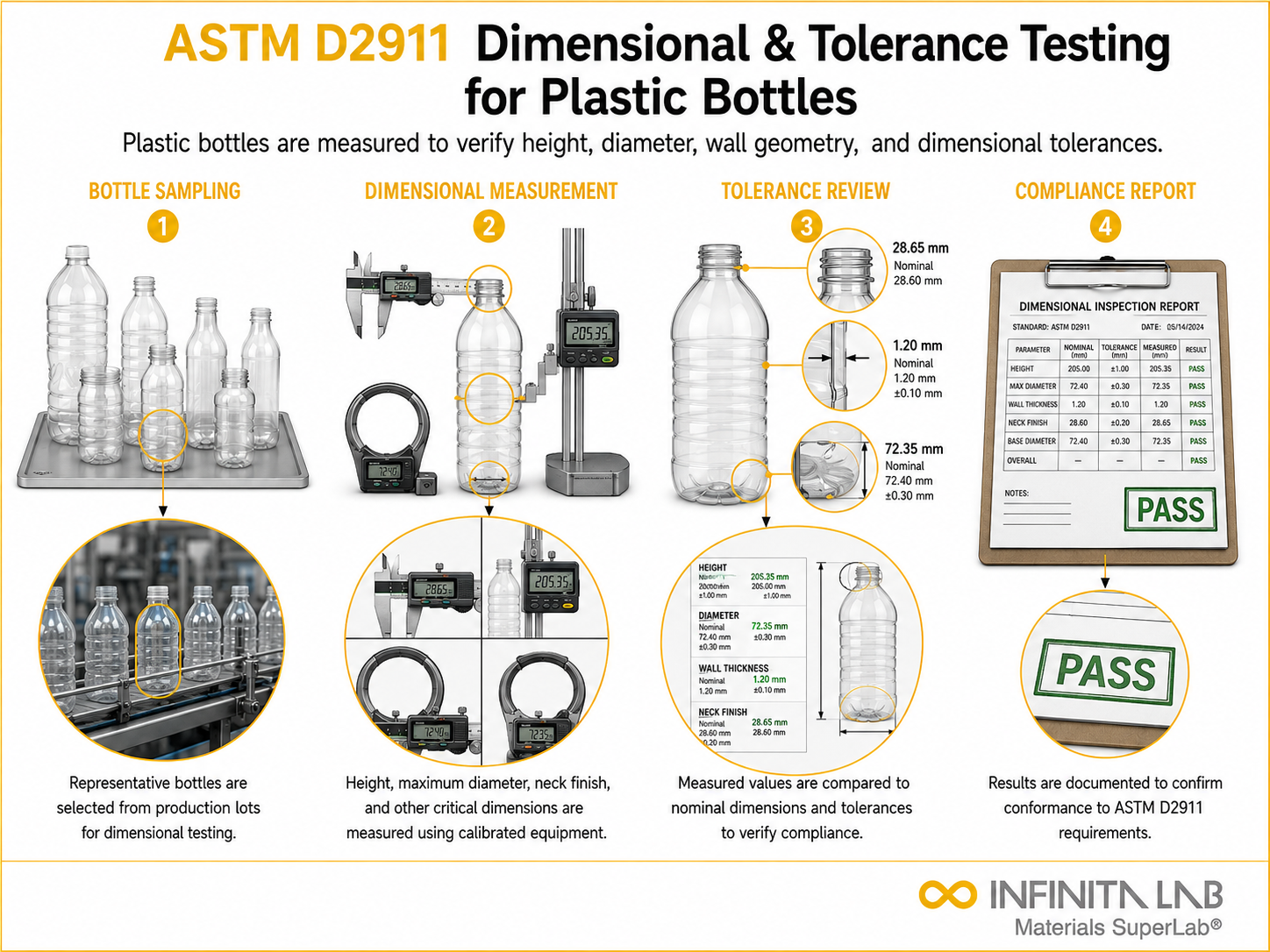
Our ASTM D2911 Testing Procedure
Sample Selection
Representative plastic bottles are selected from production batches for dimensional inspection.
1Dimensional Measurement
Critical dimensions such as height, diameter, and neck finish are measured using calibrated instruments.
2Tolerance Verification
Measured values are compared with specified tolerances defined in the standard.
3Compliance Evaluation
Results are analyzed to determine conformity with ASTM D2911 requirements.
4ASTM D2911 Test Parameters and Requirements
| Parameter | Details |
|---|---|
| Material Type | Molded plastic bottles and containers |
| Measurement Type | Linear dimensions including height, diameter, and neck finish |
| Tolerance Range | Defined allowable variations for each dimension |
| Test Principle | Dimensional verification using precision measurement tools |
| Accuracy | High precision measurement required for compliance |
| Environment | Controlled inspection conditions |


- Digital Micrometers – thread outside diameter, neck diameter, and wall or body thickness; read with fine resolution.
- Vernier and Digital Calipers – used for finish height, bottle height, and width at defined positions.
- Telescoping Gages and Bore Gages – give the inside diameter of the finish opening.
- Analytical and Precision Balances – weigh empty and water-filled bottles to determine overflow capacity.
- Optical Comparators and Profile Projectors – thread profile and sealing-surface geometry are checked against drawings.
- Environmental Conditioning Chambers – stabilize bottle specimens before dimensional measurement.
Equipment and Instrumentation Used for ASTM D2911 Testing
What You Receive: Test Report, Data, and Certification
- A dimensional report listing each measured finish, capacity, and body dimension for every bottle tested.
- Pass or fail status, comparing each result against the specified dimensions and tolerances.
- Methods, instruments, and conditioning used, stated for traceability.
- Summary statistics, such as mean and range by lot or cavity, where multiple bottles are tested.
- Photographs and notes for any non-conforming or damaged specimens.
- All of it in a clear, audit-ready document suitable for supplier files and quality agreements.
ASTM D2911 Plastic Bottle Dimensional Tolerance FAQs
ASTM D2911 is a standard that specifies dimensions and tolerances for plastic bottles. It is important because it ensures compatibility with closures, filling systems, and packaging equipment, improving efficiency, quality, and consistency in manufacturing and packaging processes.
Tolerances allow for controlled variations during manufacturing while ensuring bottles remain functional and compatible with closures and filling systems, preventing defects and operational issues.
Neck finish refers to the dimensions and design of the bottle opening, including threads or sealing surfaces, which must match closures for proper sealing.
The standard focuses only on dimensional aspects and does not evaluate mechanical strength, chemical resistance, or performance under real-world conditions.
Testing is typically conducted during production, quality control inspections, and product development to ensure consistent compliance with specifications.
Why Choose Infinita Lab for Plastic Bottle Dimensional Tolerance Testing
When your Plastic Bottle Dimensional Tolerance results have to hold up - for compliance, a customer audit, or an engineering decision - ASTM D2911 accuracy and an unbiased third-party report matter more than price. Infinita Lab routes your ASTM D2911 plastic bottle dimensional tolerance testing to ISO/IEC 17025-accredited U.S. partner labs with hands-on method experience, so you get defensible data, transparent reporting, and turnaround times built around your project deadline - not ours.

Need ASTM D2911 Plastic Bottle Dimensional Tolerance Testing You Can Rely On?
Send query us at hello@infinitalab.com or call us at (888) 878-3090 to learn more about our services and how we can support you.



Request a Quote
Submit your material details and receive testing procedures, pricing, and turnaround time within 24 hours.
 Quick Turnaround and Hasslefree process
 Confidentiality Guarantee
 Free, No-obligation Consultation
 100% Customer Satisfaction
