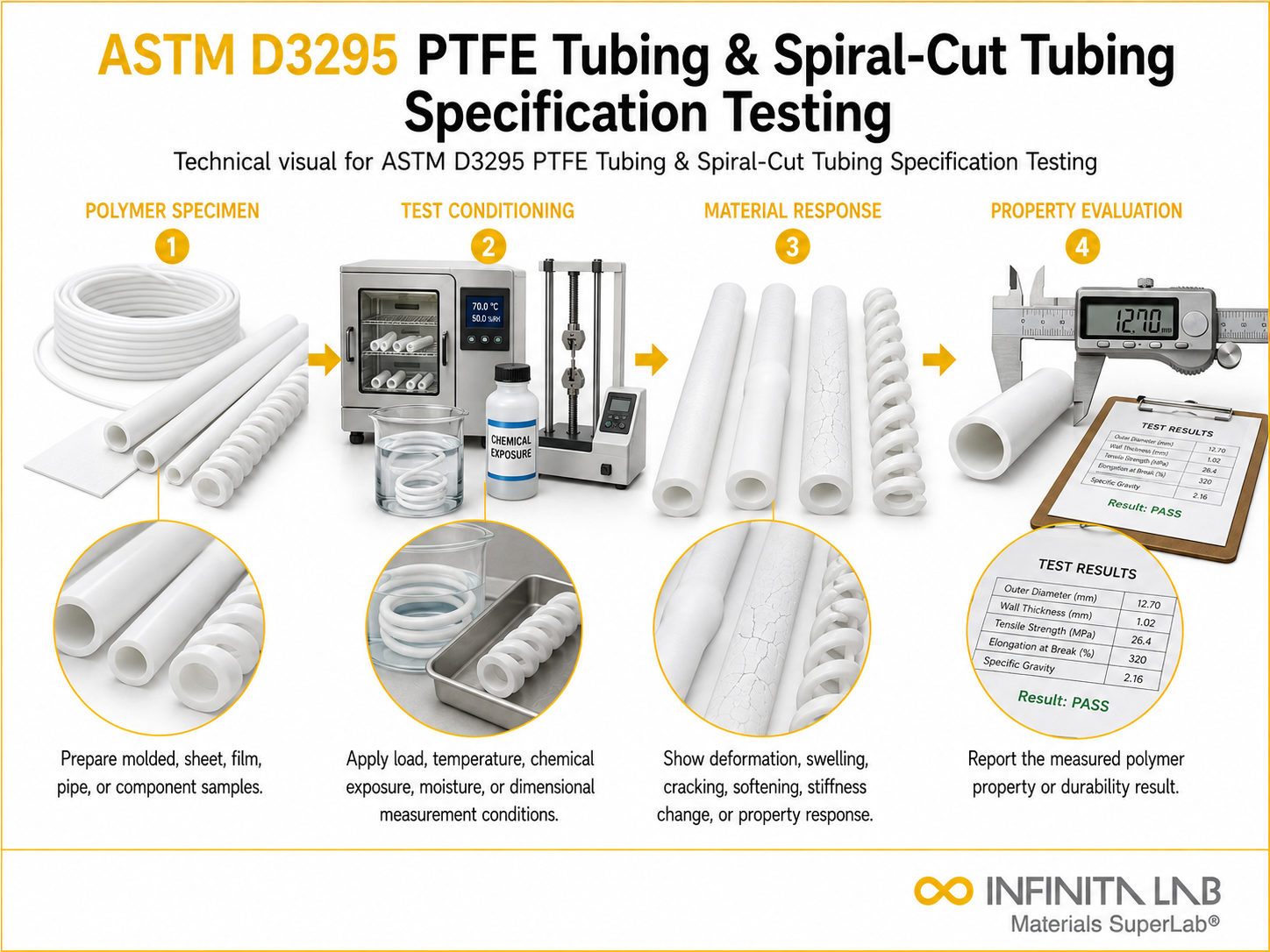


What Is ASTM D3295 PTFE Tubing Specification?
ASTM D3295, Standard Specification for PTFE Tubing, Miniature Beading and Spiral Cut Tubing, defines the material, dimensional, and performance requirements for polytetrafluoroethylene products made from dispersion-grade resin conforming to Specification D4895. The current active edition is D3295-20. It replaced D3295-15 and is maintained under ASTM Committee D20 on Plastics. D3295 is a specification, not a test method, so it doesn’t prescribe a single laboratory procedure. What it does is set the acceptance criteria tubing must satisfy, then point to established test methods for measuring each property. Products fall into five groups according to how size is expressed and what form the product takes. They also split into five classes by wall thickness, from light wall through thin wall, standard wall, chemical tubing, and heavy wall. For each combination, the standard sets dimensional requirements and tolerances for inside diameter and wall thickness. Geometry is only part of it. D3295 also lists physical and electrical requirements covering melting point, specific gravity, weight loss, tensile strength, elongation, dielectric breakdown voltage, heat resistance, and dimensional stability. Artistry and appearance are addressed too, with details such as color left to agreement between purchaser and supplier. Sampling and conformance are handled through referenced ASTM practices or an agreed statistical plan. Values are stated in SI units; inch-pound equivalents are given for reference only. The document also observes that PTFE isn’t a true thermoplastic, so reprocessing resin back into the same product isn’t practical. For buyers, engineers, and quality teams, D3295 supplies a common language for purchasing, incoming inspection, and qualification of PTFE tubing used in wire insulation, fluid handling, and chemical service.

Applications and Benefits of ASTM D3295 PTFE Tubing Specification Testing
Scope
ASTM D3295 evaluates PTFE tubing by defining performance requirements related to dimensions, mechanical strength, and thermal resistance. The test ensures reliability in demanding service conditions.
The test evaluates:
- ASTM D3295 covers PTFE tubing, miniature beading, and spiral-cut tubing manufactured from PTFE resin produced by dispersion, as specified in D4895.
- As a product specification, it defines requirements that finished tubing must meet. It isn’t one test procedure.
- Five groups, based on the sizing system and product type, such as AWG-sized tubing, fractional-inch tubing, spiral cut tubing, and miniature beading.
- Within the groups, products are further divided into classes by wall thickness: light wall, thin wall, standard wall, chemical tubing, and heavy wall.
- Inside diameter and wall thickness requirements and tolerances are tabulated for each size designation.
- On the physical side: melting point, specific gravity, weight loss, tensile strength, and elongation.
- Dielectric breakdown voltage, heat resistance, and dimensional stability make up the electrical and thermal requirements.
- Workmanship and appearance requirements apply. Features such as color are agreed between purchaser and supplier.
- SI units are the stated values, with inch-pound equivalents provided for information only.
- Current active edition: D3295-20 (issued December 2020), which supersedes D3295-15; the standard is not withdrawn.
Applications
- Qualifying PTFE tubing used as insulation sleeving over electrical wire and cable.
- Incoming inspection of tubing for chemical transfer and laboratory fluid-handling lines.
- Checking industrial PTFE tubing for supplier qualification and purchase-order conformance.
- Verifying heavy-wall and chemical-grade tubing for aggressive-media service.
- Miniature beading and spiral-cut products used for spacing and insulating fine conductors are evaluated too.
- Comparing tubing lots or suppliers against a consistent, published acceptance basis.
Benefits
- Purchasers and suppliers get a shared, published set of acceptance criteria for PTFE tubing.
- Procurement gets less ambiguous, since size groups and wall-thickness classes are defined.
- It confirms that dispersion-resin tubing meets mechanical, electrical, and thermal requirements before it enters service.
- Dimensional, melting point, and dielectric checks help detect off-specification lots.
- Audit-ready documentation is supported for regulated and high-reliability industries.
- Lot-to-lot and supplier-to-supplier comparison gets simpler.
Our ASTM D3295 Testing Procedure
Sample Preparation
PTFE tubing samples are cut to required lengths.
1Dimensional Measurement
Diameter, wall thickness, and uniformity are measured.
2Property Evaluation
Mechanical and thermal properties are tested.
3Data Recording & Evaluation
Results are analyzed to verify compliance with ASTM requirements.
4ASTM D3295 Test Parameters and Requirements
| Parameter | Details |
|---|---|
| Applicable Materials | PTFE tubing and spiral-cut tubing |
| Outer Diameter Range | Outer Diameter Range |
| Wall Thickness | ~0.1 mm to 5 mm |
| Operating Temperature | ~-200°C to 260°C |
| Tensile Strength | Tensile Strength |
| Measured Outputs | Dimensional and mechanical properties |


- Universal Testing Machine – tensile strength and elongation of tubing specimens
- Dielectric Breakdown Tester – ramps up voltage to find the breakdown voltage through the tubing wall
- Differential Scanning Calorimeter – gives the melting point of the PTFE
- Analytical Balance with Density Kit – specific gravity by displacement, and it supports weight loss measurements too
- Laser Micrometer or Pin Gauge Set – for inside diameter, outside diameter, and wall thickness
- Forced-Air Convection Oven – runs the heat resistance, weight loss, and dimensional stability exposures
- Optical Comparator or Stereo Microscope – backs up visual and artistic examination
Equipment and Instrumentation Used for ASTM D3295 Testing
What You Receive: Test Report, Data, and Certification
- A pass-or-fail conformance statement for each D3295 requirement evaluated.
- Dimensional data tables covering inside diameter, wall thickness, and tolerance compliance.
- Measured physical and electrical property values, including tensile strength, elongation, and dielectric breakdown voltage.
- Group, class, lot, and sample details tied to the tested material.
- Test methods, conditioning, and any deviations or purchaser agreements are documented clearly.
- A formal test report suitable for supplier qualification, audits, and quality records.
ASTM D3295 PTFE Tubing Specification FAQs
ASTM D3295 provides specification for PTFE tubing and spiral cut tubing. It defines dimensional, physical, and performance requirements, ensuring reliability in applications requiring chemical resistance, flexibility, and high temperature stability.
Key parameters include inner and outer diameter, wall thickness, tensile strength, elongation, and thermal properties. Manufacturing quality and dimensional tolerances are also critical for proper tubing performance.
The test verifies compliance with dimensional and physical property requirements. Results indicate suitability of PTFE tubing for fluid handling, insulation, and chemical processing applications.
ASTM D3295 applies to polytetrafluoroethylene tubing, including straight and spiral cut forms, used in chemical, electrical, and industrial applications requiring flexibility and chemical resistance.
ASTM D3295 provides specification guidelines but may not fully represent performance under all service conditions. Additional testing may be required for pressure, long-term aging, or extreme environmental exposure.
PTFE tubing provides a chemically resistant, low-friction pathway for transporting fluids, gases, or protecting electrical components. Its properties make it suitable for applications requiring chemical resistance, temperature stability, and electrical insulation. ASTM D1675 covers testing of PTFE tubing for electrical insulation.
PTFE testing evaluates properties such as dimensions, tensile strength, elongation, specific gravity, melting point, dielectric strength, and dimensional stability. The applicable tests depend on the type and intended use of the PTFE product.
Why Choose Infinita Lab for PTFE Tubing Specification Testing
When your PTFE Tubing Specification results have to hold up - for compliance, a customer audit, or an engineering decision - ASTM D3295 accuracy and an unbiased third-party report matter more than price. Infinita Lab routes your ASTM D3295 PTFE tubing specification testing to ISO/IEC 17025-accredited U.S. partner labs with hands-on method experience, so you get defensible data, transparent reporting, and turnaround times built around your project deadline - not ours.

Need ASTM D3295 PTFE Tubing Specification Testing You Can Rely On?
Send query us at hello@infinitalab.com or call us at (888) 878-3090 to learn more about our services and how we can support you.





