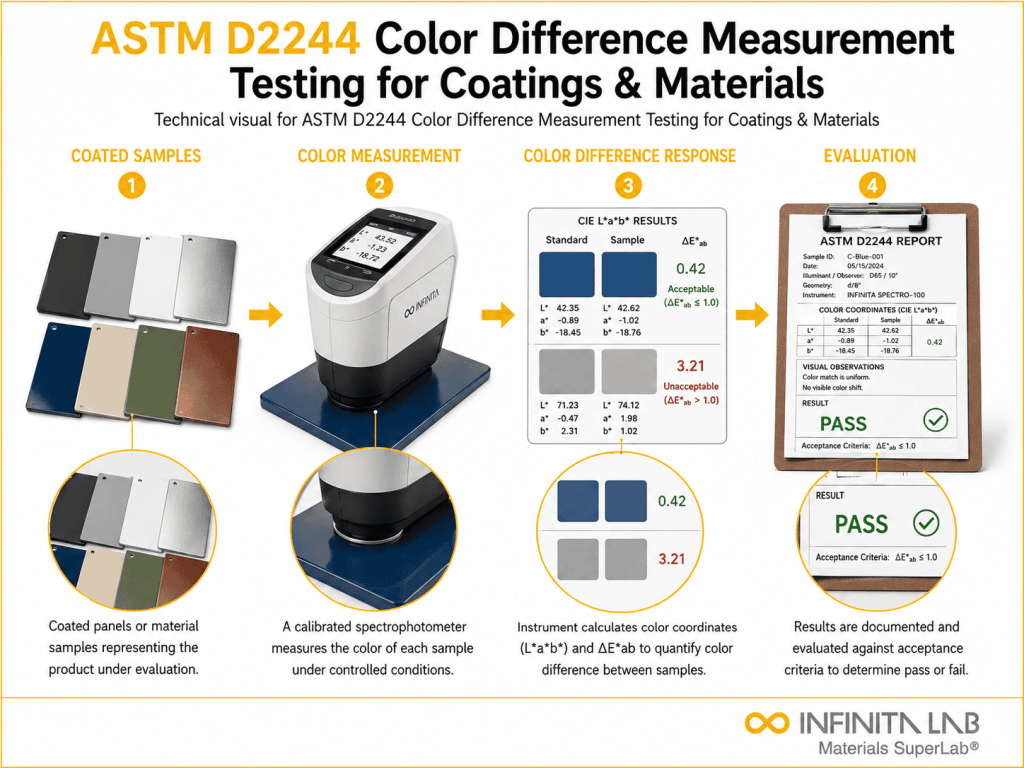


What Is ASTM D2244 Color Difference Measurement?
ASTM D2244 provides standardised practices for calculating colour differences between objects using tristimulus colorimetry. The standard defines how colour coordinates (such as CIELAB L*, a*, b*) obtained from spectrophotometric or colorimetric measurements are used to compute a total colour difference (ΔE) and individual component differences (ΔL*, Δa*, Δb*).
These calculations allow manufacturers and quality professionals to objectively quantify how much one colour deviates from a standard or target, replacing subjective visual comparison with numerical metrics. ASTM D2244 specifies the colour difference formulas, illuminant/observer conditions, and instrument geometry requirements to ensure comparable results across laboratories.
Applications and Benefits of ASTM D2244 Color Difference Measurement Testing
Scope
ASTM D2244 covers:
- CIELAB color difference calculations (ΔE*ab)
- Lightness difference (ΔL*), chroma difference (ΔC*), hue difference (ΔH*)
- CMC and CIE94 color difference formulas
- Instrument geometry and illuminant/observer requirements
- Reporting of color difference results
- Pass/fail tolerance evaluation
Applications
- Coatings and paint quality control
- Plastics color matching
- Textile and apparel color management
- Automotive OEM and refinish color control
- Printing and packaging color consistency
- Food and cosmetic product appearance
- Consumer electronics product color standardization
Benefits
- Replaces subjective visual color comparison with objective data
- Enables global color communication with universal numbers
- Supports tolerance-based pass/fail color control
- Reduces product rejects from color non-conformance
- Facilitates color consistency across production batches
- Enables remote supplier color qualification
Our ASTM D2244 Testing Procedure
Instrument Setup
Spectrophotometer or colorimeter is calibrated with white and black standards.
1Standard Measurement
Colour coordinates of the reference standard are measured and recorded.
2Sample Measurement
Colour coordinates of the test specimen are measured under identical conditions.
3Calculation
ΔE and component differences are calculated using the specified formula.
4ASTM D2244 Test Parameters and Requirements
| Parameter | Details |
|---|---|
| Applicable Materials | Paints, coatings, plastics, textiles, printed surfaces |
| Specimen Types | Opaque flat panels, plaques, swatches, coated surfaces |
| Formula Used | ΔE, CIE L*a*b*, CIEDE2000 |
| Measured Property | Colour difference and tolerance |
| Test Environment | Controlled daylight illumination (typically D65) |


- Spectrophotometer (reflectance and/or transmittance)
- White and black calibration tiles
- Color measurement software with CIELAB calculations
- Standard illuminant light source
- Sample holders and fixtures
- Color management database system
Equipment and Instrumentation Used for ASTM D2244 Testing
What You Receive: Test Report, Data, and Certification
- Color coordinate values (L*, a*, b*)
- Color difference values (ΔE*, ΔL*, Δa*, Δb*)
- Pass/fail evaluation against specified tolerances
- Graphical color difference reports
- Batch-to-batch color consistency records
ASTM D2244 Color Difference Measurement FAQs
It calculates colour difference (ΔE) and tolerance values between a test sample and a reference standard.
Common industries include paints, coatings, plastics, textiles, automotive finishes, packaging, and printing.
A spectrophotometer or colorimeter is typically used to obtain L*a*b* colour coordinates.
Results are usually reported as ΔE (Delta E) values along with L*, a*, and b* coordinates.
It helps ensure batch-to-batch colour consistency and product quality control.
ASTM D2244 determines color differences and tolerances between a test specimen and a reference color using instrumentally measured color coordinates. A spectrophotometer measures the specimen's color under specified measurement conditions, producing values such as L* (lightness), a* (red–green), and b* (yellow–blue). The measured coordinates are compared with the reference values, and a color-difference equation, such as CIELAB ΔE* or CIEDE2000 (ΔE₀₀), is used to calculate the difference. The results help assess color consistency and determine whether a product meets an agreed color tolerance. This practice is widely used for paints, coatings, plastics, textiles, and other opaque materials.
Why Choose Infinita Lab for Color Difference Measurement Testing
When your Color Difference Measurement results have to hold up - for compliance, a customer audit, or an engineering decision - ASTM D2244 accuracy and an unbiased third-party report matter more than price. Infinita Lab routes your ASTM D2244 color difference measurement testing to ISO/IEC 17025-accredited U.S. partner labs with hands-on method experience, so you get defensible data, transparent reporting, and turnaround times built around your project deadline - not ours.

Need ASTM D2244 Color Difference Measurement Testing You Can Rely On?
Send query us at hello@infinitalab.com or call us at (888) 878-3090 to learn more about our services and how we can support you.



