


ASTM D1622 Apparent Density Testing for Rigid Cellular Plastics (Foams)
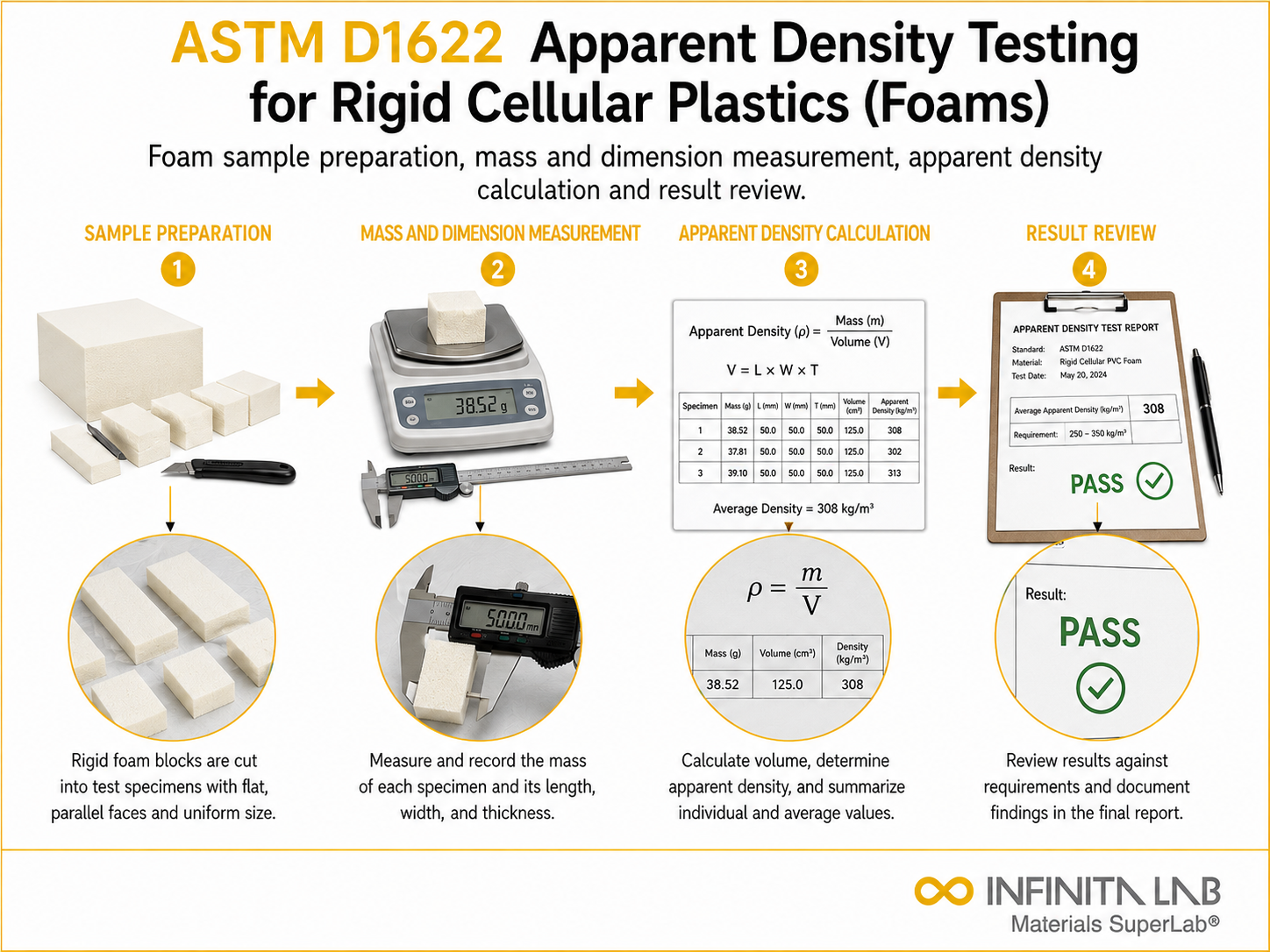
Cellular plastic density measurement is covered by this ASTM D 1622 testing protocol. It consists of two techniques: one involves determining apparent overall density, which takes into account forming skins, and the other involves determining apparent core density after the forming skins have been removed. Both methods reveal information about the material's density properties.
TRUSTED BY


Precision-driven testing for dimensional accuracy and compliance
- Overview
- Scope, Applications, and Benefits
- Test Process
- Specifications
- Instrumentation
- Results and Deliverables
Overview
ASTM D1622 determines the apparent density of rigid cellular plastics by measuring the mass and volume of a specimen. This property is critical for evaluating material structure, performance, and suitability for insulation and structural applications.
This method is widely used in foam, insulation, and construction industries. It helps ensure consistency in manufacturing and supports performance evaluation of lightweight cellular materials.

Scope, Applications, and Benefits
Scope
ASTM D1622 evaluates the apparent density of rigid cellular plastics, including foams and insulation materials. The test determines how material structure affects weight and performance.
The test evaluates:
- Apparent density of cellular plastics
- Uniformity of foam structure
- Material composition and consistency
- Suitability for insulation and structural use
- Quality of the manufacturing process
Applications
- Rigid foam insulation materials
- Polyurethane and polystyrene foams
- Construction and building materials
- Packaging and cushioning products
- Automotive and aerospace components
- Industrial thermal insulation
Benefits
- Provides accurate density measurement
- Supports material selection and design
- Ensures consistency in production
- Helps evaluate structural performance
- Enables comparison of foam materials
Test Process
Sample Preparation
Specimens are cut to precise dimensions with smooth surfaces.
1Dimensional Measurement
Length, width, and thickness are measured to calculate volume.
2Mass Measurement
Specimen weight is measured using a precision balance.
3Data Recording & Evaluation
Density is calculated as mass divided by volume.
4Technical Specifications
| Parameter | Details |
|---|---|
| Applicable Materials | Rigid cellular plastics |
| Density Range | ~10 to 500 kg/m³ |
| Specimen Size | ~25 mm to 100 mm |
| Measurement Accuracy | ±1% to ±3% |
| Test Temperature | ~23°C ± 2°C |
| Measured Outputs | Apparent density (kg/m³) |


Instrumentation Used for Testing
- Analytical balance
- Vernier calipers or micrometer
- Sample cutting tools
- Flat measuring surface
- Environmental conditioning chamber
- Data recording system
Results and Deliverables
- Apparent density values (kg/m³)
- Material uniformity assessment
- Foam structure evaluation
- Comparative density analysis
- Test condition summary
- ASTM compliance report
Frequently Asked Questions
ASTM D1622 determines apparent density of rigid cellular plastics such as foams. It measures mass-to-volume ratio, including cell structure, helping evaluate material consistency and performance in insulation and structural applications.
Key parameters include specimen dimensions, mass measurement, conditioning environment, and volume calculation. Accurate sample preparation ensures reliable density determination of cellular materials.
The test measures apparent density expressed in kg/m³ or lb/ft³. Results indicate material uniformity, cell structure, and suitability for insulation or load-bearing applications.
ASTM D1622 is used for rigid cellular plastics such as polyurethane foam, polystyrene foam, and other insulation materials used in construction, packaging, and industrial applications.
ASTM D1622 results may be affected by sample irregularities, moisture content, or surface defects. It provides apparent density and may not fully represent true density or performance under service conditions.
Why Choose Infinita Lab for Advanced Materials Testing and Characterization?
At the core of this breadth is our network of 2,000+ accredited laboratories across the USA, offering access to over 10,000 testing methods and analytical services. From advanced materials characterization (SEM, TEM, RBS, XPS) to mechanical, chemical, environmental, biological, and standardized ASTM/ISO-compliant testing, we deliver unmatched flexibility, specialization, and scale. You are never limited by geography, facility, or methodology — Infinita Lab connects you to the right expertise and testing solution, every time.

Looking for a Trusted Partner for Accurate and Reliable Testing Services?
Send query us at hello@infinitlab.com or call us at (888) 878-3090 to learn more about our services and how we can support you.



Request a Quote
Submit your material details and receive testing procedures, pricing, and turnaround time within 24 hours.
 Quick Turnaround and Hasslefree process
 Confidentiality Guarantee
 Free, No-obligation Consultation
 100% Customer Satisfaction
