


ASTM D1622: Apparent Density Of Rigid Cellular Plastics Testing Services
Accredited ASTM D1622 apparent density of rigid cellular plastics testing from Infinita Lab, performed to the exact standard requirements - accurate, reproducible results with full documentation for compliance, R&D, and quality control programs.
TRUSTED BY


Get ASTM D1622 compliant results - request your apparent density of rigid cellular plastics testing quote
- Overview
- Scope, Applications, and Benefits
- Test Process
- Specifications
- Instrumentation
- Results and Deliverables
What Is ASTM D1622 Apparent Density Of Rigid Cellular Plastics?
ASTM D1622, Standard Test Method for Apparent Density of Rigid Cellular Plastics, defines a straightforward but critical procedure for determining the mass per unit volume of rigid foam materials. Because rigid cellular plastics are composed of both solid polymer and gas-filled cells, their “apparent density” reflects the combined weight of both phases rather than the density of the polymer alone. This single property is one of the strongest predictors of how a rigid foam will perform, since density governs thermal insulation value, compressive and flexural strength, dimensional stability, and raw material cost.
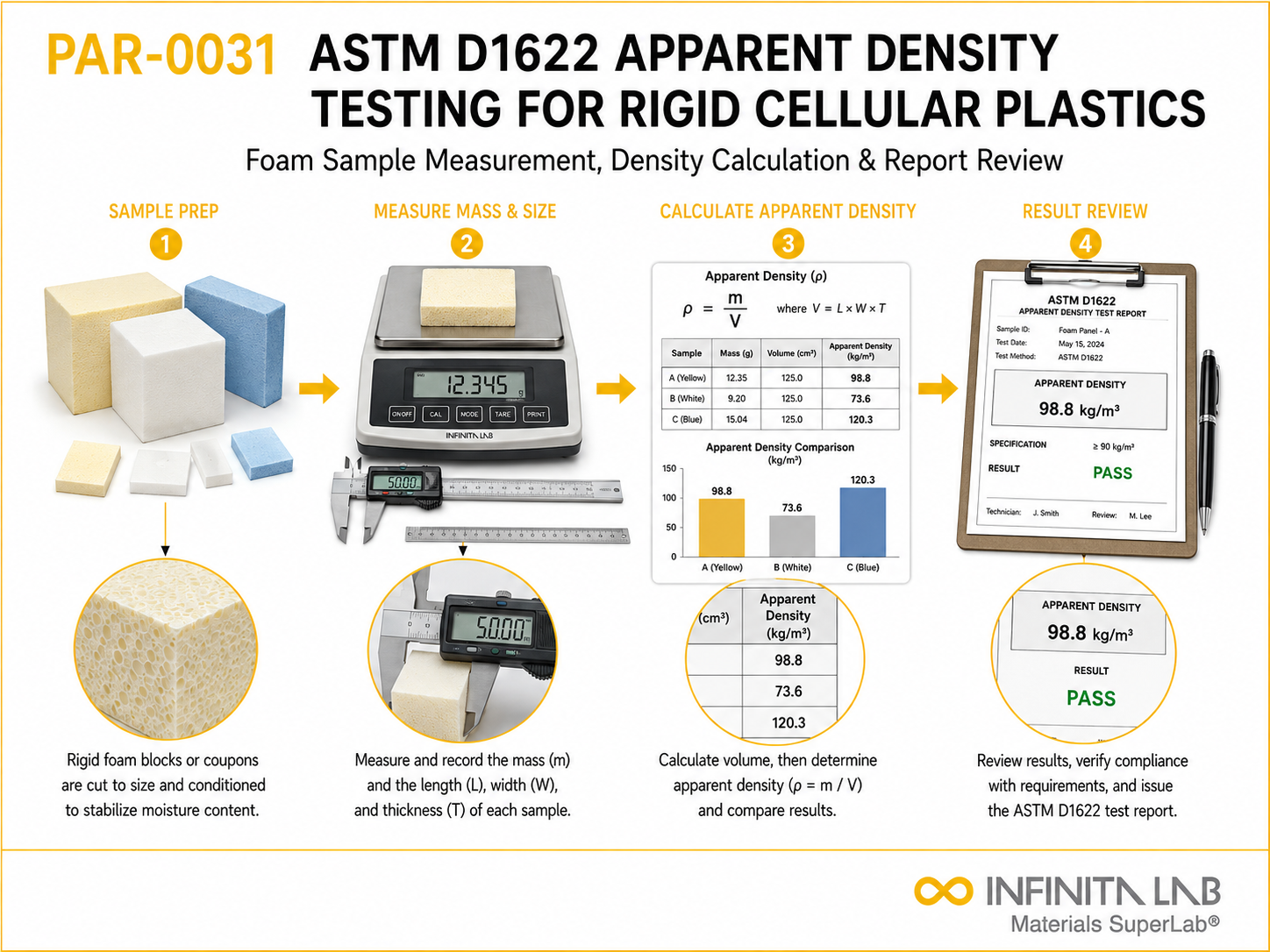
The test method works by cutting one or more specimens of known, regular geometry from a foam block, bun, panel, or moulded part, conditioning them at standard temperature and humidity, weighing them on a precision balance, and calculating their volume from carefully measured dimensions. Apparent density is then calculated simply as specimen weight divided by specimen volume, expressed in kg/m³ (with lb/ft³ reported as a secondary unit). Depending on the product form, the method distinguishes between apparent overall density, which includes any dense outer skin formed during moulding or spraying, and apparent core density, which excludes the skin to characterise the cellular interior alone.
Because density directly correlates with mechanical strength, thermal performance, and material yield, manufacturers rely on ASTM D1622 data to verify formulation consistency, confirm compliance with product specifications, and support engineering decisions during material selection. The method is equivalent to ISO 845 and is widely specified for rigid polyurethane, polyisocyanurate, polystyrene, and other rigid cellular foam products used across insulation, packaging, and structural applications. Reliable, accredited density testing gives manufacturers and buyers a defensible, third-party-verified basis for quality control, specification compliance, and comparison between competing foam formulations or suppliers.

Applications and Benefits of ASTM D1622 Apparent Density Of Rigid Cellular Plastics Testing
Scope
- ASTM D1622 measures the apparent density of rigid cellular plastics, calculated as specimen mass divided by specimen volume and expressed in kg/m³ or lb/ft³.
- The method covers both apparent overall density, which includes any forming skin present on molded or sprayed foam, and apparent core density, which is determined after the skin has been removed.
- Test specimens must have a regular, readily calculable geometry (such as a cube, rectangular block, or cylinder) with a minimum volume of 16.4 cm³ (1.0 in.³).
- A minimum of three specimens is typically cut from representative locations throughout the sample, unless the entire part is small enough to be tested as a single specimen.
- Specimens are cut with sharp tooling so that cell walls are sliced rather than crushed or torn, preserving the true cellular structure being measured.
- Before testing, specimens are conditioned at 23 ± 2°C (73.4 ± 3.6°F) and 50 ± 10% relative humidity for not less than 40 hours in accordance with Practice D618.
- Specimen dimensions are measured with a calliper or gauge having a foot of at least 6.5 cm² (1 in.²) in contact area, applied under light, controlled pressure so soft foam is not indented during measurement.
- The method applies to rigid polyurethane, rigid polyisocyanurate, rigid polystyrene, and other rigid cellular or spray-applied foam plastics across a wide density range.
- ASTM D1622 is technically equivalent to ISO 845, Cellular Plastics and Rubbers — Determination of Apparent Density, allowing results to be referenced in both U.S. and international specifications.
- Testing supports raw material qualification, in-process quality control, incoming material inspection, and finished-product verification against purchase or design specifications.
Applications
- Rigid polyurethane and polyisocyanurate insulation boards, panels, and spray foam used in building envelopes
- Appliance and refrigeration insulation foam, including refrigerator, freezer, and cold-chain packaging cores
- Structural and semi-structural foam cores used in composite panels, marine, and transportation components
- Protective and cushioning packaging foam for shipping fragile or sensitive goods
- Rigid polystyrene foam used in construction insulation and geofoam applications
- Aerospace and automotive lightweight structural and insulating foam components
- Quality assurance and formulation development for foam manufacturers and compounders
Benefits
- Delivers an accurate, repeatable measure of apparent density for material characterisation and specification compliance
- Distinguishes overall (skin-included) density from core density, giving a clearer picture of foam structure and manufacturing consistency
- Supports correlation of density to thermal, mechanical, and dimensional performance for engineering and design decisions
- Enables objective comparison between foam formulations, suppliers, or production lots
- Provides documented, standardised data that satisfies purchase specifications, building codes, and regulatory requirements
- Strengthens manufacturing quality control by flagging density drift or process variation early
Our ASTM D1622 Testing Procedure
Specimen Preparation
Sample is cut into a regular shape with known dimensions and conditioned.
1Mass Measurement
Specimen is weighed using a calibrated analytical balance.
2Volume Determination
Dimensions are measured to calculate specimen volume accurately.
3Density Calculation
Apparent density is calculated as mass divided by volume.
4ASTM D1622 Test Parameters and Requirements
| Parameter | Details |
|---|---|
| Material Type | Rigid cellular plastics |
| Specimen Shape | Regular geometry (cube, cylinder, etc.) |
| Measurement Tools | Calipers or micrometers |
| Balance Accuracy | High-precision analytical balance |
| Density Range | Wide range depending on foam type |
| Conditioning | Standard temperature and humidity |
| Output | Density in kg/m³ or g/cm³ |


- Analytical balance – weighs conditioned specimens to within ±0.1% accuracy for precise mass determination
- Callipers or dimensional gauges – measure specimen length, width, and height with a broad contact foot to calculate volume without compressing the foam
- Specimen cutting equipment – sharp saws, blades, or cutting tools that section foam blocks, buns, or panels without crushing or tearing cell structure
- Environmental conditioning chamber – maintains standard temperature and humidity conditions for the required conditioning period before testing
- Reference standards and calibration weights – verify balance and dimensional equipment accuracy before testing
- Data recording and reporting systems – capture specimen dimensions, mass, calculated density, and test conditions for the final report
Equipment and Instrumentation Used for ASTM D1622 Testing
What You Receive: Test Report, Data, and Certification
- Apparent density value(s) for each specimen, reported in kg/m³ and/or lb/ft³
- Distinction between apparent overall density and apparent core density where applicable
- Individual specimen dimensions, mass, and calculated volume
- Documented conditioning parameters and any deviations from standard procedure
- Statement of compliance with ASTM D1622 and, where relevant, ISO 845
- Clear, defensible test report suitable for specification verification, quality records, or regulatory submission
ASTM D1622 Apparent Density Of Rigid Cellular Plastics FAQs
ASTM D1622 test method determines the properties of cellular materials by providing measures of their apparent overall density (including the skins formed in the manufacturing process) and apparent core density (After removing the skins formed in the manufacturing process).
Measuring apparent density helps determine the material's mass per unit volume. This measurement is crucial for evaluating its physical properties, performance, and suitability for specific applications.
Apparent density directly affects mechanical strength, thermal insulation, and overall performance of foam materials. It helps determine suitability for specific applications and ensures that products meet design and performance requirements consistently.
ASTM D1622 helps industries ensure consistent product quality by providing accurate density measurements. This information supports material selection, quality control, and product development, leading to improved performance and reliability of cellular plastics in various applications.
Higher density typically increases strength and durability, while lower density improves insulation and reduces weight. The right balance depends on the intended application of the material.
ASTM D1622 is the Standard Test Method for Apparent Density of Rigid Cellular Plastics. It determines the apparent overall density of rigid cellular plastic materials by measuring their mass and volume.
Why Choose Infinita Lab for Apparent Density Of Rigid Cellular Plastics Testing
When your Apparent Density Of Rigid Cellular Plastics results have to hold up - for compliance, a customer audit, or an engineering decision - ASTM D1622 accuracy and an unbiased third-party report matter more than price. Infinita Lab routes your ASTM D1622 apparent density of rigid cellular plastics testing to ISO/IEC 17025-accredited U.S. partner labs with hands-on method experience, so you get defensible data, transparent reporting, and turnaround times built around your project deadline - not ours.

Looking for an Accredited Partner for ASTM D1622 Apparent Density Of Rigid Cellular Plastics Testing?
Send query us at hello@infinitalab.com or call us at (888) 878-3090 to learn more about our services and how we can support you.



Request a Quote
Submit your material details and receive testing procedures, pricing, and turnaround time within 24 hours.
 Quick Turnaround and Hasslefree process
 Confidentiality Guarantee
 Free, No-obligation Consultation
 100% Customer Satisfaction
