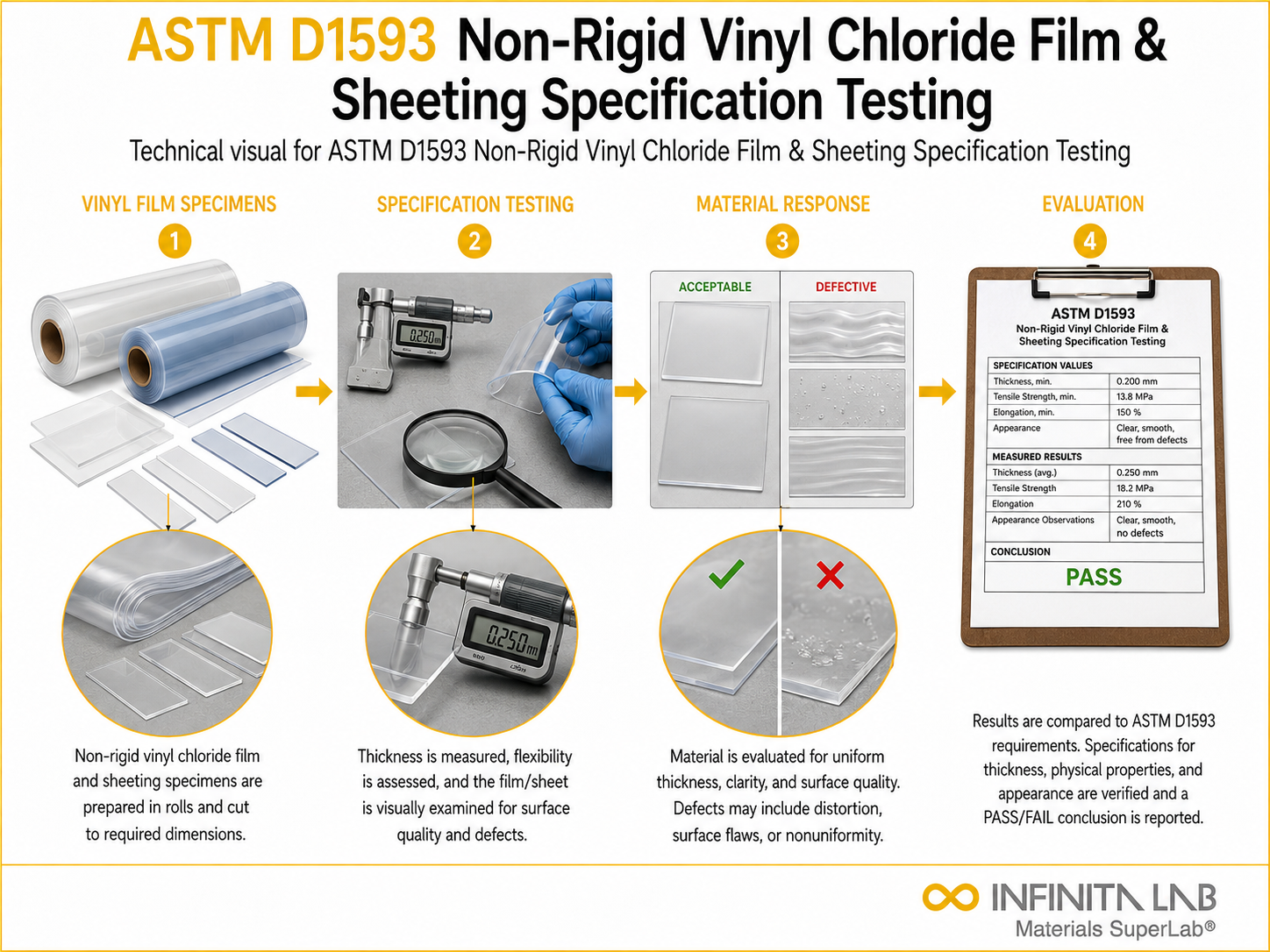


What Is ASTM D1593 Non Rigid Vinyl Chloride Film Sheeting?
ASTM D1593 defines the testing requirements for nonrigid vinyl chloride plastic films and sheeting to evaluate their mechanical strength, flexibility, and durability. These materials are widely used in applications requiring softness, transparency, and resistance to deformation under varying service conditions.
The standard focuses on tensile properties, elongation, and stress–strain behavior to ensure consistent material performance. By following ASTM D1593, manufacturers can verify that films and sheets meet quality benchmarks, ensuring reliability in applications where flexibility and mechanical integrity are critical.

Applications and Benefits of ASTM D1593 Non Rigid Vinyl Chloride Film Sheeting Testing
Scope
This test focuses on evaluating the mechanical properties and performance characteristics of nonrigid vinyl chloride films and sheeting to ensure compliance with ASTM D1593 and suitability for flexible applications.
- Measurement of tensile strength and elongation behavior
- Evaluation of flexibility and deformation characteristics
- Verification of uniformity across film and sheet thickness
- Testing of thin plastic films and flexible sheets
- Comparison of material performance across production batches
Applications
- Flexible packaging films
- Protective plastic sheeting
- Upholstery and synthetic leather
- Medical-grade flexible films
- Industrial liners and covers
- Consumer flexible plastic products
Benefits
- Ensures consistent mechanical performance
- Validates flexibility and durability of films
- Supports quality control in manufacturing
- Helps optimize material formulations
- Reduces risk of product failure
- Enhances compliance with industry standards
Our ASTM D1593 Testing Procedure
Sample Conditioning
Film specimens are conditioned under controlled temperature and humidity to stabilize material properties.
1Specimen Preparation
Standardized strips are carefully cut with uniform dimensions and thickness for accurate testing.
2Tensile Testing Execution
Samples are subjected to controlled tensile loading using a universal testing machine until rupture.
3Result Calculation & Evaluation
Tensile strength and elongation values are calculated and compared with ASTM D1593 requirements.
4ASTM D1593 Test Parameters and Requirements
| Parameter | Details |
|---|---|
| Standard | ASTM D1593 for nonrigid vinyl chloride film and sheeting |
| Method | Uniaxial tensile testing of thin flexible plastic films |
| Measurement Type | Stress–strain behavior and elongation at break |
| Sample Type | Nonrigid PVC films and sheeting specimens |
| Loading Type | Controlled tensile loading until rupture |
| Units | MPa (tensile strength), % elongation, N (force) |


- Universal testing machine (UTM)
- Extensometer or strain measurement system
- Precision cutting tools
- Thickness gauge or micrometer
- Conditioning chamber
- Vernier caliper
Equipment and Instrumentation Used for ASTM D1593 Testing
What You Receive: Test Report, Data, and Certification
- Tensile strength values (MPa)
- Elongation at break (%)
- Stress–strain curve analysis
- Compliance with ASTM D1593
- Detailed test report
- Material performance evaluation
ASTM D1593 Non Rigid Vinyl Chloride Film Sheeting FAQs
ASTM D1593 evaluates tensile strength and elongation of nonrigid vinyl chloride films and sheeting. It ensures materials meet mechanical performance requirements, particularly flexibility and durability, for applications involving stretching and deformation during use.
Tensile strength and elongation directly reflect resistance to tearing and stretching during handling, sealing, and service. These parameters help predict failure modes under mechanical stress, making them critical for evaluating durability in flexible film applications.
Plasticizer loss over time reduces flexibility and increases brittleness, lowering elongation at break. This degradation alters mechanical performance significantly, making initial tensile results insufficient without considering long-term migration effects.
Yield behavior indicates the transition from elastic to plastic deformation. Understanding this point helps predict permanent deformation under load, which is critical in applications where dimensional stability must be maintained after stretching.
Common failure modes include ductile tearing, necking, and brittle fracture depending on formulation and conditions. Identifying failure type helps understand material behavior and suitability for specific applications.
Why Choose Infinita Lab for Non Rigid Vinyl Chloride Film Sheeting Testing?
When your Non Rigid Vinyl Chloride Film Sheeting results have to hold up - for compliance, a customer audit, or an engineering decision - ASTM D1593 accuracy and an unbiased third-party report matter more than price. Infinita Lab routes your ASTM D1593 non rigid vinyl chloride film sheeting testing to ISO/IEC 17025-accredited U.S. partner labs with hands-on method experience, so you get defensible data, transparent reporting, and turnaround times built around your project deadline - not ours.

Need ASTM D1593 Non Rigid Vinyl Chloride Film Sheeting Testing You Can Rely On?
Send query us at hello@infinitalab.com or call us at (888) 878-3090 to learn more about our services and how we can support you.





