


ASTM D1238: Melt Flow Rate Testing Services
Melt Flow Rate (MFR) is a measure of ease of flow of melted plastics and is evaluated as Melt Flow Index or Melt Flow Rate by ASTM D1238, ISO 1133. MFR is used for differentiating grades of polyethylene or determining the extent of plastic deterioration caused by molding.
TRUSTED BY


Get ASTM D1238 compliant results — request your melt flow rate testing quote
- Overview
- Scope, Applications, and Benefits
- Test Process
- Specifications
- Instrumentation
- Results and Deliverables
What Is ASTM D1238 Melt Flow Rate?
ASTM D1238 and ISO 1133 determine the melt flow rate (MFR) or melt volume rate (MVR) of thermoplastic materials under specified temperature and load conditions. This test measures the ease of flow of molten polymer, which directly relates to its viscosity and processing behavior.
The method is widely used to assess material consistency, grade identification, and suitability for manufacturing processes such as injection molding and extrusion. It provides critical insights into polymer molecular weight and flow characteristics, ensuring reliable performance during processing and end-use applications.

Applications and Benefits of ASTM D1238 Melt Flow Rate Testing
Scope
ASTM D1238 and ISO 1133 cover standardized procedures for determining melt flow properties of thermoplastics using controlled temperature and load conditions.
- Applicable to thermoplastic polymers in molten state
- Measures melt flow rate (MFR) and melt volume rate (MVR)
- Supports material identification and quality control
- Suitable for pellets, granules, or powder forms
- Enables comparison of polymer flow behavior
Applications
- Quality control of polymer raw materials
- Material selection for molding and extrusion processes
- Verification of batch-to-batch consistency
- Evaluation of polymer degradation
- Comparative analysis of thermoplastic grades
Benefits
- Provides quick and reliable flow property measurement
- Helps optimize processing parameters
- Ensures consistent product quality
- Supports material grading and classification
- Detects variations in molecular weight
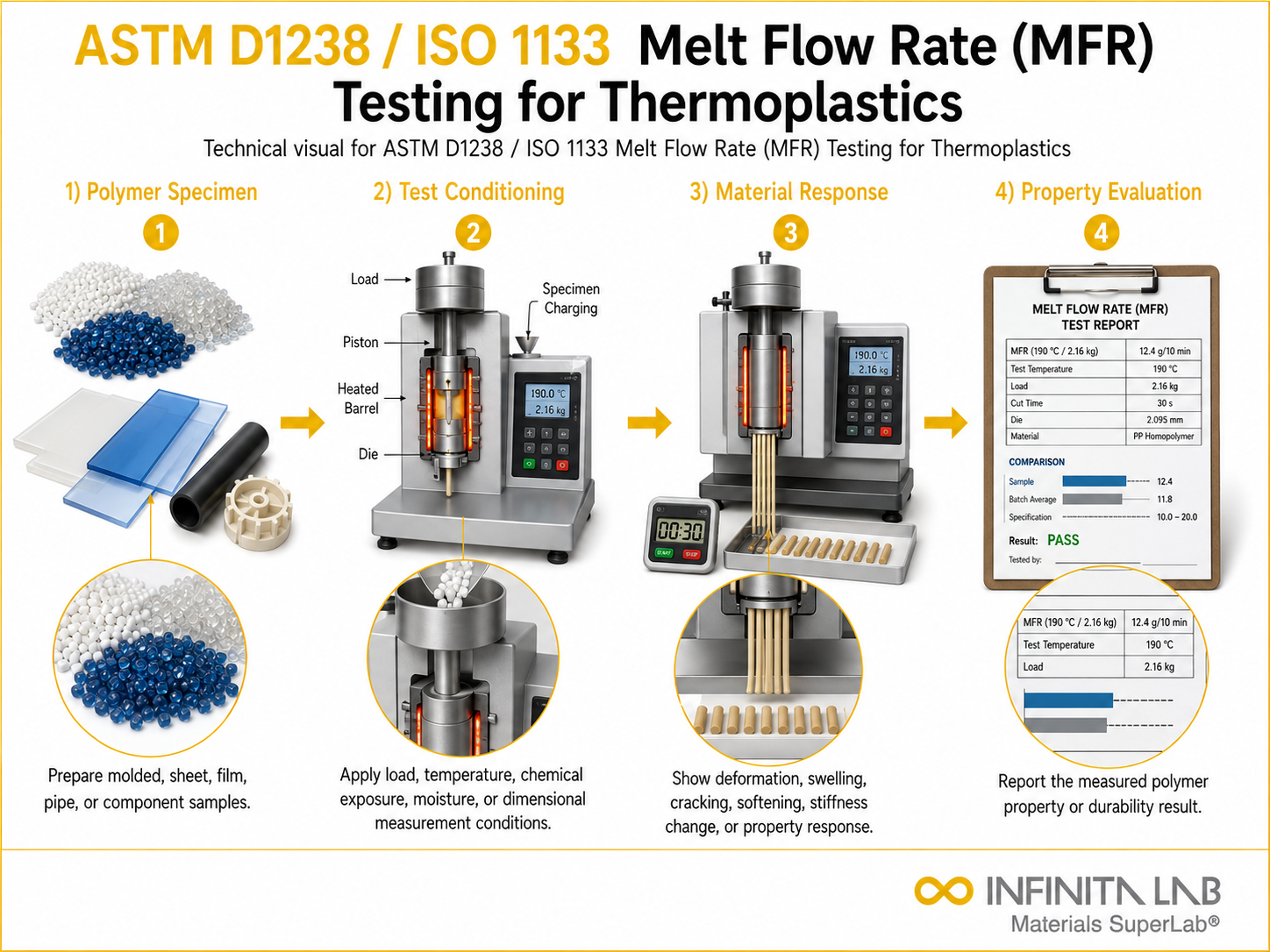
Our ASTM D1238 Testing Procedure
Sample Loading
Polymer sample is placed into the heated barrel of the melt flow indexer.
1Melting and Conditioning
The material is heated to a specified temperature until fully molten.
2Load Application
A standard load is applied to extrude the molten polymer through a die.
3Measurement
The extruded material is measured over time to calculate MFR or MVR values.
4ASTM D1238 Test Parameters and Requirements
| Parameter | Details |
|---|---|
| Property Measured | Melt Flow Rate (g/10 min), Melt Volume Rate (cm³/10 min) |
| Temperature | Defined based on polymer type |
| Load | Standard weights such as 2.16 kg or 5 kg |
| Material Form | Pellets, granules, or powder |
| Methods | Procedure A (manual), Procedure B (automatic) |
| Die Specification | Standard orifice dimensions |
| Applicable Materials | Thermoplastics only |
| Output Units | g/10 min or cm³/10 min |
| Key Indicator | Flow behavior and viscosity |


- Melt Flow Index Tester
- Heated barrel and die assembly
- Standard load weights
- Timer or automatic cutter
- Precision balance
Equipment and Instrumentation Used for ASTM D1238 Testing
What You Receive: Test Report, Data, and Certification
- Melt Flow Rate (MFR) values
- Melt Volume Rate (MVR) values
- Test temperature and load details
- Material identification
- Standard-compliant test report
ASTM D1238 Melt Flow Rate FAQs
ASTM D1238 and ISO 1133 are used to measure the melt flow rate of thermoplastic materials, helping determine flow characteristics, processing suitability, and consistency of polymer materials used in manufacturing applications.
Melt Flow Rate is the amount of polymer that flows through a standard die in ten minutes under defined conditions. It indicates the material’s viscosity and ease of processing in manufacturing operations.
It ensures consistent material performance during processing. Variations in melt flow can affect product quality, making this test essential for maintaining manufacturing efficiency and product reliability.
It ensures materials flow consistently during processing, reducing defects and improving product quality. Stable melt flow properties are critical for efficient and reliable production operations.
A high MFR value indicates low viscosity and high flowability. This means the material is easier to process and is suitable for applications requiring rapid flow, such as injection molding. 9. What does
Why Choose Infinita Lab for Melt Flow Rate Testing
At the core of this breadth is our network of 2,000+ accredited laboratories across the USA, offering access to over 10,000 testing methods and analytical services. From advanced materials characterization (SEM, TEM, RBS, XPS) to mechanical, chemical, environmental, biological, and standardized ASTM/ISO-compliant testing, we deliver unmatched flexibility, specialization, and scale. You are never limited by geography, facility, or methodology — Infinita Lab connects you to the right expertise and testing solution, every time.

Need ASTM D1238 Melt Flow Rate Testing You Can Rely On?
Send query us at hello@infinitalab.com or call us at (888) 878-3090 to learn more about our services and how we can support you.



Request a Quote
Submit your material details and receive testing procedures, pricing, and turnaround time within 24 hours.
 Quick Turnaround and Hasslefree process
 Confidentiality Guarantee
 Free, No-obligation Consultation
 100% Customer Satisfaction
