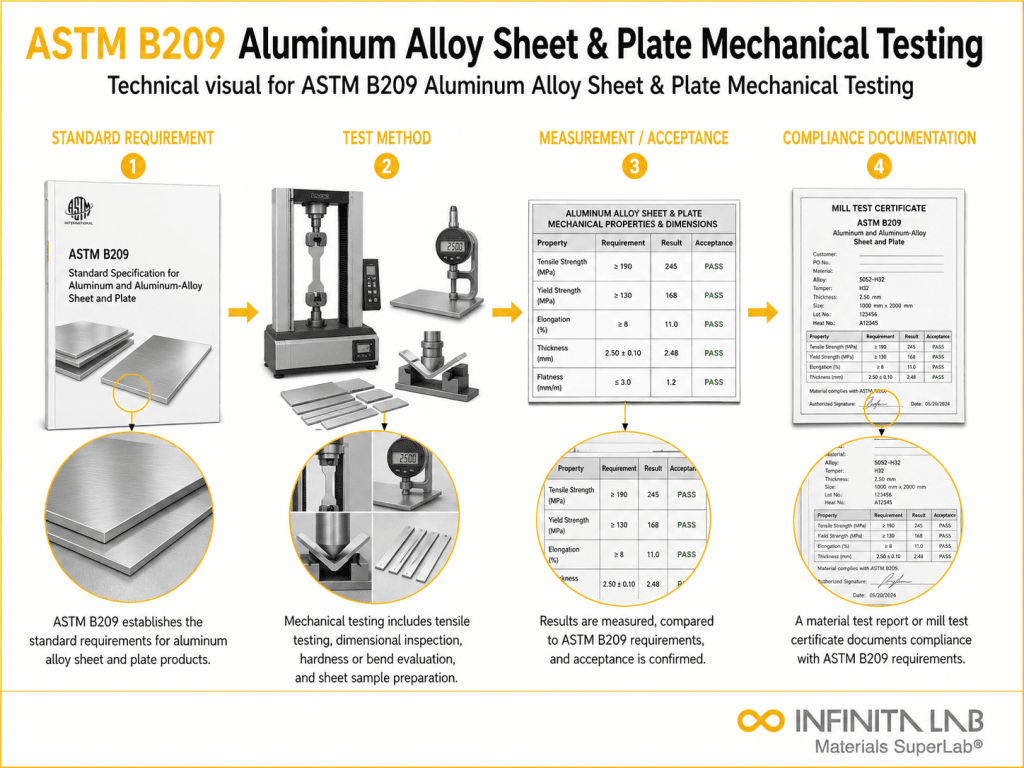


What Is ASTM B209 Aluminum Alloy Sheet Plate?
ASTM B209 defines the requirements for aluminum and aluminum-alloy sheet and plate, including mechanical properties, chemical composition, and dimensional tolerances. It ensures consistent quality and performance of flat-rolled aluminum products.
This standard is widely used in the materials, aerospace, automotive, and manufacturing industry to verify that aluminum sheets and plates meet required strength, formability, and application-specific performance criteria.
Applications and Benefits of ASTM B209 Aluminum Alloy Sheet Plate Testing
Scope
ASTM B209 covers the specification and testing of aluminum and aluminum-alloy sheet and plate products used in structural and general engineering applications.
It includes requirements for composition, mechanical properties, heat treatment conditions, and inspection criteria.
- Chemical composition verification
- Mechanical property testing (tensile, yield strength)
- Thickness and dimensional tolerance checks
- Surface quality inspection
- Heat treatment condition verification
- Flatness and finish evaluation
- Product identification and marking
Applications
- Aircraft structures and panels
- Automotive body sheets
- Industrial equipment and enclosures
- Marine structures
- Construction components
Benefits
- Ensures consistent material quality
- Verifies mechanical strength and durability
- Supports compliance with industry standards
- Improves product reliability
- Enables material traceability
- Reduces risk of material failure
- Suitable for critical structural applications
Our ASTM B209 Testing Procedure
Sample Selection
Samples are taken from sheet or plate as per specified lot and standard requirements.
1Mechanical Testing
Tensile and other tests are conducted to determine strength and elongation properties.
2Dimensional Inspection
Thickness, flatness, and tolerances are measured using calibrated tools.
3Result Evaluation
Results are compared with ASTM B209 limits to confirm compliance.
4ASTM B209 Test Parameters and Requirements
| Parameter | Details |
|---|---|
| Material Type | Aluminum and aluminum-alloy sheets and plates. |
| Thickness Range | Typically from thin sheets to thick plates. |
| Mechanical Properties | Tensile strength, yield strength, and elongation. |
| Temper Designation | Includes O, H, and T tempers. |
| Dimensional Tolerances | Controlled thickness, width, and length limits. |
| Identification | Marking for traceability and specification compliance. |


- Universal Testing Machine (UTM)
- Micrometers and calipers
- Thickness gauges
- Optical inspection tools
- Spectrometer for composition analysis
- Surface inspection equipment
Equipment and Instrumentation Used for ASTM B209 Testing
What You Receive: Test Report, Data, and Certification
- Mechanical test reports
- Chemical composition analysis
- Dimensional inspection results
- Surface quality evaluation
- Material certification documents
- Final inspection report
ASTM B209 Aluminum Alloy Sheet Plate FAQs
ASTM B209 is a standard specification that defines requirements for aluminum and aluminum-alloy sheet and plate, including mechanical properties, composition, and tolerances to ensure consistent quality and performance.
It ensures that aluminum products meet required performance standards, improving reliability and safety in critical applications.
Tempers such as O, H, and T indicate the material’s heat treatment or work-hardening condition, affecting strength and formability.
Industries like aerospace, automotive, marine, and manufacturing rely on ASTM B209 materials for structural and functional components.
It specifies strict limits for chemical composition, mechanical properties, and dimensional tolerances, along with inspection requirements, ensuring that aluminum products consistently meet performance and safety expectations.
ASME SB-209 specifies requirements for aluminum and aluminum-alloy sheets and plates used in pressure vessels and other applications covered by the ASME Boiler and Pressure Vessel Code. It defines acceptable alloy compositions, tempers, mechanical properties, dimensions, and material quality requirements to help ensure compliance with applicable code provisions.
ASTM B209 specifies requirements for flat, coiled, and plate products made from aluminum and aluminum alloys. The material is evaluated against specified alloy composition, temper, tensile properties, dimensions, and finish requirements. Compliance helps verify that the supplied aluminum sheet or plate meets the required material specification.
Why Choose Infinita Lab for Aluminum Alloy Sheet Plate Testing
When your Aluminum Alloy Sheet Plate results have to hold up - for compliance, a customer audit, or an engineering decision - ASTM B209 accuracy and an unbiased third-party report matter more than price. Infinita Lab routes your ASTM B209 aluminum alloy sheet plate testing to ISO/IEC 17025-accredited U.S. partner labs with hands-on method experience, so you get defensible data, transparent reporting, and turnaround times built around your project deadline - not ours.

Need ASTM B209 Aluminum Alloy Sheet Plate Testing You Can Rely On?
Send query us at hello@infinitalab.com or call us at (888) 878-3090 to learn more about our services and how we can support you.