


ASTM A572 HSLA Structural Steel Testing
Five classes of high-strength low-alloy structural steel forms, plates, sheet piling, and bars are covered by ASTM A572/A572M-21. The grades 42 (290), 50 (345), and 55 (380) are for riveted, bolted, or welded buildings, respectively. The grades 60 (415) and 65 (450) are designed for riveted or bolted bridge construction. The final results of this method are displayed keeping in view the international standards and inch-pound units.
TRUSTED BY


ASTM A572 HSLA Structural Steel Testing
- Overview
- Scope, Applications, and Benefits
- Test Process
- Specifications
- Instrumentation
- Results and Deliverables
ASTM A572 HSLA Structural Steel Testing Overview
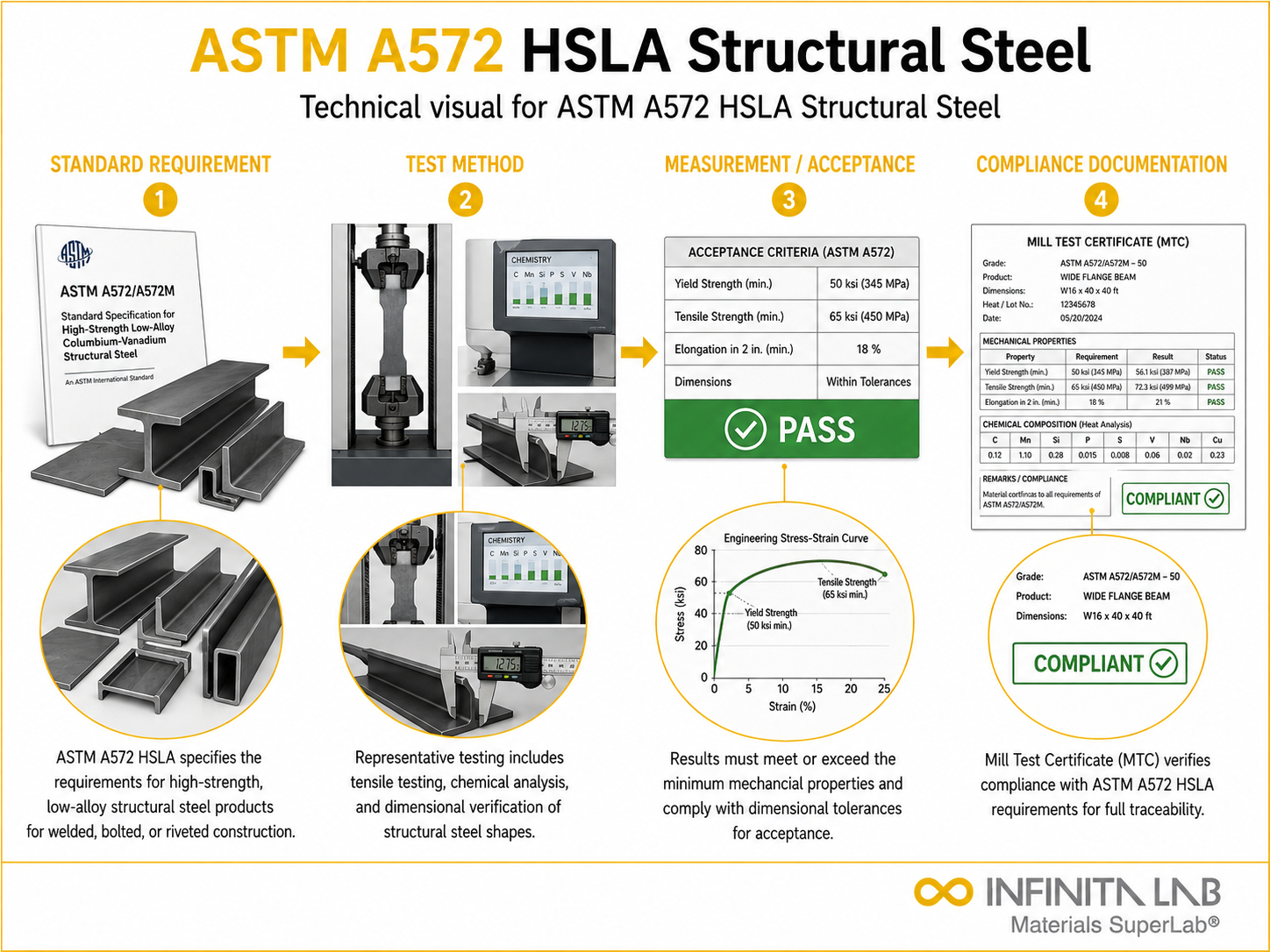
ASTM A572 covers high-strength low-alloy (HSLA) columbium-vanadium structural steels supplied in plate, sheet piling, and structural shapes for use in bolted, welded, and riveted structures. The standard defines five yield strength grades – 42, 50, 55, 60, and 65 ksi (290, 345, 380, 415, and 450 MPa) – each representing a minimum yield point that the steel must meet or exceed. Grade 50 is by far the most widely specified grade and is the standard replacement for ASTM A36 in structural applications where higher strength-to-weight ratio is required.
HSLA steels achieve their elevated strength through microalloying with small additions of niobium (columbium), vanadium, or both, which refine the grain structure and provide precipitation strengthening without requiring quenching and tempering heat treatment. This means A572 steel can be produced by controlled rolling and normalizing, and maintains good weldability because the carbon equivalent remains low relative to the strength level achieved. The mechanical property requirements of ASTM A572 include minimum yield strength, minimum tensile strength, and minimum elongation, all verified by tensile testing of specimens taken from the product.
Testing to ASTM A572 is required for material acceptance, specification conformance, and mill certification verification. Structural engineers specify A572 Grade 50 as the default structural steel for beams, columns, plates, and connections in buildings, bridges, and industrial structures. Material testing confirms that the delivered product meets the grade requirements, and is particularly important when the source mill certification cannot be verified or when testing is required by project specifications.

ASTM A572 HSLA Structural Steel Testing Scope, Applications, and Benefits
Scope
ASTM A572 testing applies to steel plates, structural shapes (W, S, M, HP sections), sheet piling, and bars produced to the A572 specification in Grades 42, 50, 55, 60, or 65. Testing verifies the mechanical property requirements defined in the standard. Key evaluation areas include:
- Yield strength (0.2% offset or yield point) verification against grade minimum
- Ultimate tensile strength verification against grade minimum
- Elongation in 2-inch or 8-inch gauge length against grade minimum
- Verification that yield-to-tensile ratio does not exceed grade limits where specified
- Charpy impact testing where low-temperature toughness is required by specification
- Chemical composition verification for columbium and vanadium microalloy content
Applications
- Structural building frame member acceptance testing
- Bridge girder and plate material conformance verification
- Industrial structure and equipment support frame qualification
- Pressure vessel and storage tank plate verification where A572 is specified
- Construction project incoming material testing for specification conformance
- Forensic testing of in-service structural steel of unknown certification
Benefits
- Confirms that higher-strength grade steel meets yield and tensile minimums before installation
- Provides independent verification of mill certification data
- Identifies steel not meeting the specified grade – which can have serious structural consequences
- Supports project close-out documentation and material traceability records
- Required by many structural specifications and building codes for special inspection
- Detects substitution of lower-grade material incorrectly supplied as A572
ASTM A572 HSLA Structural Steel Testing Process
Specimen Selection and Preparation
Specimens are taken from the required location in the product (longitudinal or transverse as specified).
1Tensile Testing
The specimen is loaded in tension at the specified rate.
2Charpy Impact Testing
Where required, Charpy V-notch specimens are extracted and tested at the specified temperature per ASTM A370
3Reporting
All measured properties are compared against the A572 grade requirements.
4ASTM A572 HSLA Structural Steel Testing Technical Specifications
| Parameter | Details |
|---|---|
| Standard | ASTM A572 |
| Grades | 42, 50, 55, 60, 65 (yield strength in ksi) |
| Grade 50 Minimum Yield | 50 ksi (345 MPa) |
| Grade 50 Minimum Tensile | 65 ksi (450 MPa) |
| Grade 50 Minimum Elongation | 21% in 8-inch gauge length |
| Test Method Standard | ASTM A370 (mechanical testing of steel products) |


Instrumentation Used for ASTM A572 HSLA Structural Steel Testing
- Universal tensile testing machine with traceable calibration
- Extensometer for yield strength and elongation measurement
- Charpy impact testing machine (where impact testing is required)
- Specimen machining equipment for tensile bar preparation
- Optical emission spectrometer or X-ray fluorescence for chemical analysis where required
- Data acquisition and reporting software
ASTM A572 HSLA Structural Steel Testing Results and Deliverables
- Yield strength (0.2% offset or yield point) in ksi or MPa
- Ultimate tensile strength in ksi or MPa
- Elongation at break in 2-inch or 8-inch gauge length
- Charpy impact energy at specified temperature where required
- Pass/fail determination against ASTM A572 grade requirements
- Quality assurance documentation
Frequently Asked Questions
Testing commonly evaluates mechanical properties such as tensile strength, yield strength, elongation, and chemical composition to verify compliance with the specified ASTM A572 grade.
ASTM A572 includes multiple grades with different strength requirements. Verifying the correct grade ensures the material meets the structural performance and design specifications for its intended application.
Yes. Mechanical and chemical testing can reveal deviations from ASTM A572 requirements, helping identify issues such as incorrect alloy composition, insufficient strength, or manufacturing inconsistencies.
While ASTM A572 specifies chemical and mechanical requirements that influence weldability, additional welding qualification or weld testing may be required depending on the application's code or specification.
Why Choose Infinita Lab for Advanced Materials Testing and Characterization?
At the core of this breadth is our network of 2,000+ accredited laboratories across the USA, offering access to over 10,000 testing methods and analytical services. From advanced materials characterization (SEM, TEM, RBS, XPS) to mechanical, chemical, environmental, biological, and standardized ASTM/ISO-compliant testing, we deliver unmatched flexibility, specialization, and scale. You are never limited by geography, facility, or methodology — Infinita Lab connects you to the right expertise and testing solution, every time.

Looking for a Trusted Partner for Accurate and Reliable Testing Services?
Send query us at hello@infinitalab.com or call us at (888) 878-3090 to learn more about our services and how we can support you.



Request a Quote
Submit your material details and receive testing procedures, pricing, and turnaround time within 24 hours.
 Quick Turnaround and Hasslefree process
 Confidentiality Guarantee
 Free, No-obligation Consultation
 100% Customer Satisfaction
