


X-Ray Fluorescence (XRF) Analysis
XRF is useful for inspection and quick nondestructive analysis of large objects such as automotive parts, archaeological samples, art objects, or forensic samples.
TRUSTED BY


Precision-driven testing for dimensional accuracy and compliance
- Overview
- Scope, Applications, and Benefits
- Test Process
- Specifications
- Instrumentation
- Results and Deliverables
X-Ray Fluorescence (XRF) Analysis Overview
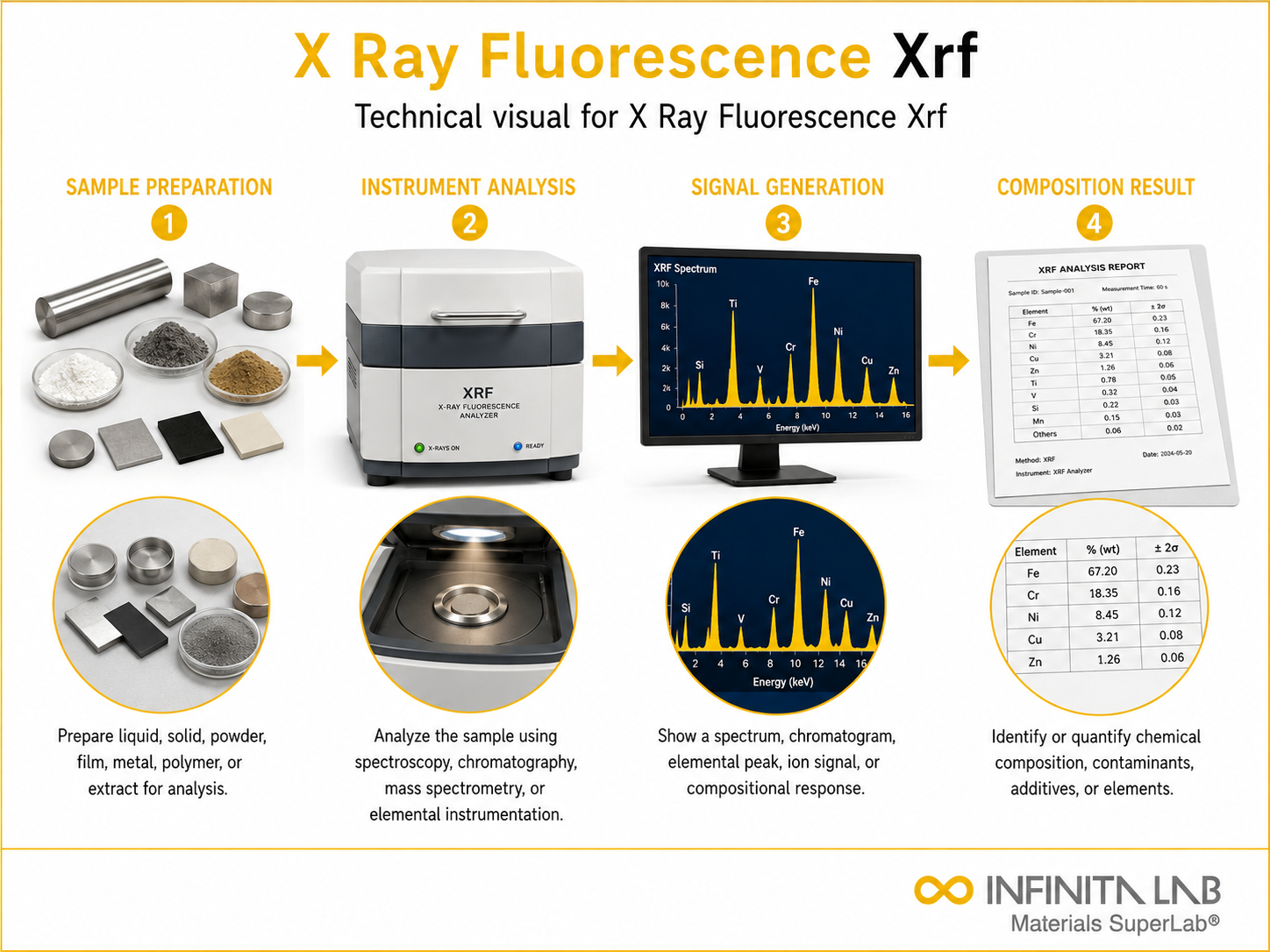
X-ray fluorescence (XRF) is a non-destructive analytical technique used to determine the elemental composition of a material. When a sample is irradiated with a primary X-ray beam, atoms within the material absorb energy and re-emit (fluoresce) secondary X-rays at wavelengths or energies characteristic of each element present. By measuring the position and intensity of these characteristic emission lines, XRF identifies which elements are present in a sample and quantifies their concentrations.
XRF is available in two principal configurations: energy dispersive XRF (EDXRF), which measures the energy of emitted X-rays directly, and wavelength dispersive XRF (WDXRF), which disperses emitted X-rays by wavelength using analyzing crystals for higher resolution and sensitivity. XRF is widely used across metals, polymers, coatings, ceramics, minerals, and environmental samples for both qualitative screening and quantitative compositional analysis.

X-Ray Fluorescence (XRF) Analysis Scope, Applications, and Benefits
Scope
XRF analysis applies to solid, powdered, and liquid samples across a broad range of materials, including:
- Metals and alloys — bulk metal, coatings, and plating for elemental composition and grade verification
- Polymers and coatings — screening for restricted elements (e.g., RoHS-regulated substances) and additive/filler composition
- Minerals, ores, and geological samples — elemental characterization for mining, cement, and geological applications
- Environmental and consumer product samples — screening for heavy metals and other regulated elements in soils, dust, and consumer goods
Applications
- Alloy and grade verification (PMI) — confirming metal composition matches specification prior to fabrication or installation
- RoHS/regulatory compliance screening — detecting restricted elements such as lead, cadmium, mercury, and hexavalent chromium in materials and finished products
- Coating thickness and composition measurement — determining plating thickness and elemental makeup on metal substrates
- Raw material verification and incoming inspection — confirming that received materials match purchase specifications
- Contamination and failure analysis — identifying elemental contaminants responsible for corrosion, discoloration, or component failure
- Quality control in manufacturing — routine verification of elemental composition during production
Benefits
- Non-destructive — samples can be analyzed with little to no preparation and are typically preserved for further testing
- Rapid, multi-element screening — a single measurement can detect and quantify most elements from sodium through uranium
- Portable and laboratory options — handheld XRF analyzers support field screening, while laboratory WDXRF/EDXRF systems provide higher precision for quantitative work
- Broad applicability — usable across metals, polymers, coatings, minerals, and environmental samples
- Cost-effective screening tool — provides fast compositional information before committing to more time-intensive wet-chemical or mass spectrometry methods
X-Ray Fluorescence (XRF) Analysis Test Process
Prepare the Sample
Grind, polish, pelletise, or place the sample in a suitable liquid cell.
1Calibrate the Instrument
Calibrate the XRF system using certified reference materials or fundamental parameters.
2Analyse and Calculate
Measure elemental fluorescence and convert the signals into concentrations using matrix corrections.
3Report the Results
Document identified elements, concentrations, and compliance with applicable limits.
4X-Ray Fluorescence (XRF) Analysis Technical Specifications
| Parameter | Details |
|---|---|
| Applicable Materials | Metals, alloys, polymers, coatings, ceramics, minerals, environmental samples |
| Elemental Range | Typically sodium (Na) through uranium (U), instrument dependent |
| Sample Form | Solid, powder (pressed pellet or loose powder), liquid, or coated substrate |
| Result Parameters | Qualitative elemental identification and quantitative elemental concentration (weight percent or ppm) |
| Detection Limits | Parts-per-million range for many elements, instrument and matrix dependent |
| Related Standards | ASTM E572 (steel analysis), ASTM E1621, ASTM D6247, IEC 62321 (RoHS screening) |


Instrumentation Used for X-Ray Fluorescence (XRF) Analysis
- Energy dispersive XRF (EDXRF) spectrometer or wavelength dispersive XRF (WDXRF) spectrometer
- X-ray tube source with selectable target material and filters
- Solid-state or gas-flow proportional detectors for emitted X-ray measurement
- Sample preparation equipment — pellet press, grinder/polisher, or liquid sample cells as required
- Certified reference materials for instrument calibration
- Handheld XRF analyzer for field or in-process screening applications
X-Ray Fluorescence (XRF) Analysis Results and Deliverables
- Test report — documentation of sample preparation, instrument settings, and calibration reference used
- Elemental composition data — identified elements and quantified concentrations for the analyzed sample
- Regulatory compliance comparison — measured concentrations compared against applicable regulatory thresholds (e.g., RoHS limits), where requested
- Comparative analysis — side-by-side elemental comparison across multiple samples, lots, or suppliers
- Pass/fail determination — compliance assessment against a governing specification or regulatory limit
Frequently Asked Questions
XRF can detect many elements from sodium or magnesium through uranium, depending on the instrument configuration. It is particularly effective for measuring metals and other medium-to-heavy elements.
XRF can analyse solid components, metal alloys, powders, soils, rocks, liquids and coatings. Samples may require grinding, polishing, pelletising or fusion to improve accuracy.
XRF is generally non-destructive because the sample usually remains intact after testing. However, destructive preparation such as grinding or fusion may be required for highly accurate quantitative analysis.
Energy-dispersive XRF measures a broad range of emitted X-ray energies simultaneously and is suited to rapid analysis. Wavelength-dispersive XRF provides higher resolution and improved accuracy for complex materials.
Surface roughness, sample thickness, particle size, contamination and material homogeneity can influence measurements. Matrix effects, spectral overlaps and calibration quality may also affect accuracy.
Why Choose Infinita Lab for Advanced Materials Testing and Characterization?
At the core of this breadth is our network of 2,000+ accredited laboratories across the USA, offering access to over 10,000 testing methods and analytical services. From advanced materials characterization (SEM, TEM, RBS, XPS) to mechanical, chemical, environmental, biological, and standardized ASTM/ISO-compliant testing, we deliver unmatched flexibility, specialization, and scale. You are never limited by geography, facility, or methodology — Infinita Lab connects you to the right expertise and testing solution, every time.

Looking for a Trusted Partner for Accurate and Reliable Testing Services?
Send query us at hello@infinitlab.com or call us at (888) 878-3090 to learn more about our services and how we can support you.



Request a Quote
Submit your material details and receive testing procedures, pricing, and turnaround time within 24 hours.
 Quick Turnaround and Hasslefree process
 Confidentiality Guarantee
 Free, No-obligation Consultation
 100% Customer Satisfaction
