


Total Organic Carbon TOC Testing Services
Total organic carbon (TOC) is measured at various concentrations using different oxidation and detection methods depending on the type, concentration, and analytical needs. Methods such as high-temperature combustion with NDIR, platinum-catalyzed oxidation with NDIR, thermochemical oxidation, and photochemical oxidation are used. UV photo-oxidation alone or with a catalyst is the most accurate and low-maintenance approach for measuring TOC in ultra-pure fluids. Scrubber tubes are used to reduce interference in some methods. Overall, the choice of method depends on the specific requirements and characteristics of the sample being analyzed.
TRUSTED BY


Get compliant results — request your total organic carbon TOC testing quote
- Overview
- Scope, Applications, and Benefits
- Test Process
- Specifications
- Instrumentation
- Results and Deliverables
What Is Total Organic Carbon TOC?
Total organic carbon (TOC) analysis measures the concentration of carbon bound in organic compounds in a water or aqueous sample. Organic carbon enters water from natural sources such as decomposing plant material and soil humus, and from anthropogenic sources including industrial effluents, agricultural runoff, pharmaceutical and personal care product residues, and disinfection byproducts. TOC is widely used as a single-number indicator of overall organic contamination because it captures all organic carbon regardless of the specific compound identity, making it practical for routine monitoring where complete compound-by-compound identification would be impractical.
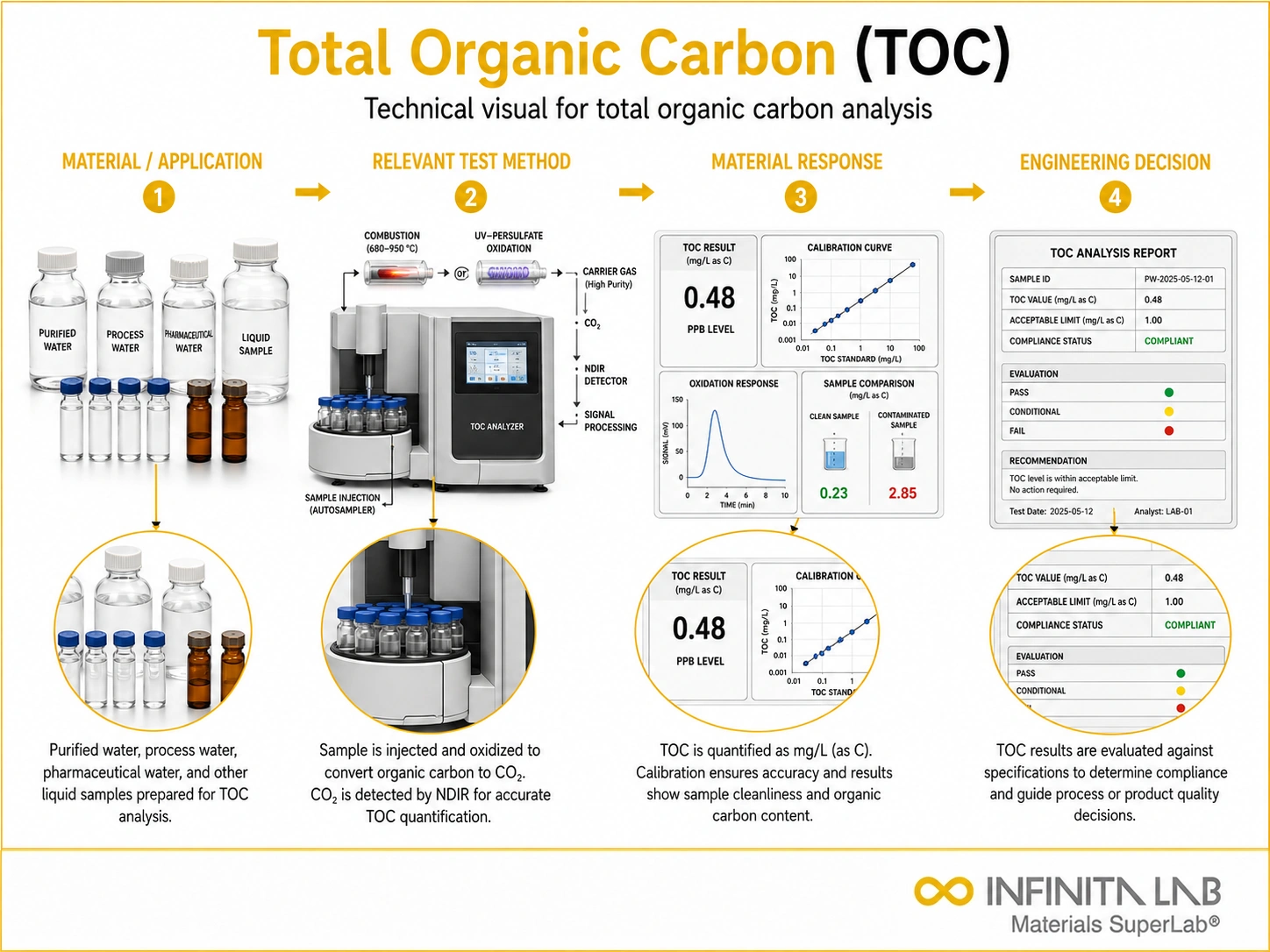
TOC is measured by oxidizing all organic carbon in the sample to carbon dioxide and measuring the amount of CO2 produced. Two principal oxidation approaches are used: high-temperature combustion, where the sample is injected into a furnace at 680 to 1000 degrees Celsius and the evolved CO2 is measured by non-dispersive infrared (NDIR) detection; and wet chemical oxidation, where UV radiation, chemical oxidants, or a combination of both convert organic carbon to CO2 in solution. Most modern TOC analyzers also measure total carbon (TC), which includes both organic and inorganic carbon, and total inorganic carbon (TIC) from carbonates and bicarbonates, calculating TOC as TC minus TIC or measuring the non-purgeable organic carbon (NPOC) fraction directly.
TOC testing is required or routinely used in pharmaceutical water system monitoring (per USP 643 and EP 2.2.44), semiconductor ultrapure water quality control, drinking water treatment monitoring, industrial wastewater discharge measurement, and environmental compliance monitoring of surface and groundwater. In pharmaceutical applications, TOC is used to verify the cleanliness of purified water and water for injection (WFI) systems, with maximum allowable limits of 500 micrograms per liter for purified water and 500 micrograms per liter for WFI per USP standards.

Applications and Benefits of Total Organic Carbon TOC Testing
Scope
TOC analysis applies to liquid water samples including drinking water, process water, ultrapure water, pharmaceutical water, surface water, groundwater, and industrial wastewater. The method is also applicable to solid samples after aqueous extraction. Evaluation areas include:
- Bulk organic contamination level in water systems
- Pharmaceutical purified water and WFI quality monitoring
- Semiconductor process water ultrapurity verification
- Industrial wastewater organic load measurement for discharge control
- Environmental surface water and groundwater organic carbon baseline characterization
- Cleaning validation effectiveness verification through rinse water TOC measurement
Applications
- Pharmaceutical water system qualification and ongoing monitoring (USP 643)
- Semiconductor fab ultrapure water quality control
- Municipal drinking water treatment process monitoring
- Industrial effluent organic load measurement for regulatory discharge compliance
- Environmental baseline and impact studies for organic carbon in surface water
- Cleaning validation in pharmaceutical and food equipment manufacturing
Benefits
- Single measurement captures total organic contamination without compound-specific analysis
- Fast, automated analysis suitable for high-frequency monitoring programs
- Traceable methods with known sensitivity and reproducibility
- Widely specified in pharmacopoeial standards and environmental regulations
- Sensitive enough for ultrapure water monitoring at sub-microgram per liter levels
- Complementary to other water quality parameters (turbidity, conductivity, pH) in monitoring programs
Total Organic Carbon (TOC) Testing Process
Sample Collection and Preservation
Water samples are collected in pre-cleaned glass or plastic containers and preserved according to the method requirements.
1Inorganic Carbon Removal
For NPOC measurement, inorganic carbon is removed by acidification and sparging before organic carbon oxidation
2Oxidation and CO2 Generation
Organic carbon in the sample is oxidized by high-temperature combustion or UV/chemical oxidation.
3CO2 Measurement and Reporting
CO2 concentration is measured by NDIR detection. TOC concentration is calculated from the detector response
4Test parameters and requirements
| Parameter | Details |
|---|---|
| Applicable Standards | USP 643, EPA 415.3, Standard Methods 5310, ISO 8245 |
| Detection Method | Non-dispersive infrared (NDIR) for CO2 measurement |
| Oxidation Method | High-temperature combustion (680-1000 degrees Celsius) or UV/persulfate wet oxidation |
| Detection Range | Approximately 0.1 micrograms/L to several thousand mg/L depending on method |
| Sample Type | Aqueous solutions, surface water, groundwater, process water, wastewater |
| Output Units | mg/L or micrograms/L (ppb) of total organic carbon |


- TOC analyzer with combustion furnace or UV oxidation unit
- Non-dispersive infrared (NDIR) CO2 detector
- Inorganic carbon sparging and acidification system
- Auto-sampler for high-throughput sample sets
- Calibration standards prepared from certified organic carbon standard solutions
- Data acquisition and reporting software
Equipment and Instrumentation Used for Testing
What You Receive: Test Report, Data, and Certification
- Total organic carbon concentration in mg/L or micrograms/L
- Total carbon and total inorganic carbon values where measured
- Comparison against applicable specification limits (USP, EPA, customer-defined)
- Calibration curve and instrument performance verification records
- Sample collection and preservation chain of custody documentation
- Quality assurance documentation
Total Organic Carbon TOC FAQs
TOC testing quantifies the amount of organic carbon present in a sample, providing an overall indication of organic contamination. It is widely used to assess water purity, process cleanliness, and product quality.
TOC testing can be performed on purified water, wastewater, pharmaceuticals, chemicals, environmental samples, and other liquid matrices, depending on the applicable test method.
Unlike COD and BOD, which estimate the oxygen required to oxidize organic matter, TOC directly measures the carbon content of organic compounds, offering a faster and more direct assessment of organic contamination.
TOC testing helps verify product purity, monitor process performance, and demonstrate compliance with industry standards in sectors such as pharmaceuticals, biotechnology, semiconductor manufacturing, and environmental monitoring.
Why Choose Infinita Lab for Total Organic Carbon TOC Testing
At the core of this breadth is our network of 2,000+ accredited laboratories across the USA, offering access to over 10,000 testing methods and analytical services. From advanced materials characterization (SEM, TEM, RBS, XPS) to mechanical, chemical, environmental, biological, and standardized ASTM/ISO-compliant testing, we deliver unmatched flexibility, specialization, and scale. You are never limited by geography, facility, or methodology — Infinita Lab connects you to the right expertise and testing solution, every time.

Looking for an Accredited Partner for Total Organic Carbon TOC Testing?
Send query us at hello@infinitalab.com or call us at (888) 878-3090 to learn more about our services and how we can support you.



Request a Quote
Submit your material details and receive testing procedures, pricing, and turnaround time within 24 hours.
 Quick Turnaround and Hasslefree process
 Confidentiality Guarantee
 Free, No-obligation Consultation
 100% Customer Satisfaction
