


Thermal Resistance Testing for Insulation & Electronic Components
Thermal resistance testing is the measurement of thermal resistance through the material or it could be the reciprocal of thermal conductance of the material. The output of this technique is expressed in Kelvin/watt or Celsius/watt.
TRUSTED BY


Precision-driven testing for dimensional accuracy and compliance
- Overview
- Scope, Applications, and Benefits
- Test Process
- Specifications
- Instrumentation
- Results and Deliverables
Thermal Resistance Testing Overview
Thermal resistance testing provides engineers with a reliable, reproducible method to measure how effectively a material, assembly, or component resists heat transfer. The testing process evaluates thermal performance under controlled environmental and operating conditions, helping manufacturers understand insulation efficiency, heat retention behavior, and thermal management capability. The method is widely used to characterize materials intended for thermal insulation, electronic cooling systems, construction products, automotive assemblies, and industrial equipment.
The test is typically performed by applying a controlled temperature difference across the specimen while monitoring heat flow through the material or component. Thermal resistance is then calculated based on temperature differential, heat transfer rate, specimen thickness, and surface area. Depending on the application, testing may be conducted using guarded hot plates, heat flow meters, thermal conductivity analyzers, or specialized thermal interface measurement systems.
Thermal resistance testing is widely used across electronics, aerospace, automotive, construction, energy, and industrial manufacturing industries where thermal management directly impacts product reliability, efficiency, and safety. Materials and products tested under this methodology include insulation panels, thermal interface materials, composites, foams, textiles, coatings, batteries, electronic assemblies, and heat-resistant components. The generated data support product qualification, thermal design validation, quality assurance, and research and development activities where precise heat transfer performance is critical.

Thermal Resistance Testing Scope, Applications, and Benefits
Scope
Thermal resistance testing provides quantitative data for assessing the thermal performance of materials and electronic components. This is achieved by evaluating their heat transfer characteristics under controlled-heating or steady-state conditions.
Thermal resistance testing evaluates:
- Resistance to heat flow through materials
- Heat dissipation characteristics of components
- Thermal conductance behaviour
- Temperature response under applied power
Applications
Thermal resistance testing is used wherever heat flow control, insulation efficiency, and thermal management performance are critical for product reliability and functionality:
- Electronics & semiconductors — evaluation of thermal interface materials, heat spreaders, circuit boards, batteries, and electronic assemblies where heat dissipation directly affects device performance and lifespan
- Automotive systems — testing of battery insulation materials, under-hood components, thermal barriers, and interior insulation systems exposed to elevated operating temperatures
- Aerospace & defense — characterization of lightweight thermal protection materials, insulation systems, and high-temperature components used in aircraft and defense applications
- Construction & building materials — assessment of insulation panels, roofing systems, wall assemblies, glazing materials, and energy-efficient building products designed to reduce heat transfer
- Industrial equipment & energy systems — measurement of thermal resistance properties in pipes, furnaces, process equipment, heat exchangers, and energy storage systems operating under thermal stress
- R&D and material development — comparative thermal performance analysis across formulations, thicknesses, coatings, and manufacturing processes during product development and optimization
Benefits
- Measures real-world heat transfer performance — thermal resistance testing evaluates how effectively a material limits heat flow under controlled operating conditions, helping engineers optimize thermal management and insulation efficiency.
- Supports product reliability and safety — accurate thermal resistance data helps prevent overheating, thermal degradation, energy loss, and temperature-related component failure in demanding applications.
- Enables material and design optimization — test data helps engineers optimize thickness, density, coatings, fillers, and thermal interface designs to achieve targeted heat transfer performance.
- Improves energy efficiency — materials with higher thermal resistance reduce unwanted heat transfer, improving system efficiency in buildings, electronics, automotive systems, and industrial equipment.
- Supports product qualification and compliance — documented thermal resistance results are commonly used for product validation, thermal design verification, and compliance with industry performance requirements.
- Early-stage QC — identifies variations in insulation quality, thermal conductivity behavior, bonding integrity, or material consistency before products enter production or field use.
Thermal Resistance Testing Process
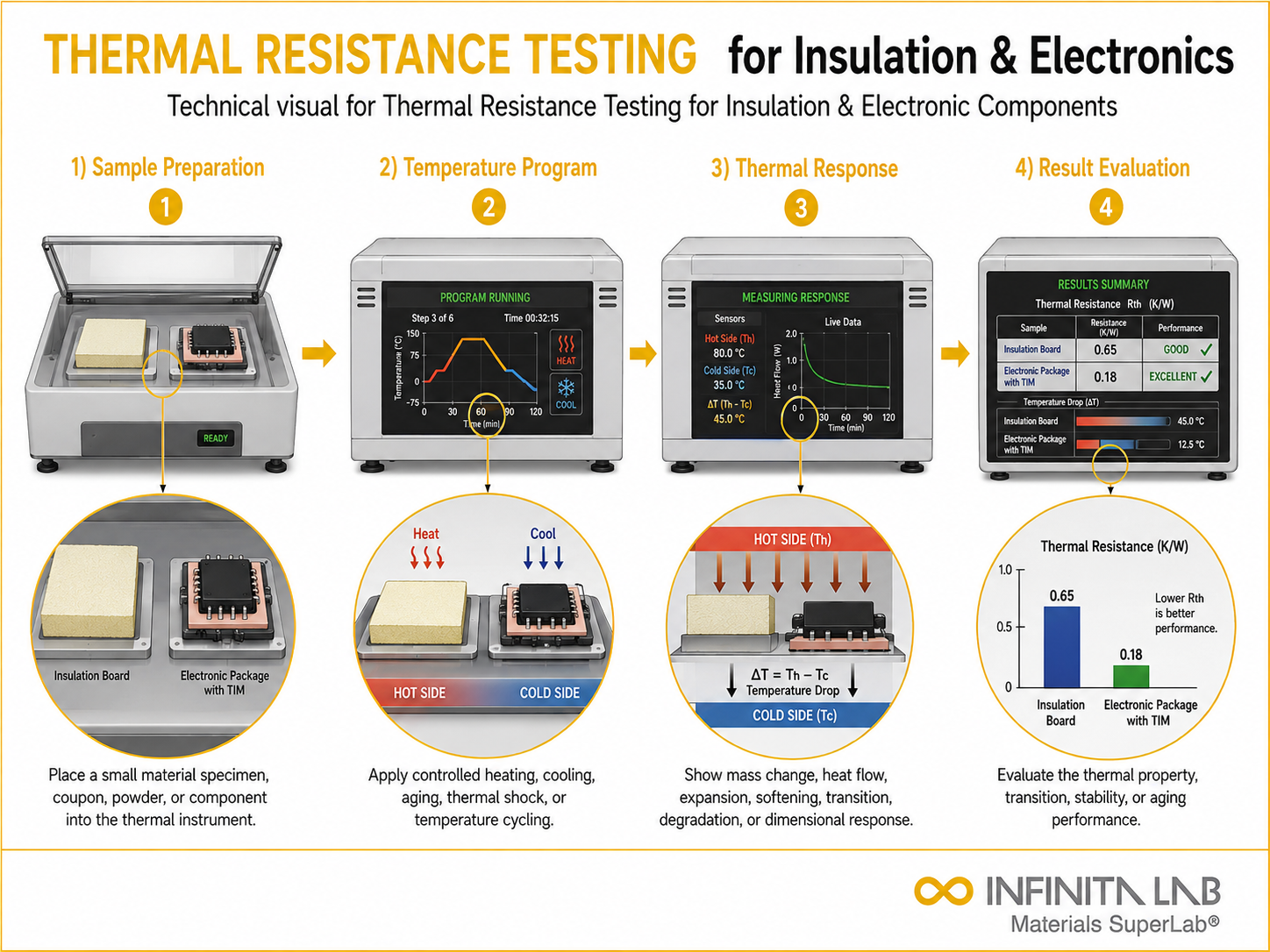
Sample Preparation & Setup
The test specimen is mounted to ensure proper thermal contact with the heat source or heat sink.
1Sensor Installation
Thermocouples or thermal sensors are attached to the test surface to measure temperature.
2Heat Application
Controlled electrical power is applied to generate heat flow through the specimen.
3Data Recording & Evaluation
Temperature difference and applied power are measured to calculate thermal resistance.
4Thermal Resistance Testing Technical Specifications
| Parameter | Details |
|---|---|
| Test Temperature Range | −10 °C to 60 °C (HFM method) |
| Test Method | Heat Flow Meter (HFM) or Modified Transient Plane Source (MTPS) |
| Applied Power | Controlled electrical input |
| Contact Pressure | Maintained to ensure proper thermal contact |
| Measurement Mode | Steady-state or controlled transient |
| Measured Outputs | Temperature difference and thermal resistance |
| Specimen form | Flat slabs, panels, films, discs, or packaged electronic components depending on method |
| Specimen size (typical) | C518: 300 × 300 mm minimum slab; E1461: 10–12.7 mm disc; electronic packages: per JEDEC fixture |


Instrumentation Used for Thermal Resistance Testing
- Heat Flow Meter (HFM) apparatus
- Modified Transient Plane Source (MTPS) system
- Copper heat sink with cooling arrangement
- Thermocouples or thermal sensors
- Power supply and control unit
- Data acquisition and recording system
Thermal Resistance Testing Results and Deliverables
- Test report — thermal resistance values, temperature differentials, and heat flow measurements for all specimens tested
- Statistical summary — mean thermal resistance values, standard deviation, and thermal performance variability analysis
- Thermal performance analysis — comparison of heat transfer behavior across materials, thicknesses, or assembly configurations
- Temperature and heat flow curves — raw thermal response data recorded during testing
- Surface and interface analysis — observations identifying voids, bonding defects, deformation, or thermal contact irregularities affecting thermal resistance performance
- Specimen dimension records — thickness and specimen measurements confirming conformance to testing requirements
Frequently Asked Questions
Thermal resistance testing is a method of measuring the resistance of a material to the flow of heat under steady-state conditions, which can be used to assess the suitability of an insulation material for a particular application.
hermal conductivity (λ, W/m·K) is an intrinsic material property — it describes how readily heat flows through a unit thickness of material under a unit temperature gradient, independent of geometry. Thermal resistance (Rth) is geometry-dependent — it describes the total opposition to heat flow through a specific thickness and area, or across a component junction. Rth depends on λ, thickness, and cross-sectional area.
Thermal resistance is a function of material composition, thickness, density, temperature difference, and contact conditions. Careful specimen preparation and controlled testing conditions are necessary for obtaining accurate thermal resistance data.
Thermal resistance testing is a common application in the construction industry, aerospace, electronics, automotive, and energy sectors where a material is required to resist the flow of heat for purposes of protection, efficiency, or reliability.
Thermal resistance is usually measured using guarded hot plate or heat flow meter methods. The two setups are used to create a controlled temperature difference in order to measure the heat flow through a flat material specimen.
Why Choose Infinita Lab for Advanced Materials Testing and Characterization?
At the core of this breadth is our network of 2,000+ accredited laboratories across the USA, offering access to over 10,000 testing methods and analytical services. From advanced materials characterization (SEM, TEM, RBS, XPS) to mechanical, chemical, environmental, biological, and standardized ASTM/ISO-compliant testing, we deliver unmatched flexibility, specialization, and scale. You are never limited by geography, facility, or methodology — Infinita Lab connects you to the right expertise and testing solution, every time.

Looking for a Trusted Partner for Accurate and Reliable Testing Services?
Send query us at hello@infinitlab.com or call us at (888) 878-3090 to learn more about our services and how we can support you.



Request a Quote
Submit your material details and receive testing procedures, pricing, and turnaround time within 24 hours.
 Quick Turnaround and Hasslefree process
 Confidentiality Guarantee
 Free, No-obligation Consultation
 100% Customer Satisfaction
