


Steel Reinforcing Bar Bond Strength Testing Guide
Determining the bond strength of steel reinforcing bars is a test that measures the force required to pull a steel reinforcing bar (rebar) out of concrete. The bond between the steel rebar and the surrounding concrete is critical for the strength and stability of reinforced concrete structures such as buildings, bridges, and highways.
TRUSTED BY


Precision Testing Solutions for Accurate, Reliable, and Standards-Compliant Results
- Overview
- Scope, Applications, and Benefits
- Test Process
- Specifications
- Instrumentation
- Results and Deliverables
Rebar Bond Strength Test – Overview
Determining the bond strength of steel reinforcing bars evaluates the interaction between steel reinforcement and surrounding concrete. This bond is essential for effective load transfer, ensuring composite action and structural integrity in reinforced concrete systems.
The test measures the resistance to slip between the steel bar and concrete under controlled loading conditions. It is widely used to assess anchorage performance, design efficiency, and durability of reinforced concrete structures in construction and infrastructure projects.

Scope, Applications, and Benefits
Scope
This method defines procedures to evaluate the bond behavior between steel reinforcing bars and concrete using pull-out or beam-type testing. It examines the interfacial adhesion, mechanical interlocking, and frictional resistance developed during loading.
The analysis supports understanding of load transfer mechanisms and failure modes in reinforced concrete.
- Measurement of bond stress between steel and concrete
- Evaluation of slip behavior under tensile loading
- Assessment of anchorage and development length
- Analysis of failure modes (pull-out, splitting)
- Comparison of bar surface conditions and coatings
- Standardized structural performance testing
Applications
- Reinforced concrete structural design validation
- Construction quality control and inspection
- Evaluation of ribbed and coated reinforcement bars
- Infrastructure projects such as bridges and buildings
- Research on concrete–steel interaction
- Seismic performance assessment
- Material and design optimization
Benefits
- Ensures effective load transfer between steel and concrete
- Improves structural safety and reliability
- Helps optimize anchorage and development length
- Identifies potential bond failure risks
- Supports compliance with construction standards
- Enhances durability of reinforced structures
Rebar Bond Strength Test – Test Process
Specimen Preparation
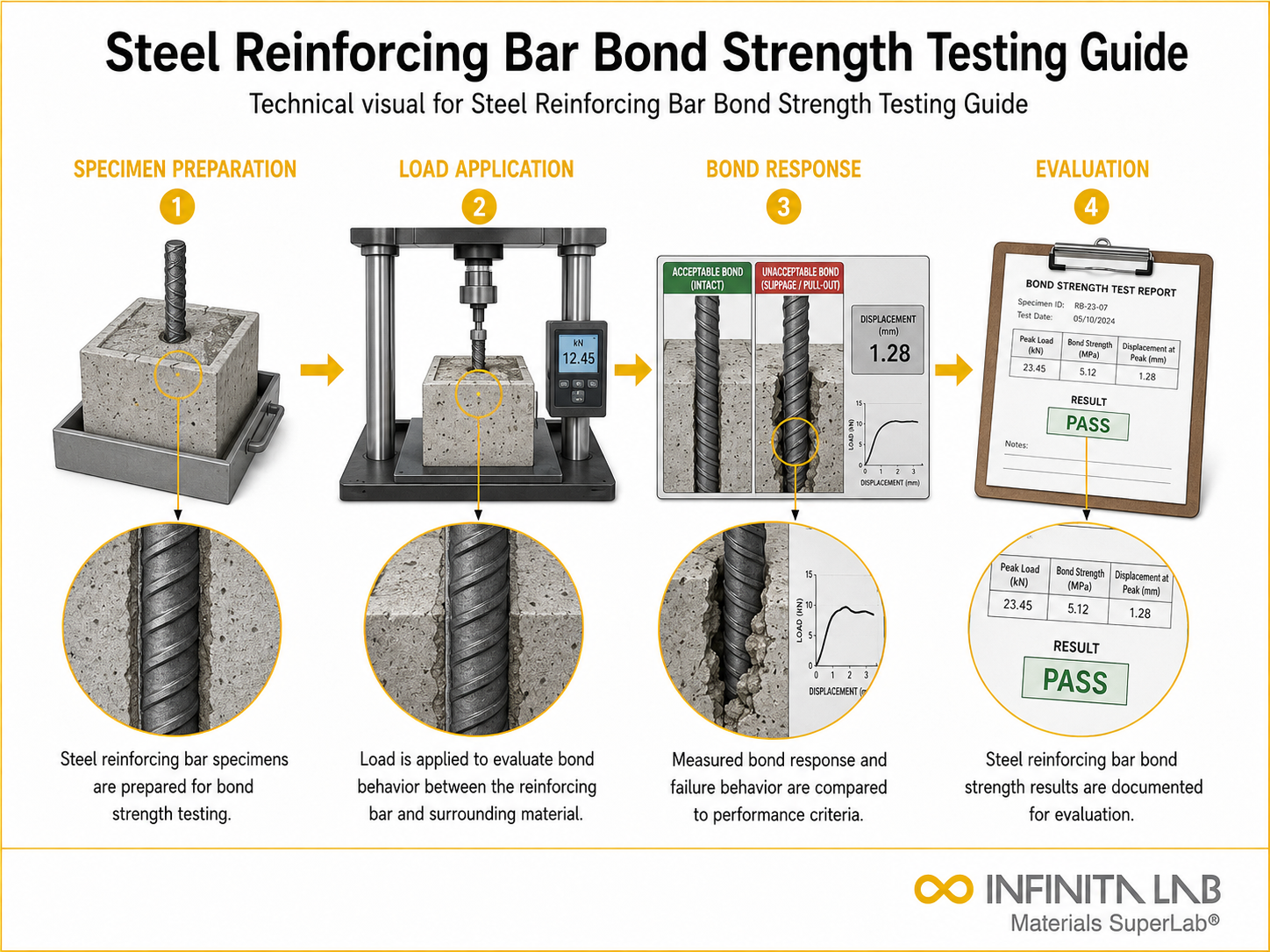
Steel reinforcing bars are embedded in concrete specimens with controlled dimensions and curing conditions to ensure uniform bonding.
1Test Setup
The specimen is mounted in a testing machine with fixtures to apply tensile force to the rebar while restraining the concrete block.
2Load Application
Tensile load is applied gradually to pull the bar out, while slip and load are continuously monitored.
3Data Evaluation
Bond stress, slip characteristics, and failure mode are analyzed to determine bond strength performance.
4Rebar Bond Strength Test – Technical Specification
| Parameter | Details |
|---|---|
| Sample Type | Steel reinforcing bars embedded in concrete |
| Sample Condition | Properly cured concrete with defined embedment length |
| Measurement Method | Pull-out or beam bond testing |
| Loading Type | Controlled tensile loading |
| Environmental Conditions | Ambient or controlled curing/testing conditions |
| Measurement Units | MPa (bond stress), mm (slip) |


- Universal testing machine (UTM)
- Pull-out test fixture
- Slip measurement gauges (LVDT)
- Load cell
- Concrete mold and curing setup
- Alignment fixtures
- Data acquisition system
- Measuring tools (calipers, scales)
Instrumentation Used for Testing
Results and Deliverables
- Bond strength (MPa)
- Load vs slip curve
- Maximum pull-out load
- Failure mode identification
- Crack pattern analysis
- Test report as per standard
- Quality control documentation
- Structural performance evaluation
Frequently Asked Question
Bond strength arises from chemical adhesion, friction, and mechanical interlocking between ribbed bar surfaces and surrounding concrete, collectively resisting slip and ensuring effective load transfer under applied stresses.
Ribbed deformations on reinforcing bars create bearing resistance against concrete, significantly enhancing load transfer capacity compared to smooth bars that rely mainly on adhesion and friction.
Embedment length determines the contact area for stress transfer; insufficient length reduces bond capacity, while excessive length may shift failure mode from pull-out to concrete splitting.
Pull-out testing isolates the bond mechanism in a controlled setup, allowing precise measurement of load-slip behavior and facilitating comparison between different materials and conditions.
Higher bond strength allows shorter development lengths, improving structural efficiency, while lower bond strength requires longer embedment for safe load transfer.
Why Choose Infinita Lab for Advanced Materials Testing and Characterization?
At the core of this breadth is our network of 2,000+ accredited laboratories across the USA, offering access to over 10,000 testing methods and analytical services. From advanced materials characterization (SEM, TEM, RBS, XPS) to mechanical, chemical, environmental, biological, and standardized ASTM/ISO-compliant testing, we deliver unmatched flexibility, specialization, and scale. You are never limited by geography, facility, or methodology — Infinita Lab connects you to the right expertise and testing solution, every time.

Looking for a Trusted Partner for Accurate and Reliable Testing Services?
Send query us at hello@infinitalab.com or call us at (888) 878-3090 to learn more about our services and how we can support you.



Request a Quote
Submit your material details and receive testing procedures, pricing, and turnaround time within 24 hours.
 Quick Turnaround and Hasslefree process
 Confidentiality Guarantee
 Free, No-obligation Consultation
 100% Customer Satisfaction
