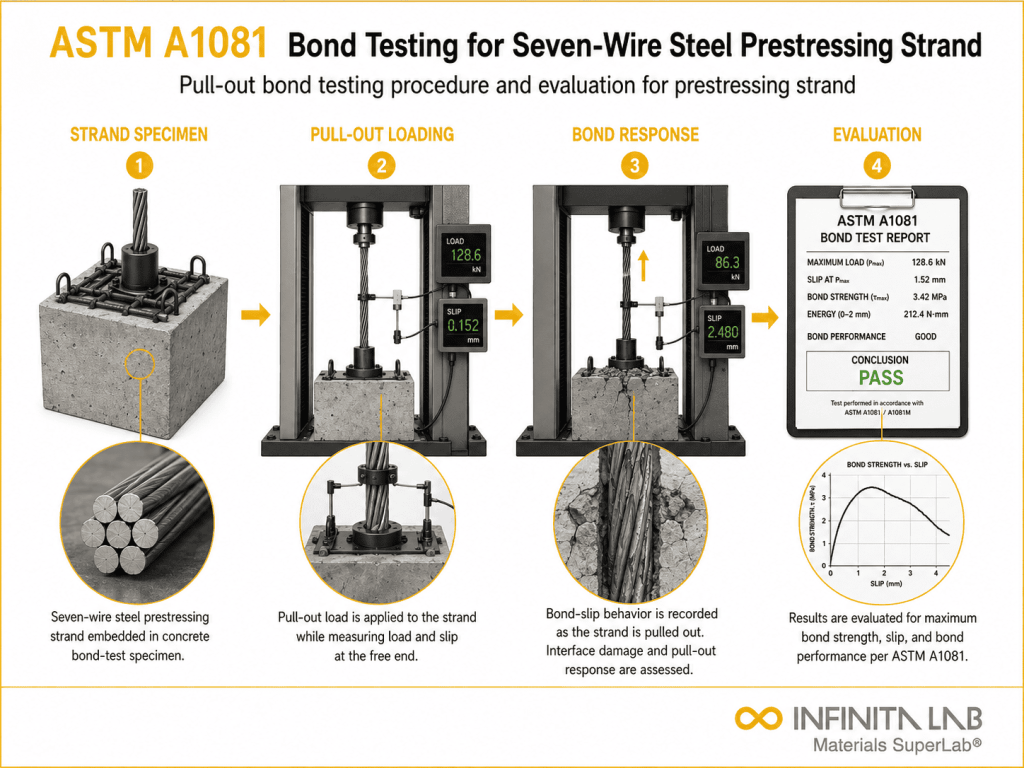


What Is ASTM A1081 Prestressing Strand Bond?
ASTM A1081 is a standardised test method that investigates the bonding ability of seven-wire steel prestressing strands with concrete when they are embedded. The test method assesses bonding properties by measuring the transfer length and the force required for the strand to begin slipping.
This test method is important for evaluating the bonding efficiency of prestressing strands in transferring prestress forces to concrete structures. Efficient bonding is essential for providing structural integrity and durability in prestressed concrete structures.
Applications and Benefits of ASTM A1081 Prestressing Strand Bond Testing
Scope
ASTM A1081 is a test method that evaluates the ability of seven-wire steel prestressing strands to bond to concrete in prestressed concrete members. The standard concerns the ability of the prestressing force to transfer from the steel strand to the concrete, which is important for the structure to perform as expected.
The standard applies to:
– Seven-wire steel prestressing strands
– Prestressed concrete members
– Bond between the strand and the concrete
– Transfer length and strand slip
Applications
- Quality control of prestressing strands
- Evaluation of prestressed concrete elements
- Bridge and highway construction
- Precast concrete manufacturing
- Structural concrete components
- Infrastructure development projects
- Research and development of prestressing systems
Benefits
- Ensures proper bond between strand and concrete
- Evaluates effective stress transfer capability
- Improves structural safety and performance
- Supports quality assurance in prestressed concrete production
- Provides standardized testing for bond evaluation
- Helps optimize prestressing strand surface characteristics
- Enhances reliability of structural components
Our ASTM A1081 Testing Procedure
Specimen Preparation & Curing
Prestressing strand is embedded in concrete and cured to achieve required strength.
1Strand Stressing
The strand is tensioned using hydraulic equipment to simulate service conditions.
2Load & Slip Measurement
Tensile load is applied while gauges measure strand slip relative to concrete.
3Bond Evaluation
Transfer length and slip behaviour are analyzed to evaluate bond performance.
4ASTM A1081 Test Parameters and Requirements
| Parameter | Details |
|---|---|
| Applicable Materials | Seven-wire steel prestressing strands embedded in concrete |
| Specimen Type | Concrete block containing embedded prestressing strand |
| Measured Properties | Bond strength, transfer length, strand slip |
| Test Environment | Controlled laboratory conditions |
| Output Units | Force (kN), displacement (mm), transfer length (mm) |


- Universal testing machine (UTM) or hydraulic loading system
- Slip or displacement gauges
- Load cells
- Concrete casting molds
- Strand gripping fixtures
- Measuring instruments for displacement
- Data acquisition system
Equipment and Instrumentation Used for ASTM A1081 Testing
What You Receive: Test Report, Data, and Certification
- Bond performance evaluation report
- Transfer length measurement
- Strand slip analysis
- Load versus displacement data
- Comparative bond performance results
- Reports
ASTM A1081 Prestressing Strand Bond FAQs
Proper bond ensures that the prestressing force is efficiently transferred to the concrete structure. This is critical for maintaining structural strength, durability, and load-bearing performance.
The test specifically applies to seven-wire steel prestressing strands commonly used in prestressed concrete structures such as bridges, beams, and slabs.
A concrete block with an embedded prestressing strand is prepared and cured before testing. The strand is then tensioned and evaluated for bond performance.
Typical equipment includes a universal testing machine or hydraulic loading system, displacement gauges, load cells, concrete molds, strand gripping fixtures, and data acquisition systems.
The test produces results such as bond performance evaluation, transfer length measurement, strand slip data, and load versus displacement curves used for quality control and compliance verification.
According to ASTM A1081/A1081M, steel strand testing evaluates the bond performance of seven-wire steel prestressing strand used in concrete construction. A strand specimen is embedded in cement mortar inside a cylindrical steel casing and allowed to cure. The specimen is then placed in a tensile testing machine, which pulls the strand while measuring the applied force and movement. The test determines the force required to produce a specified movement of the strand, helping assess its ability to transfer prestressing forces to concrete.
ASTM A1081/A1081M evaluates the bond strength of seven-wire prestressing steel strand through a controlled pull-out test, rather than measuring the strand's conventional tensile strength. The strand is embedded in cured mortar within a steel casing, and its exposed end is gripped by a tensile testing machine. The machine pulls the strand while recording the applied tensile force and the movement at the opposite end. The reported result is the force corresponding to 2.5 mm (0.1 in.) of movement at the free end, indicating the strand's bond performance with the mortar.
Why Choose Infinita Lab for Prestressing Strand Bond Testing?
When your Prestressing Strand Bond results have to hold up - for compliance, a customer audit, or an engineering decision - ASTM A1081 accuracy and an unbiased third-party report matter more than price. Infinita Lab routes your ASTM A1081 prestressing strand bond testing to ISO/IEC 17025-accredited U.S. partner labs with hands-on method experience, so you get defensible data, transparent reporting, and turnaround times built around your project deadline - not ours.

Looking for an Accredited Partner for ASTM A1081 Prestressing Strand Bond Testing?
Send query us at hello@infinitalab.com or call us at (888) 878-3090 to learn more about our services and how we can support you.



