

What Is Soap Ingredient Analysis?
Laboratory testing to determine ingredients in soap involves chemical and analytical methods to identify and quantify the active, functional, and potentially restricted components present in bar soaps, liquid soaps, syndets, and specialty cleansing products. Testing covers saponification value, free alkali, moisture, total fatty matter, glycerol, and specific additive concentrations.
This service supports soap manufacturers, private label brands, and regulatory compliance teams in verifying formulation accuracy, ensuring consumer safety, meeting labeling requirements, and qualifying raw materials before production.
Applications and Benefits of Soap Ingredient Analysis Testing
Scope
Soap ingredient testing evaluates the key chemical and physical parameters that determine the quality, safety, and formulation consistency of soap products. It helps verify compliance with industry standards and ensures the product performs as intended.
Key parameters typically assessed include:
- Total Fatty Matter (TFM) and free fatty acid content to determine soap quality and cleansing efficiency
- Free caustic alkali and total alkali to check formulation balance and skin safety
- Moisture and volatile matter content to assess stability and shelf life
- Glycerol and unsaponifiable matter to evaluate moisturising components and non-soap residues
- Preservatives, colourants, and fragrances using GC-MS/HPLC for compositional analysis and regulatory compliance
- pH testing (especially for liquid soaps) to ensure mildness and user safety
Applications
- Bar soap and liquid soap formulation verification
- Raw material (lye, oils, additives) incoming quality control
- Regulatory compliance (EU Cosmetics Regulation, US FDA)
- Consumer safety and allergen testing
- Private label and contract manufacturing QA
Benefits
- Confirms formulation accuracy and batch consistency
- Detects restricted or undeclared substances
- Supports product labelling and claims substantiation
- Ensures compliance with safety and regulatory standards
- Identifies root causes of product quality complaints
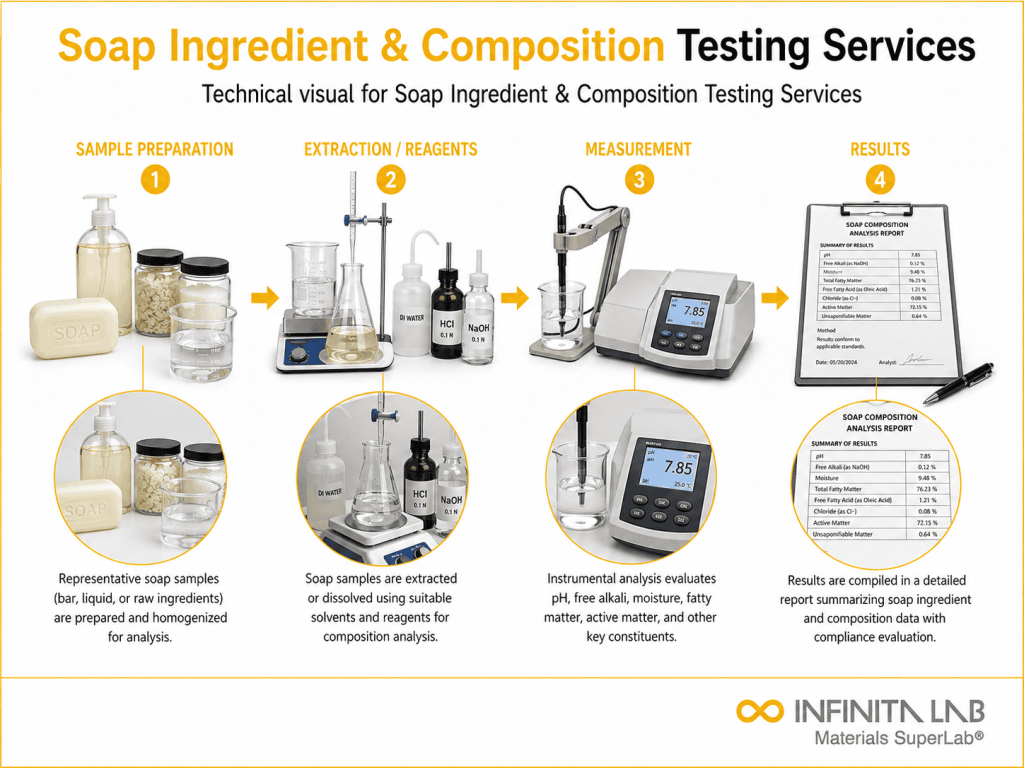
Our Testing Procedure
Sample Preparation
Samples are homogenized, extracted, or diluted as required.
1Chemical Testing
TFM, free alkali, moisture, and saponification value are measured.
2Additive Analysis
Additives and contaminants are identified and quantified.
3Reporting
Results are compiled, compared to specs, and reported with pass/fail.
4Test parameters and requirements
| Parameter | Details |
|---|---|
| Key Tests | TFM, free alkali, moisture, saponification value, pH, glycerol |
| Advanced Analysis | GC-MS (fragrances), HPLC (preservatives, colorants), IC (anions) |
| Sample Types | Bar soap, liquid soap, syndet bars, shampoo bars |
| pH Range | 4.5–11 (method: ISO 4316) |


- Analytical balance and Karl Fischer titrator (moisture)
- Titration equipment (alkali, TFM, saponification)
- GC-MS system (fragrance and volatile organics)
- HPLC with UV/DAD detector (preservatives, colourants)
- pH meter with calibrated electrode
Equipment and Instrumentation Used for Testing
What You Receive: Test Report, Data, and Certification
- Quantitative values for all tested parameters
- Compliance comparison to specification or label claims
- GC-MS/HPLC chromatograms and identification reports
- Restricted substance screening results
- Full analytical test report with method citations
Soap Ingredient Analysis FAQs
Soap formation takes place by mixing lye and oil. This process is known as "saponification."
The key tests performed during the saponification process are: PH testing, Titration. Free fatty acid test, Moisture content analysis test.
Saponification occurs between 60 to 80 degrees of temperature for 15-60 minutes.
Saponification is an exothermic process.
Yes. GC-MS and HPLC screening can detect a wide range of undeclared additives, restricted preservatives (e.g., triclosan, parabens), allergens, and contaminants not listed on the ingredient label.
Soap analysis evaluates the chemical composition, purity, and quality of soap products through laboratory testing. A representative sample is prepared and analyzed for parameters such as total fatty matter (TFM), moisture content, free alkali, chloride content, and matter insoluble in alcohol. Chemical titration, solvent extraction, gravimetric analysis, and oven drying are used to determine these properties. The results help identify formulation variations, excess alkali, impurities, and moisture-related changes. Soap analysis supports product quality control, formulation verification, and compliance with applicable product specifications.
Soap quality is checked by evaluating its physical, chemical, and performance characteristics using standardized laboratory methods. Common tests include total fatty matter (TFM), moisture content, free caustic alkali, pH, chloride content, hardness, and lather performance. Laboratory procedures such as titration, oven drying, and gravimetric analysis help determine the composition and consistency of the soap. The results are compared with applicable product specifications to assess purity, formulation balance, and cleaning performance. These evaluations help manufacturers maintain consistent quality, safety, and product performance.
Soaps analysis involves examining the chemical and physical properties of soap to determine its composition and manufacturing quality. The sample is prepared using appropriate laboratory procedures and tested for total fatty matter, free alkali, moisture, unsaponified matter, and inorganic salts. Analytical techniques such as acid-base titration, solvent extraction, and gravimetric measurement are used to quantify individual components. The measured values are compared with established specifications to identify impurities, formulation inconsistencies, and processing variations. This analysis helps verify raw materials, monitor production batches, and ensure consistent soap quality.
Why Choose Infinita Lab for Soap Ingredient Analysis Testing
When your Soap Ingredient Analysis results have to hold up - for compliance, a customer audit, or an engineering decision - accuracy and an unbiased third-party report matter more than price. Infinita Lab routes your soap ingredient analysis testing to ISO/IEC 17025-accredited U.S. partner labs with hands-on method experience, so you get defensible data, transparent reporting, and turnaround times built around your project deadline - not ours.

Looking for an Accredited Partner for Soap Ingredient Analysis Testing?
Send query us at hello@infinitalab.com or call us at (888) 878-3090 to learn more about our services and how we can support you.