


PFAS Testing Services
PFAS (Perfluoroalkyl and Polyfluoroalkyl Substances) testing is done to detect the concentration of PFAS in a product. PFAS are a complex group of produced chemicals that are used as ingredients in several everyday products. These chemicals are very stable as a result of the strong chemical bonds between the carbon and multiple fluorine atoms.
TRUSTED BY


Get compliant results — request your PFAS testing quote
- Overview
- Scope, Applications, and Benefits
- Test Process
- Specifications
- Instrumentation
- Results and Deliverables
What Is PFAS?
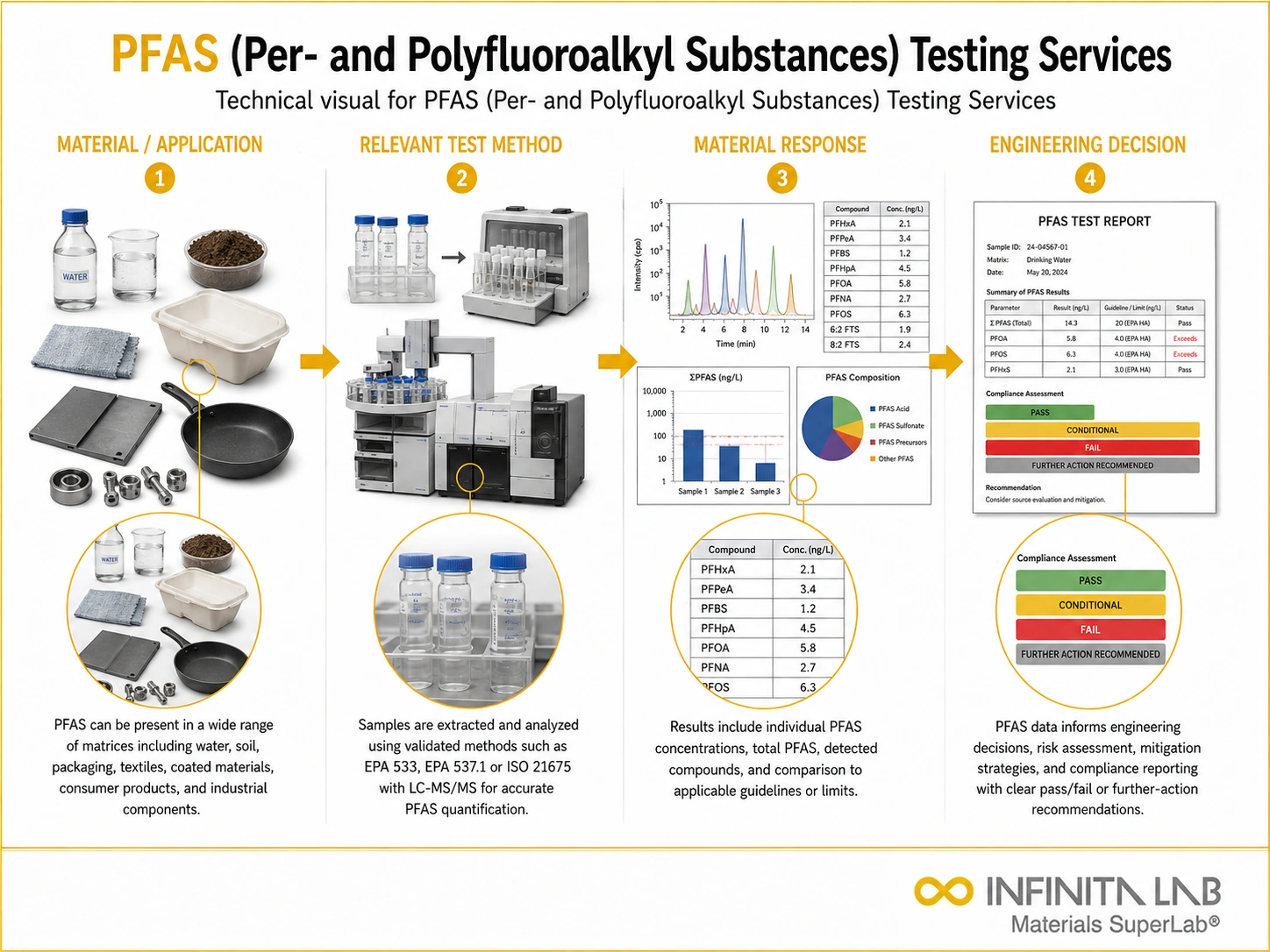
PFAS (Perfluoroalkyl and Polyfluoroalkyl Substances) Testing evaluates the presence, concentration, and distribution of persistent fluorinated compounds in various materials and environmental samples. These substances are chemically stable and resistant to degradation, making accurate detection critical for safety and regulatory compliance.
The testing involves advanced analytical techniques such as chromatography and mass spectrometry to identify trace-level contaminants. It supports risk assessment, contamination monitoring, and regulatory validation by quantifying individual PFAS compounds and total fluorine content across different sample matrices.

Applications and Benefits of PFAS Testing
Scope
PFAS Testing focuses on detecting and quantifying a wide range of fluorinated compounds in environmental, industrial, and material samples under controlled laboratory conditions.
It includes targeted and non-targeted analysis, enabling identification of known PFAS compounds as well as unknown fluorinated substances, ensuring comprehensive contamination assessment.
- Detection of specific PFAS compounds at trace levels
- Quantification of total PFAS concentration in samples
- Analysis of water, soil, air, and material samples
- Evaluation using targeted and non-targeted analytical methods
- Measurement of total organic fluorine content
- Identification of emerging and unknown PFAS compounds
- Assessment of contamination sources and distribution
- Verification of compliance with regulatory limits
Applications
- Drinking water and wastewater analysis
- Soil and environmental monitoring
- Industrial material testing
- Packaging and consumer products
- Firefighting foam evaluation
- Regulatory compliance testing
Benefits
- Detects PFAS at very low concentration levels
- Supports environmental and health risk assessment
- Enables regulatory compliance verification
- Identifies contamination sources
- Provides accurate and reliable analytical data
- Supports remediation and monitoring programs
Our Testing Procedure
Sample Collection & Controlled Preservation Procedure
Samples are collected using contamination-free techniques and preserved to prevent PFAS loss or external interference.
1Sample Preparation & Extraction Optimization Stage
PFAS compounds are extracted using solvent-based or solid-phase extraction methods to isolate analytes.
2Instrumental Analysis Using Advanced Detection Techniques –
Chromatography coupled with mass spectrometry is used to separate and quantify individual PFAS compounds.
3Data Interpretation & Quantitative Reporting Analysis
Analytical data is processed to determine concentration levels and ensure compliance with specified limits.
4Test parameters and requirements
| Parameter | Details |
|---|---|
| Test Method | Chromatographic separation with mass spectrometric detection |
| Measurement Type | Quantification of individual PFAS compounds and total fluorine |
| Sample Type | Water, soil, air, and solid materials |
| Loading Type | Chemical extraction and analytical detection process |
| Units | ng/L, µg/kg, mg/kg |
| Detection Limit | Trace-level detection in parts per trillion range |


- Liquid chromatography system
- Mass spectrometer
- Solid-phase extraction system
- Sample preparation workstation
- Analytical balance
- Clean laboratory environment setup
Equipment and Instrumentation Used for Testing
What You Receive: Test Report, Data, and Certification
- Concentration of individual PFAS compounds
- Total PFAS or total fluorine content
- Detection limits and analytical sensitivity data
- Compliance evaluation with regulatory standards
- Contamination assessment and distribution analysis
- Detailed analytical test report
PFAS FAQs
PFAS compounds are highly stable, exist at very low concentrations, and often occur as complex mixtures. Their chemical diversity requires sensitive analytical techniques and careful sample preparation to achieve accurate and reliable detection.
Even very low concentrations of PFAS can pose environmental and health risks, making high-sensitivity detection essential for accurate risk assessment and regulatory compliance.
Targeted analysis measures specific known PFAS compounds, while non-targeted analysis identifies unknown or emerging compounds, providing a more comprehensive assessment.
Solid-phase extraction concentrates PFAS from large sample volumes and removes interfering substances, significantly improving detection sensitivity and analytical accuracy in complex environmental matrices.
Mass spectrometry identifies compounds based on unique mass-to-charge ratios and fragmentation patterns, allowing differentiation between closely related PFAS compounds even at very low concentrations.
Why Choose Infinita Lab for PFAS Testing?
At the core of this breadth is our network of 2,000+ accredited laboratories across the USA, offering access to over 10,000 testing methods and analytical services. From advanced materials characterization (SEM, TEM, RBS, XPS) to mechanical, chemical, environmental, biological, and standardized ASTM/ISO-compliant testing, we deliver unmatched flexibility, specialization, and scale. You are never limited by geography, facility, or methodology — Infinita Lab connects you to the right expertise and testing solution, every time.

Looking for an Accredited Partner for PFAS Testing?
Send query us at hello@infinitalab.com or call us at (888) 878-3090 to learn more about our services and how we can support you.



Request a Quote
Submit your material details and receive testing procedures, pricing, and turnaround time within 24 hours.
 Quick Turnaround and Hasslefree process
 Confidentiality Guarantee
 Free, No-obligation Consultation
 100% Customer Satisfaction
