


Moisture Resistance Humidity Testing Services
Moisture resistance/humidity testing evaluates components and materials to determine their resistance to high humidity and heat. It helps identify potential issues with corrosion, physical distortion, decomposition, leaching, and changes in electrical properties. Military specifications provide guidelines for manufacturers to ensure material integrity in humid climates.
TRUSTED BY


Get compliant results — request your moisture resistance humidity testing quote
- Overview
- Scope, Applications, and Benefits
- Test Process
- Specifications
- Instrumentation
- Results and Deliverables
What Is Moisture Resistance Humidity?
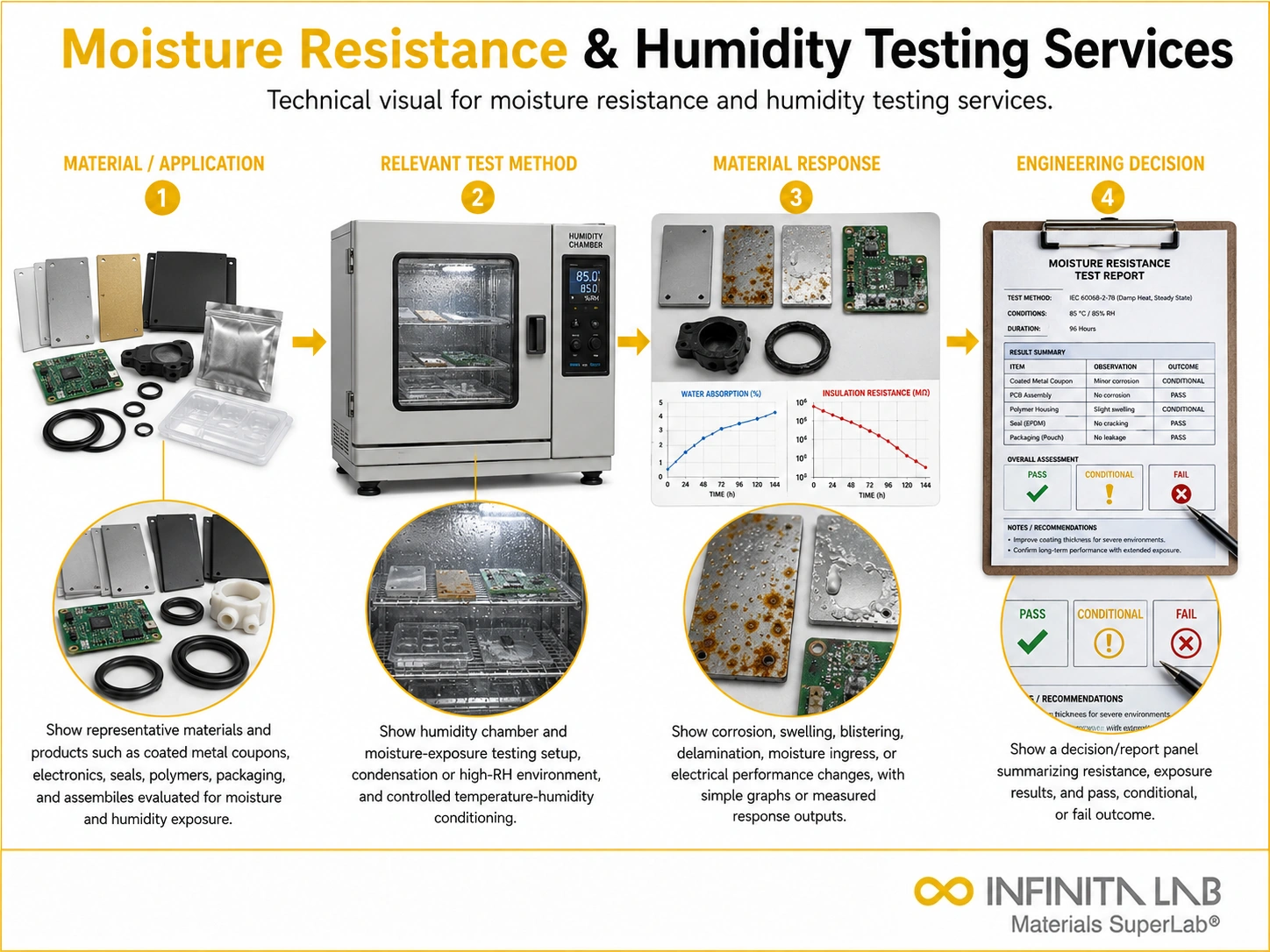
Moisture resistance (humidity) testing evaluates the ability of materials, coatings, and products to withstand prolonged exposure to high-humidity environments without degradation. It simulates real-world conditions such as tropical climates, condensation, and storage environments where moisture can significantly affect performance and durability.
This testing is typically performed in controlled environmental chambers where relative humidity can reach up to 100%, and temperature is elevated (~38°C or higher) to accelerate moisture exposure. Condensation forms on specimen surfaces, enabling evaluation of corrosion, blistering, swelling, and electrical failure under humid conditions.

Applications and Benefits of Moisture Resistance Humidity Testing
Scope
Moisture resistance (humidity) testing evaluates:
- Resistance to high humidity exposure (up to ~100% RH)
- Condensation and moisture ingress behavior
- Corrosion and oxidation performance
- Coating adhesion and blistering resistance
- Electrical insulation degradation
- Material swelling, cracking, and delamination
Applications
- Coatings, paints, and surface finishes
- Electronics and electrical components
- Plastics, polymers, and composites
- Automotive and aerospace materials
- Construction and industrial equipment
Benefits
- Identifies moisture-induced failure mechanisms
- Simulates real-world humid and tropical conditions
- Improves product durability and reliability
- Supports material selection and design optimization
- Enables accelerated life testing
Our Testing Procedure
Sample Preparation
Specimens are cleaned, conditioned, and mounted to ensure uniform exposure.
1Humidity Exposure
Samples are placed in a chamber at controlled humidity (typically 95–100% RH) and temperature (~38°C).
2Condensation Formation
Saturated air creates condensation on specimen surfaces for continuous moisture exposure.
3Data Analysis
Samples are evaluated for corrosion, blistering, adhesion loss, or electrical degradation.
4Test parameters and requirements
| Parameter | Details |
|---|---|
| Standards | ASTM D2247, ASTM D1735, IEC 60068-2-78, MIL-STD-810 Method 507 |
| Test Principle | Exposure to controlled humidity and condensation |
| Humidity Level | Up to 100% RH |
| Temperature | ~38°C (typical ASTM D2247 condition) |
| Test Type | Continuous humidity or cyclic condensation |
| Duration | Hours to weeks depending on requirement |
| Measured Outputs | Corrosion, blistering, adhesion loss, electrical performance |


- Humidity chambers (controlled RH and temperature)
- Condensation humidity cabinets
- Environmental test chambers
- Corrosion evaluation tools
- Electrical testing equipment (insulation resistance)
- Data acquisition systems
Equipment and Instrumentation Used for Testing
What You Receive: Test Report, Data, and Certification
- Moisture resistance performance data
- Corrosion and surface degradation analysis
- Coating adhesion and blistering evaluation
- Electrical insulation performance (if applicable)
- Pass/fail assessment based on selected standards
Moisture Resistance Humidity FAQs
Moisture resistance testing evaluates how materials perform under high humidity or condensation conditions, identifying degradation such as corrosion, blistering, or electrical failure caused by prolonged moisture exposure.
ASTM D2247 is a standard that exposes samples to 100% relative humidity at controlled temperature (~38°C) to evaluate water resistance and durability of coatings.
Common failures include corrosion, blistering, adhesion loss, swelling, cracking, and electrical insulation breakdown due to continuous exposure to moisture and condensation.
Industries such as automotive, electronics, coatings, construction, and aerospace use humidity testing to ensure products can withstand humid and tropical environments.
It helps predict product durability in real-world environments, ensuring reliability and preventing moisture-related failures during storage, transport, and operation.
Why Choose Infinita Lab for Moisture Resistance Humidity Testing
At the core of this breadth is our network of 2,000+ accredited laboratories across the USA, offering access to over 10,000 testing methods and analytical services. From advanced materials characterization (SEM, TEM, RBS, XPS) to mechanical, chemical, environmental, biological, and standardized ASTM/ISO-compliant testing, we deliver unmatched flexibility, specialization, and scale. You are never limited by geography, facility, or methodology — Infinita Lab connects you to the right expertise and testing solution, every time.

Looking for an Accredited Partner for Moisture Resistance Humidity Testing?
Send query us at hello@infinitalab.com or call us at (888) 878-3090 to learn more about our services and how we can support you.



Request a Quote
Submit your material details and receive testing procedures, pricing, and turnaround time within 24 hours.
 Quick Turnaround and Hasslefree process
 Confidentiality Guarantee
 Free, No-obligation Consultation
 100% Customer Satisfaction
