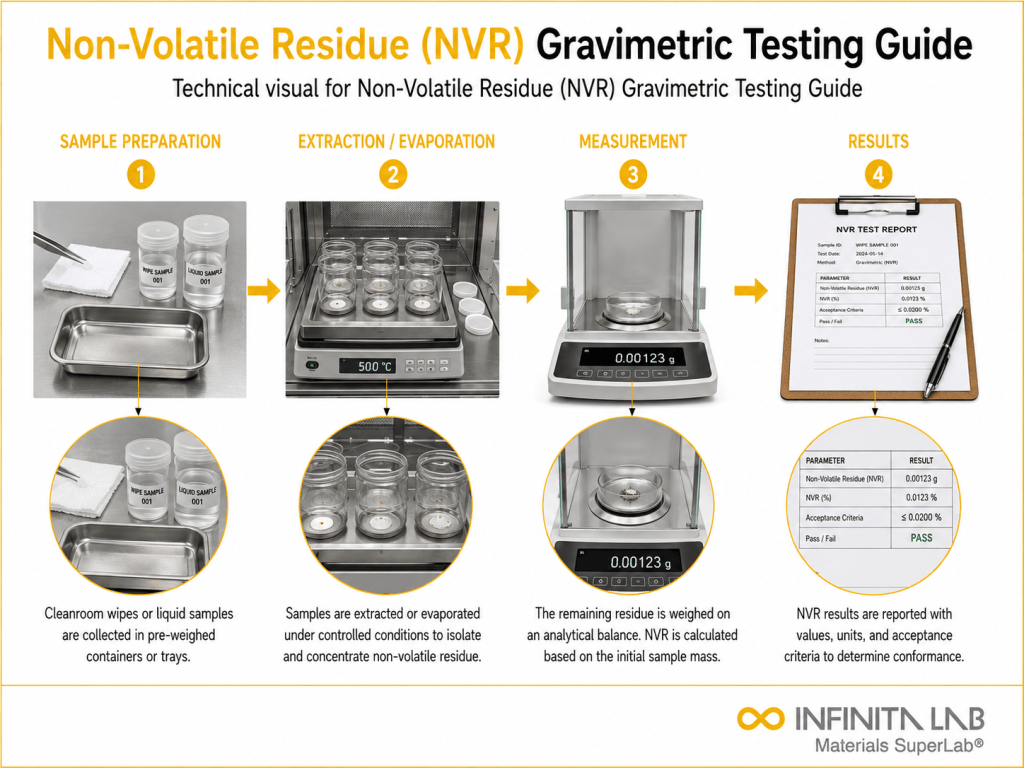


Unleashing the Power of Gravimetric NVR Testing – Overview
Gravimetric Non-Volatile Residue (NVR) testing is an analytical method used to quantify the amount of non-volatile contaminants left after a liquid sample is evaporated under controlled conditions. It is widely used to assess trace residues such as oils, salts, particulates, and organic contaminants that can affect surface cleanliness, product performance, and system reliability. The method relies on precise mass measurement before and after evaporation to determine residue concentration with high sensitivity.
This testing is critical in industries where ultra-clean surfaces and high-purity fluids are required. It helps ensure contamination control in manufacturing, cleaning validation, and quality assurance processes by providing accurate gravimetric data on residual impurities that could impact performance or cause system failure.
Applications and Benefits of Non Volatile Residue NVR Gravimetric Guide Testing
Scope
Gravimetric NVR testing determines non-volatile residue content in liquid samples after controlled evaporation.
- Measures non-volatile contaminants in liquids
- Applicable to solvents, cleaning agents, and process fluids
- Evaluates particulate and organic residue levels
- Supports surface cleanliness verification
- Used in contamination control and validation studies
- Helps assess fluid purity and system cleanliness
- Suitable for ultra-trace residue detection analysis
Applications
- Aerospace component cleanliness validation
- Semiconductor and microelectronics cleaning verification
- Pharmaceutical manufacturing cleanliness control
- Precision optical and instrument cleaning
- Industrial solvent purity assessment
- Medical device manufacturing quality control
Benefits
- Ensures ultra-high cleanliness standards
- Detects trace contamination at micro levels
- Improves product reliability and performance
- Supports regulatory and validation compliance
- Reduces risk of contamination-related failure
- Enhances process control in critical industries
Our Testing Procedure
Sample Collection and Preparation
A measured volume of liquid sample is collected and handled in contamination-free conditions to avoid external interference.
1Evaporation Stage
The sample is evaporated under controlled temperature and environmental conditions until only non-volatile residue remains
2Weighing of Residue
The remaining residue is precisely weighed using a high-sensitivity microbalance for accurate mass determination.
3Data Calculation
NVR value is calculated by comparing initial sample mass with final residue mass and expressed as concentration.
4Test parameters and requirements
| Parameter | Details |
|---|---|
| Measurement Principle | Mass difference after controlled evaporation |
| Detection Range | µg/L to mg/L levels depending on system sensitivity |
| Sample Volume | 10 mL to 100 mL typical |
| Temperature Range | Ambient to controlled evaporation temperature (up to 150°C) |
| Balance Sensitivity | Microgram-level precision |
| Evaporation Method | Controlled heating or inert gas purge |
| Data Output | Residue mass and concentration value |


- High-precision microbalance
- Evaporation heating system
- Clean evaporation chambers
- Glassware and contamination-free vessels
- Desiccators for cooling and stabilization
- Environmental control systems
Equipment and Instrumentation Used for Testing
What You Receive: Test Report, Data, and Certification
- Non-volatile residue concentration report
- Gravimetric mass loss data
- Contamination level classification
- Process cleanliness validation report
- Quality compliance documentation
- Comparative purity analysis
Non Volatile Residue NVR Gravimetric Guide FAQs
Gravimetric NVR testing measures non-volatile contaminants left after evaporation of a liquid sample. It is critical because even trace residues can compromise surface cleanliness, product reliability, and system performance in high-precision industries.
It detects oils, organic compounds, dissolved salts, particulates, and residual process chemicals that remain after complete solvent evaporation under controlled conditions.
Gravimetric analysis provides direct mass-based quantification of total residue, making it highly reliable for overall contamination assessment without requiring identification of individual compounds.
Controlled evaporation ensures only non-volatile substances remain. Improper evaporation can trap volatiles or introduce artifacts, leading to inaccurate residue measurements.
TDS measures dissolved ionic content in solution, while NVR measures all non-volatile residues after evaporation, including organic and particulate matter.
Non-volatile residue (NVR) testing measures the amount of material remaining after a liquid solvent evaporates under controlled conditions. A measured sample is filtered when required, transferred into a preweighed container, and evaporated to remove volatile components. The remaining residue is dried, cooled, and weighed using a precision analytical balance. The measured residue helps assess solvent purity, surface contamination, and cleanliness of materials used in sensitive manufacturing environments.
NVR analysis uses gravimetric measurement to determine the quantity of nonvolatile contaminants present in a liquid or extracted from a surface. A representative sample is collected, and the solvent is evaporated under controlled conditions. The remaining residue is weighed and compared with the original sample quantity or extraction volume. Results are typically reported in milligrams per liter (mg/L), parts per million (ppm), or milligrams per unit area, depending on the sample and test method.
A gravimetric testing laboratory measures the mass of substances to determine their concentration, residue content, or material composition. For NVR analysis, technicians use preweighed containers, controlled evaporation equipment, filtration systems, and precision analytical balances. The sample is processed to remove volatile components, and the remaining nonvolatile material is weighed. Blank corrections and controlled laboratory conditions help improve measurement accuracy and reliability.
Why Choose Infinita Lab for Non Volatile Residue NVR Gravimetric Guide Testing
When your Non Volatile Residue NVR Gravimetric Guide results have to hold up - for compliance, a customer audit, or an engineering decision - accuracy and an unbiased third-party report matter more than price. Infinita Lab routes your non volatile residue NVR gravimetric guide testing to ISO/IEC 17025-accredited U.S. partner labs with hands-on method experience, so you get defensible data, transparent reporting, and turnaround times built around your project deadline - not ours.

Looking for an Accredited Partner for Non Volatile Residue NVR Gravimetric Guide Testing?
Send query us at hello@infinitalab.com or call us at (888) 878-3090 to learn more about our services and how we can support you.