


Nickel Release Testing Services
Nickel release tests are done as nickel is widely used as a bleaching element in white gold alloys for jewelry and in manufacturing medical devices, pharmaceuticals, and vaccines, where the highest standards of hygiene and sterility are essential. Although master alloy suppliers promise the safety of their products, nickel allergy cases caused by such white gold jewelry are reported now and then. In hospitals and medical facilities, these materials are equally important.
TRUSTED BY


Get compliant results — request your nickel release testing quote
- Overview
- Scope, Applications, and Benefits
- Test Process
- Specifications
- Instrumentation
- Results and Deliverables
What Is Nickel Release?
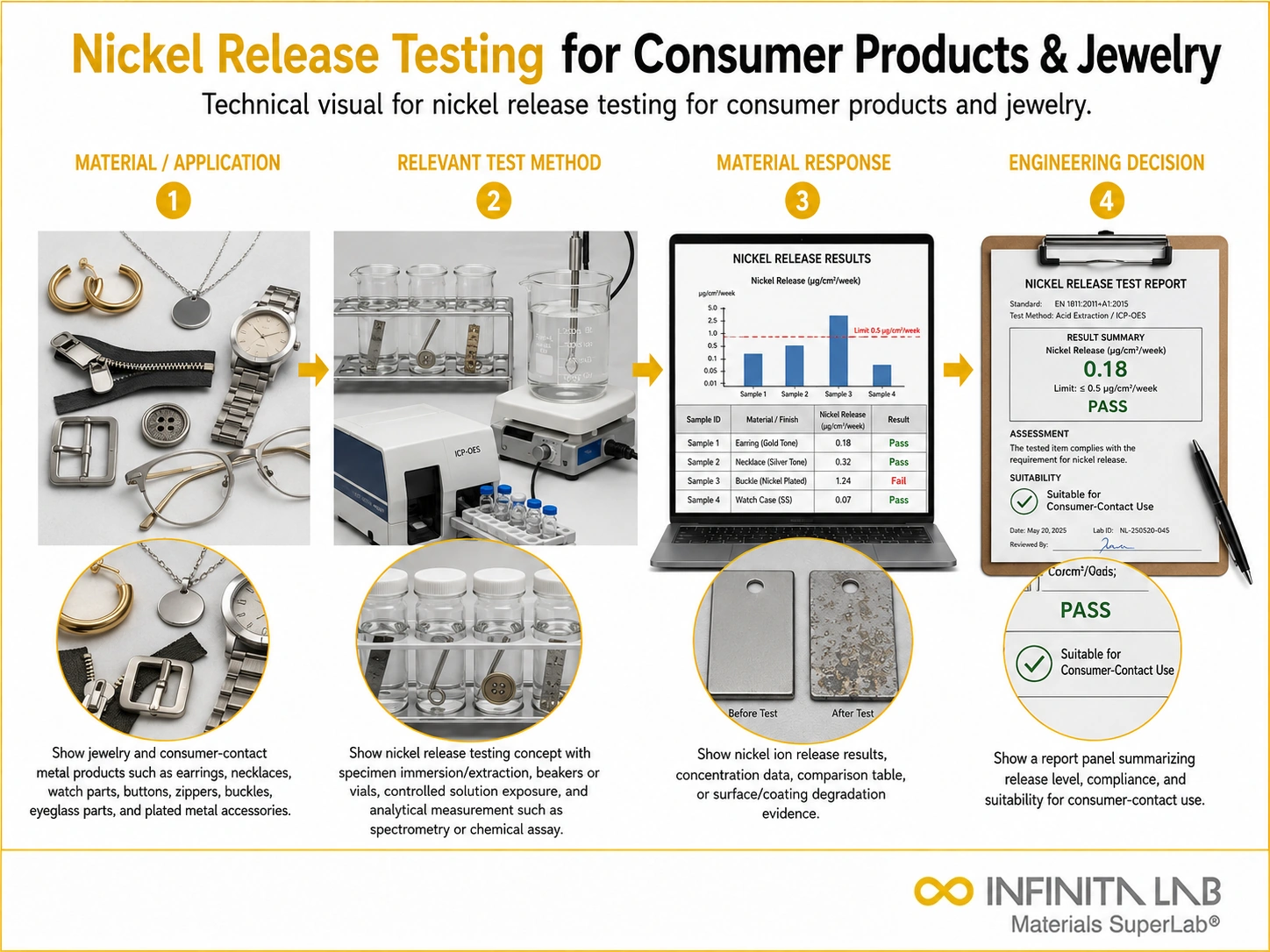
Nickel Release Testing determines the amount of nickel released from materials that come into direct and prolonged contact with skin. It is critical for evaluating compliance with safety limits, as excessive nickel release can cause allergic contact dermatitis and adverse skin reactions.
The test typically involves immersing the sample in an artificial sweat solution under controlled conditions, followed by chemical analysis to quantify released nickel. Results are compared against regulatory limits to ensure material safety, especially for products intended for continuous skin exposure.

Applications and Benefits of Nickel Release Testing
Scope
Nickel release testing focuses on quantifying the release of nickel ions from metallic or coated materials under simulated skin contact conditions, supporting safety compliance and material evaluation.
- Measurement of nickel ion release from surfaces
- Evaluation under simulated sweat exposure conditions
- Testing of coated, plated, or alloy materials
- Verification of compliance with regulatory limits
- Assessment of surface treatment effectiveness
Applications
- Jewelry and accessories testing
- Watches and wearable components
- Fasteners such as buttons, zippers, and clasps
- Consumer products with skin contact
- Coated or plated metal components
- Quality control and compliance verification
Benefits
- Ensures safety for skin-contact products
- Prevents allergic reactions due to nickel exposure
- Supports regulatory compliance requirements
- Evaluates effectiveness of coatings and finishes
- Enhances consumer confidence and product quality
- Reduces risk of product recalls
Nickel Release Test – Test Process
Sample Preparation
The sample is cleaned and conditioned to remove surface contaminants without altering coating integrity.
1Artificial Sweat Exposure
The sample is immersed in a standardized artificial sweat solution under controlled temperature and duration conditions.
2Extraction & Analysis
The solution is analyzed using chemical techniques such as spectrometry to quantify released nickel ions.
3Result Evaluation
Measured nickel release is compared with regulatory limits to determine compliance status.
4Nickel Release Test – Technical Specification
| Parameter | Details |
|---|---|
| Test Method | Artificial sweat extraction followed by chemical quantification |
| Sample Type | Metallic or coated items intended for direct skin contact |
| Exposure Medium | Artificial sweat solution with defined pH and composition |
| Test Duration | Typically 1 week exposure under controlled conditions |
| Temperature | Maintained around 30°C to simulate skin conditions |
| Measurement Technique | Atomic absorption spectroscopy (AAS) or ICP-OES |
| Measurement Units | µg/cm²/week (nickel release rate) |


- Atomic absorption spectrometer (AAS)
- Inductively coupled plasma optical emission spectrometer (ICP-OES)
- pH meter
- Temperature-controlled chamber
- Analytical balance
- Sample containers and extraction vessels
Equipment and Instrumentation Used for Testing
What You Receive: Test Report, Data, and Certification
- Nickel release rate (µg/cm²/week)
- Compliance status against specified limits
- Analytical test report with method details
- Interpretation of coating or material performance
- Identification of non-compliant samples
- Recommendations for corrective actions
Nickel Release FAQs
Nickel release testing measures the amount of nickel ions released from materials under simulated skin contact. It is important to prevent allergic reactions and ensure products meet safety regulations for prolonged skin exposure.
Nickel ions released from surfaces penetrate skin and trigger immune responses in sensitized individuals. The release rate directly influences exposure level, making quantitative limits essential to minimize sensitization risk and prevent allergic contact dermatitis under prolonged contact conditions.
This unit normalizes release relative to surface area and exposure duration, providing a realistic measure of skin exposure. It ensures comparability across different product geometries and accurately reflects actual user contact conditions rather than bulk concentration alone.
Nickel release occurs through corrosion processes where nickel atoms oxidize into ions in the presence of sweat electrolytes. Factors such as pH, chloride ions, and oxygen availability accelerate dissolution, influencing release rates significantly.
Coatings act as barriers, but defects such as porosity, microcracks, or wear can expose the substrate. Over time, mechanical abrasion and corrosion degrade coatings, leading to increased nickel release and potential compliance failure.
Why Choose Infinita Lab for Nickel Release Testing
At the core of this breadth is our network of 2,000+ accredited laboratories across the USA, offering access to over 10,000 testing methods and analytical services. From advanced materials characterization (SEM, TEM, RBS, XPS) to mechanical, chemical, environmental, biological, and standardized ASTM/ISO-compliant testing, we deliver unmatched flexibility, specialization, and scale. You are never limited by geography, facility, or methodology — Infinita Lab connects you to the right expertise and testing solution, every time.

Looking for an Accredited Partner for Nickel Release Testing?
Send query us at hello@infinitalab.com or call us at (888) 878-3090 to learn more about our services and how we can support you.



Request a Quote
Submit your material details and receive testing procedures, pricing, and turnaround time within 24 hours.
 Quick Turnaround and Hasslefree process
 Confidentiality Guarantee
 Free, No-obligation Consultation
 100% Customer Satisfaction
