


NES Smoke Index Testing Services
Accredited NES smoke index testing from Infinita Lab, performed to the exact standard requirements - accurate, reproducible results with full documentation for compliance, R&D, and quality control programs.
TRUSTED BY


Get compliant results - request your NES smoke index testing quote
- Overview
- Scope, Applications, and Benefits
- Test Process
- Specifications
- Instrumentation
- Results and Deliverables
What Is NES Smoke Index?
NES 711 evaluates the smoke emission characteristics of materials exposed to controlled combustion and thermal decomposition conditions for naval, marine, defense, offshore, and transportation applications. The test measures the optical smoke density generated during material burning to determine whether the material produces excessive smoke that can reduce visibility, obstruct evacuation routes, interfere with emergency response operations, or compromise personnel safety in confined environments such as naval vessels, submarines, offshore platforms, and enclosed transportation systems. The standard is widely specified by the UK Ministry of Defense (MOD) and is also referenced as Def Stan 02-711 for military and naval material qualification programs.
NES 711 is commonly performed alongside NES 713 toxicity testing as part of complete naval fire hazard qualification requirements for Royal Navy and UK MOD applications. The test evaluates smoke density under flaming and non-flaming combustion conditions using optical density measurements and smoke index calculations derived from controlled combustion exposure. Materials are assessed for compliance with specified smoke index acceptance limits to verify suitability for use in confined marine and military environments, where preserving visibility during fire incidents is critical for safe evacuation and operational survivability. NES 711 testing is also frequently referenced alongside SOLAS Chapter II-2 and IMO FTP Code fire safety requirements for marine and offshore applications.

Applications and Benefits of NES Smoke Index Testing
Scope
NES 711 evaluates the smoke-generating characteristics of materials under controlled heating or burning conditions to determine their smoke index.
The scope includes:
- Measurement of smoke generation from materials
- Evaluation of smoke density during combustion
- Testing of materials used in marine and naval applications
- Determination of the smoke index value
- Verification of fire safety performance
Applications
- Naval & Defense – Royal Navy shipbuilding materials, submarine compartment systems, military equipment enclosures, and UK MOD qualification programs requiring smoke density compliance
- Marine & Offshore – offshore platform materials, marine structural assemblies, shipboard insulation systems, and confined-space fire safety qualification testing under SOLAS and IMO fire protection requirements
- Aerospace – aircraft interior panels, cabin materials, composite structures, and aerospace polymer systems requiring smoke visibility evaluation
- Railway & Transportation – passenger cabin materials, flooring systems, seating assemblies, insulation materials, and enclosed transportation fire safety testing
- Electrical & Electronics – cable insulation systems, polymer housings, electrical enclosure materials, and smoke emission qualification of electrical assemblies
- Construction & Infrastructure – fire-resistant wall systems, coatings, insulation materials, structural composites, and smoke-controlled building materials
- Industrial Equipment – control panel materials, polymer assemblies, protective coatings, and industrial enclosure systems exposed to fire risk environments
- Oil & Gas – offshore equipment housings, hazardous-area insulation systems, platform structural materials, and confined-environment fire safety evaluation
Benefits
- Helps select low-smoke materials
- Improves fire safety in enclosed spaces
- Supports marine and defense compliance
- Enhances visibility during fire emergencies
- Ensures material safety and reliability
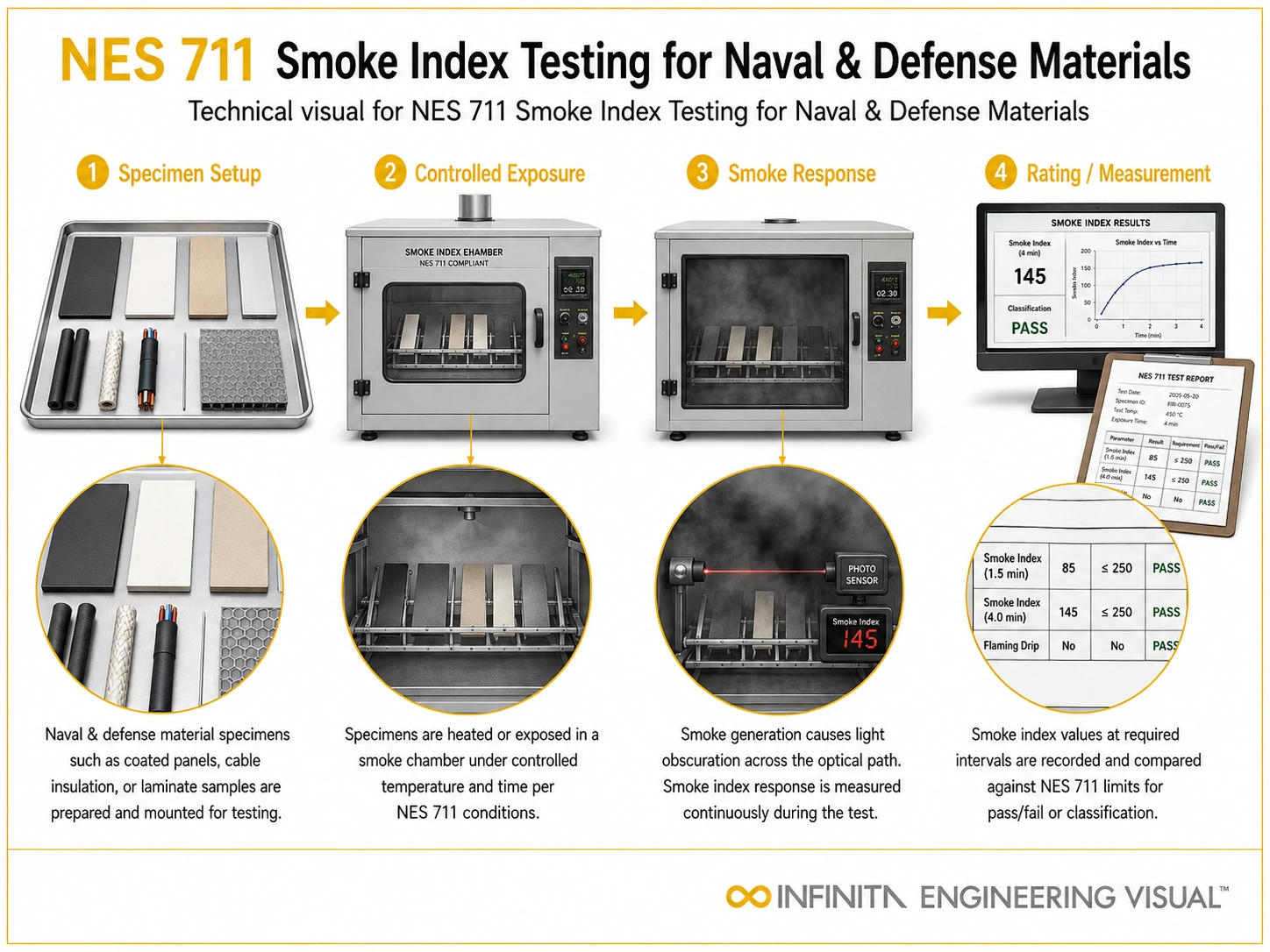
Our Testing Procedure
Specimen Preparation
Small specimens (~75 mm × 75 mm, ≤25 mm thick) are prepared for testing.
1Thermal Exposure
The specimen is exposed to a controlled heat source or flame in the smoke testing apparatus.
2Smoke Measurement
The amount and density of smoke generated are measured using optical instruments during the test.
3Smoke Index Calculation
The smoke data is analyzed to calculate the smoke index value based on standard evaluation criteria.
4Test parameters and requirements
| Parameter | Details |
|---|---|
| Test Objective | Smoke density and smoke index evaluation |
| Evaluation Method | Optical density measurement |
| Combustion Conditions | Flaming and non-flaming exposure |
| Sample Type | Polymers, cables, coatings, composites |
| Sample Size | ~75 mm × 75 mm, thickness ≤25 mm |
| Test Duration | ~24 hours (typical exposure cycle) |
| Smoke Density Metric | Smoke Index (SI), Ds, and optical density |
| Smoke Chamber Type | NBS-type smoke density chamber or equivalent |
| Heating Conditions | Controlled radiant heating exposure |
| Typical Radiant Flux | Approximately 40 kW/m² |
| Sample Conditioning | Controlled temperature and humidity pre-conditioning |
| Related Standards | NES 713, ISO 5659-2, IMO FTP Code, SOLAS |
| Evaluation Parameters | Smoke density, optical transmission, smoke index |


- Smoke density chamber
- Controlled furnace or radiant heat source
- Optical density measurement system (photometric setup)
- Temperature control system
- Sample holder and chamber enclosure
- Data acquisition and analysis system
Equipment and Instrumentation Used for Testing
What You Receive: Test Report, Data, and Certification
- Smoke index value
- Optical density vs time curve
- Smoke generation characteristics
- Comparative material performance
- Fire safety evaluation report
NES Smoke Index FAQs
NES 711 evaluates the smoke generation characteristics of materials when exposed to fire conditions, providing a smoke index value used to assess visibility hazards and safety in confined environments such as naval vessels.
Smoke generation can significantly reduce visibility and hinder evacuation during fire incidents. NES 711 testing helps ensure materials used in ships produce limited smoke, improving safety for personnel onboard.
Materials such as cables, insulation, coatings, sealants, flooring, and composite components used in naval ships and offshore structures are commonly evaluated to verify compliance with smoke emission requirements.
NES 711 testing is mainly required in naval shipbuilding, marine engineering, offshore platforms, and defense sectors where strict fire safety standards are essential for enclosed operational environments.
The test report provides a smoke index value based on measured smoke density during controlled combustion, helping determine whether the tested material meets specified fire safety acceptance criteria.
Smoke content testing measures the amount or optical density of smoke produced when a material is exposed to controlled heat or flame. In ASTM E662 testing, smoke accumulates in a sealed chamber, and a light beam measures how much the smoke reduces light transmission. The results are reported as specific optical density.
Why Choose Infinita Lab for NES Smoke Index Testing?
When your NES Smoke Index results have to hold up - for compliance, a customer audit, or an engineering decision - accuracy and an unbiased third-party report matter more than price. Infinita Lab routes your NES smoke index testing to ISO/IEC 17025-accredited U.S. partner labs with hands-on method experience, so you get defensible data, transparent reporting, and turnaround times built around your project deadline - not ours.

Looking for an Accredited Partner for NES Smoke Index Testing?
Send query us at hello@infinitalab.com or call us at (888) 878-3090 to learn more about our services and how we can support you.



Request a Quote
Submit your material details and receive testing procedures, pricing, and turnaround time within 24 hours.
 Quick Turnaround and Hasslefree process
 Confidentiality Guarantee
 Free, No-obligation Consultation
 100% Customer Satisfaction
