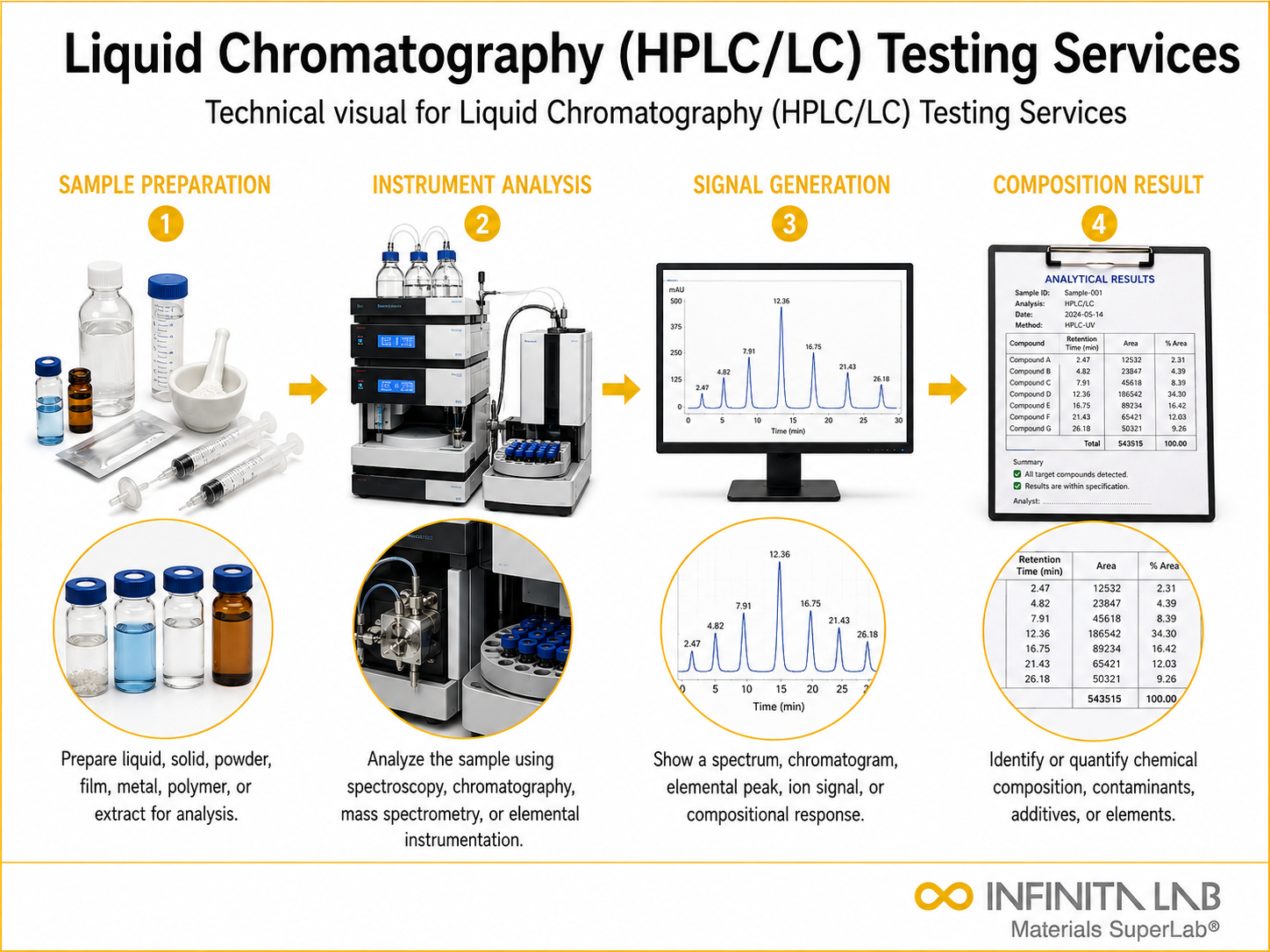


What Is Liquid Chromatography LC?
Liquid Chromatography (LC) is a standard technique used in separating, identifying, and quantifying the components of a liquid sample. It is used in various industries, including pharmaceuticals, polymers, food, environment, and chemicals, to analyse complex mixtures with high accuracy.
Liquid Chromatography plays a vital role in detecting impurities, tracing product quality, and supporting research and development activities. It may be used for both analytical and preparative purposes based on the procedure followed.

Applications and Benefits of Liquid Chromatography LC Testing
Scope
Liquid Chromatography (LC) is a technique used to analyse a liquid or dissolved sample and separate the various components of the sample. It is a popular method used to verify the content of a mixture of substances. LC is used in various fields such as pharmaceuticals, food science, environmental science, and biochemistry, among others. It helps in verifying the active ingredients of a substance, impurities in a substance, additives in a substance, and contaminants in a substance.
It helps in verifying:
– Organic and inorganic compounds
– Impurities
– Additives
– Contaminants
Applications
- Monitoring purity of raw materials
- Analysis of polymer additives and degradation products
- Food safety and nutritional analysis
- Environmental monitoring of water and soil
- Research and development of new compounds
- Bioanalytical studies
- Validation of manufacturing processes
Benefits
- Accurate and reproducible quantification
- Separation of complex mixtures
- Detection of impurities at trace levels
- Supports quality control and regulatory compliance
- Enhances product safety and performance
- Provides standardised analytical methodology
- Applicable to a wide range of sample types
- Supports process optimisation and R&D
Our Testing Procedure
Sample & Mobile Phase Preparation
Samples are extracted, diluted, or filtered, and solvents/buffers are prepared.
1Column Setup & Injection
Suitable LC column is selected, and the sample is introduced into the system.
2Separation
Components are separated under controlled flow and temperature conditions.
3Detection & Analysis
Separated analytes are detected, and concentrations or purities are determined using calibration standards.
4Test parameters and requirements
| Parameter | Details |
|---|---|
| Applicable Materials | polymers, environmental samples, biochemical mixtures |
| Mobile Phases Used | Water, organic solvents, buffer solutions depending on method |
| Detection Methods | UV/Vis, Fluorescence, Refractive Index, Mass Spectrometry |
| Typical Concentration Range | Trace to high levels depending on application |
| Measured Compounds | APIs, impurities, additives, contaminants, degradation products |
| Output Units | Concentration (mg/L, μg/mL), % composition, or area under peak |


- Liquid chromatography system (HPLC or UPLC)
- UV/Vis, fluorescence, refractive index, or mass spectrometer detectors
- Analytical balance
- Sample filtration and extraction apparatus
- Mobile phase degassing and preparation system
- Data acquisition and analysis software
Equipment and Instrumentation Used for Testing
What You Receive: Test Report, Data, and Certification
- Quantitative concentrations of analytes
- Purity and impurity profiles
- Chromatographic separation reports
- Comparative analysis with standards
- Reports
Liquid Chromatography LC FAQs
LC is an analytical technique used to separate, identify, and quantify components in liquid or soluble samples. It relies on the distribution of compounds between a stationary phase (column) and a mobile phase (solvent).
LC provides: Accurate and reproducible quantification of analytes, Separation of complex mixtures, Detection of impurities at trace levels, Quality control and regulatory compliance support, Analysis of diverse sample types
HPLC (High-Performance Liquid Chromatography) uses conventional high-pressure systems for separation, whereas UPLC (Ultra-Performance Liquid Chromatography) operates at higher pressures, providing faster analysis, higher resolution, and better sensitivity.
Yes. With sensitive detectors such as UV, fluorescence, or mass spectrometry, LC can detect analytes at very low concentrations, often in the parts-per-million (ppm) or parts-per-billion (ppb) range.
Yes. LC can identify compounds (qualitative) based on retention time and spectral properties and quantify them (quantitative) using calibration curves or internal standards.
Liquid chromatography testing separates the components of a sample using a liquid mobile phase and a column containing a stationary phase. The sample is injected into the system, and its compounds move through the column at different rates depending on their interactions with both phases. A detector records the separated compounds, producing a chromatogram used to identify and quantify target substances. This technique is widely used in pharmaceutical, chemical, food, and environmental testing.
Liquid chromatography tests for the presence, concentration, purity, and composition of specific compounds in a sample. Depending on the method and detector, it can measure pharmaceutical ingredients, impurities, food additives, pesticides, vitamins, organic acids, and other chemical substances. When coupled with mass spectrometry (LC-MS), it can also help identify compounds based on their mass-to-charge ratios. The analytes that can be detected depend on the method, column, and detector selected.
Why Choose Infinita Lab for Liquid Chromatography LC Testing
When your Liquid Chromatography LC results have to hold up - for compliance, a customer audit, or an engineering decision - accuracy and an unbiased third-party report matter more than price. Infinita Lab routes your liquid chromatography LC testing to ISO/IEC 17025-accredited U.S. partner labs with hands-on method experience, so you get defensible data, transparent reporting, and turnaround times built around your project deadline - not ours.

Looking for an Accredited Partner for Liquid Chromatography LC Testing?
Send query us at hello@infinitalab.com or call us at (888) 878-3090 to learn more about our services and how we can support you.