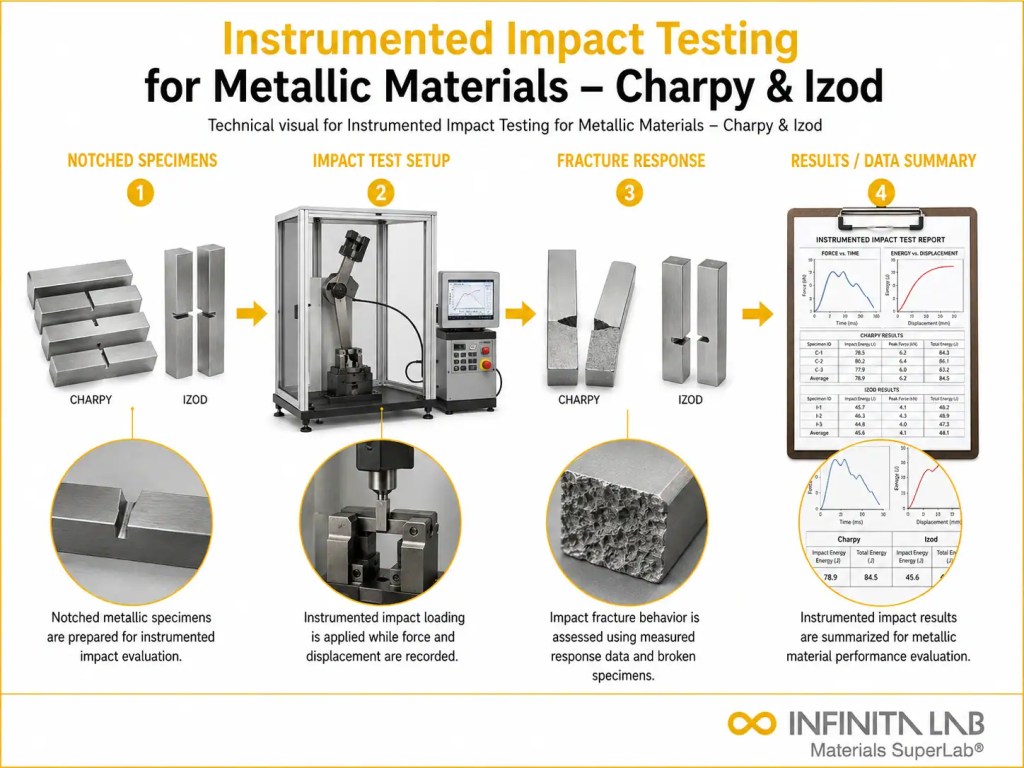


What Is Instrumented Impact Metallic Materials?
Instrumented Impact Testing of metallic materials is an advanced mechanical testing method used to evaluate a material’s behavior under high strain rate conditions. Unlike conventional impact tests, it records force, energy, and displacement throughout the impact event, providing deeper insights into fracture behavior, toughness, and energy absorption characteristics of metals.
This testing method is widely used in industries such as automotive, aerospace, and construction to assess material performance under sudden loading conditions. It helps identify brittle or ductile failure modes, supports material selection, and ensures compliance with safety and performance standards for critical engineering applications.
Applications and Benefits of Instrumented Impact Metallic Materials Testing
Scope
Instrumented Impact Testing measures the dynamic response of metallic materials under sudden impact loading, capturing detailed data on force and energy during fracture. It is used for evaluating toughness and failure characteristics.
- Applicable to ferrous and non-ferrous metals
- Evaluates impact strength and fracture behavior
- Captures force-displacement and energy data
- Supports material qualification and R&D
- Ensures compliance with testing standards
Applications
- Automotive crashworthiness analysis
- Aerospace material qualification
- Structural steel evaluation
- Weld and joint performance testing
- Failure and fracture analysis
Benefits
- Provides detailed impact behavior data
- Differentiates ductile and brittle fracture modes
- Enhances material selection accuracy
- Supports advanced failure analysis
- Improves safety and product reliability
Our Testing Procedure
Specimen Preparation
Standard notched specimens are machined and conditioned as per testing requirements.
1Instrument Setup
The impact tester is calibrated and equipped with sensors to record force and energy.
2Impact Testing
The pendulum strikes the specimen and records force, displacement, and absorbed energy.
3Data Analysis
Recorded data is analyzed to evaluate toughness, fracture characteristics, and material behavior.
4Test parameters and requirements
| Parameter | Details |
|---|---|
| Test type | Charpy or Izod instrumented impact test |
| Specimen | Notched metallic samples (V-notch or U-notch) |
| Energy range | Typically up to 300 J or higher |
| Measurement | Force, energy, velocity, and displacement |
| Data output | Force-time, energy-time, and force-displacement curves |
| Temperature | Ambient or sub-zero testing conditions |


- Instrumented impact testing machine (Charpy/Izod)
- Pendulum hammer with sensors
- Data acquisition system
- Temperature chamber (if required)
- Specimen preparation tools
Equipment and Instrumentation Used for Testing
What You Receive: Test Report, Data, and Certification
- Absorbed impact energy values
- Force-displacement and energy-time curves
- Fracture behavior analysis
- Test report with compliance status
- Graphical representation of impact data
Instrumented Impact Metallic Materials FAQs
Instrumented impact testing measures how metals behave under sudden loading by recording force, energy, and displacement during fracture. It provides detailed insights into toughness, ductility, and failure characteristics beyond conventional impact testing methods.
Unlike standard tests that measure only absorbed energy, instrumented testing records the entire impact event. It provides detailed data such as force-time and energy-displacement curves, enabling better understanding of crack initiation and propagation.
It is important for understanding how materials behave under dynamic conditions. The detailed data helps engineers design safer structures, select appropriate materials, and prevent failures in critical applications.
The notch creates a stress concentration point, promoting crack initiation during impact. This helps simulate real-world conditions and allows accurate evaluation of material fracture toughness and failure behavior.
Yes, testing can be conducted at ambient, sub-zero, or elevated temperatures. Temperature variation helps evaluate material behavior under different environmental conditions, especially for applications exposed to extreme climates.
Why Choose Infinita Lab for Instrumented Impact Metallic Materials Testing?
When your Instrumented Impact Metallic Materials results have to hold up - for compliance, a customer audit, or an engineering decision - accuracy and an unbiased third-party report matter more than price. Infinita Lab routes your instrumented impact metallic materials testing to ISO/IEC 17025-accredited U.S. partner labs with hands-on method experience, so you get defensible data, transparent reporting, and turnaround times built around your project deadline - not ours.

Looking for an Accredited Partner for Instrumented Impact Metallic Materials Testing?
Send query us at hello@infinitalab.com or call us at (888) 878-3090 to learn more about our services and how we can support you.



