


HALT HASS Testing Services
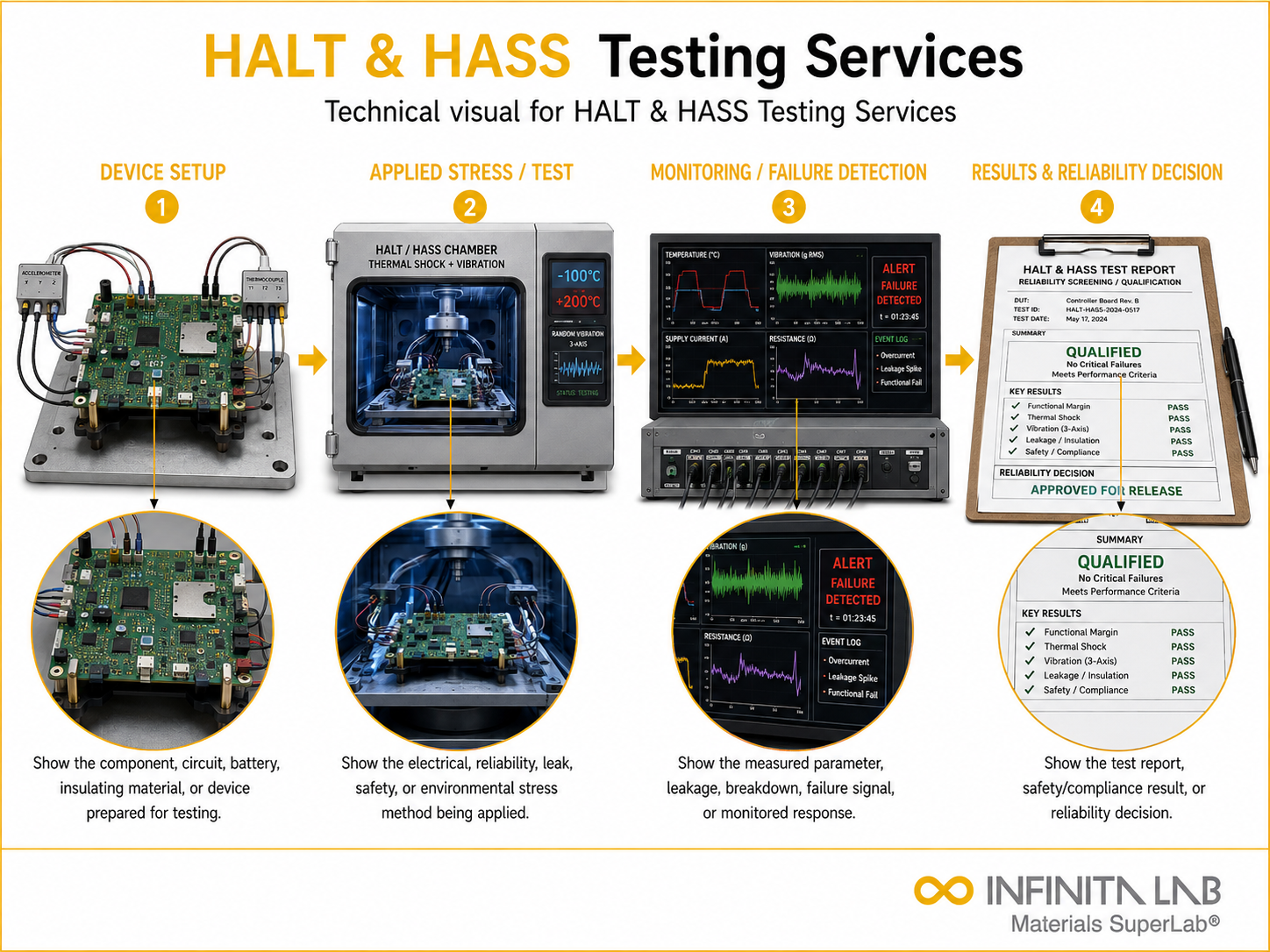
A product’s design and manufacturing flaw is tested using the techniques known as Highly Accelerated Life Testing (HALT) and Highly Accelerated Stress Screening (HASS). HALT is performed on products and components during the design phase before production, and HASS is carried out once the product is prepared for manufacturing. These tests assess any flaws that might emerge in the product during production. According to the needs of clients in the USA and other nations, Infinita Lab professionals design the finest plans to carry out accelerated life tests.
TRUSTED BY


Get compliant results — request your HALT HASS testing quote
- Overview
- Scope, Applications, and Benefits
- Test Process
- Specifications
- Instrumentation
- Results and Deliverables
What Is HALT HASS?
Highly Accelerated Life Testing (HALT) and Highly Accelerated Stress Screening (HASS) are reliability techniques that apply aggressive, combined thermal and vibration stress to electronic and electromechanical products – deliberately pushing well beyond specification limits to expose design weaknesses and latent manufacturing defects quickly and efficiently. Where conventional environmental testing confirms a product survives its rated environment, HALT and HASS go further: they stress until something fails, revealing the weakest points of the design or production process so they can be fixed before products reach the field.
HALT is a development-phase technique. A small number of samples are subjected to rapidly changing temperatures and six-degree-of-freedom (6-DoF) vibration, stepping the stress levels progressively higher until failures occur. The goal is not to pass a test, but to find failures – and the test intentionally pushes the product to its operating limit (the highest stress at which it still functions) and then to its destruct limit (where it fails permanently). These margins define how robust the design is, and each failure discovered and corrected during HALT is one fewer failure in the field.
HASS takes the knowledge gained from HALT and applies it as a production screen. Once a HASS profile is developed and shown not to damage good product, it is applied to every unit or batch coming off the production line. At stress levels below the design’s operating and destruct limits but above what the product will see in service, HASS precipitates and detects latent defects – marginal solder joints, out-of-tolerance components, workmanship errors – before they escape to the customer. Both HALT and HASS are performed in a combined stress chamber that can apply rapid thermal cycling and broadband 6-DoF vibration simultaneously.

Applications and Benefits of HALT HASS Testing
Scope
HALT and HASS apply combined thermal and vibration stress – in a dedicated chamber capable of rapid temperature change and 6-DoF vibration – to find design weaknesses (HALT) and screen production for latent defects (HASS).
Key aspects of the scope include:
- HALT stresses – cold step stress, hot step stress, rapid thermal transitions, vibration step stress, and combined thermal plus vibration stress, stepped progressively to find operating and destruct limits
- HASS stresses – a defined thermal cycling and vibration profile derived from HALT results, applied as a production screen at stress levels shown not to damage conforming product
- 6-DoF vibration – the HALT/HASS chamber applies broadband vibration in all six degrees of freedom simultaneously (three translational, three rotational), which is far more stimulating than single-axis vibration
- Rapid thermal transitions – temperature change rates far exceeding those of conventional temperature-cycling chambers (typically 60°C/min or more), which dramatically amplifies thermal stress
- Operating limit – the highest stress level at which the product still functions (with recovery)
- Destruct limit – the stress level at which the product sustains permanent failure
- HASS profile development and validation – the HASS stress profile must be proven not to consume product life or damage conforming units before it is applied in production
- Functional monitoring – the product is powered and exercised throughout both HALT and HASS so that failures are detected in real time
Applications
- Electronics design validation – finding the weakest points in a circuit board, module, or assembly design during development, before design freeze
- New product introduction – using HALT at the prototype stage to discover and fix vulnerabilities before tooling, with the widest opportunity to implement design changes
- Production defect screening – applying HASS to every production unit or batch to catch latent defects (solder bridges, cold joints, out-of-tolerance components, connector seating issues) before shipment
- Automotive electronics – HALT and HASS for automotive control modules and electronic components that must survive harsh vehicle environments
- Aerospace and defense equipment – reliability stress testing of avionics and defense electronics, where field failure consequences are severe
- Medical devices – finding latent weaknesses in implantable and capital medical electronics during development and production
- Consumer and industrial electronics – improving product reliability for competitive markets where warranty cost and reputation are at stake
- Component and subassembly screening – applying HASS at the subassembly level to detect defects before integration into a larger system
Benefits
- Finds failures in days, not months – by applying stress far beyond normal use levels, HALT exposes weaknesses in a short test that would take months or years of field use to surface
- Requires very few samples – HALT can deliver meaningful results from two to five units, far fewer than conventional reliability tests, making it practical at the prototype stage
- Fixes problems when it is cheapest – a design change in HALT during development costs far less than a field recall or warranty repair after launch
- 6-DoF vibration is highly stimulating – simultaneous multi-axis vibration excites more modes and finds more weaknesses than single-axis testing, especially for connectors, solder joints, and mechanical attachments
- HASS screens out latent defects before shipment – catching defects in production before they reach customers reduces warranty claims, returns, and the reputation damage of early-life failures
- Establishes design robustness margins – knowing the operating and destruct limits tells the engineering team how much design margin the product has against its rated specification, and where the risk lies
Our Testing Procedure
Set Up Monitoring
Power and connect the product for continuous functional monitoring during testing.
1Perform HALT
Apply increasing temperature and vibration stresses to identify operating limits, destruct limits, and design weaknesses.
2Perform HASS
Apply the validated HALT-based screen to production units to detect latent manufacturing defects.
3Analyse and Report
Document stress limits, failures, root causes, corrective actions, screen profile, and detected defects.
4Test parameters and requirements
| Parameter | Details |
|---|---|
| Chamber Type | Combined thermal + 6-DoF vibration (HALT/HASS chamber) |
| Temperature Range | Typically −100°C to +200°C (chamber-dependent) |
| Thermal Transition Rate | Typically ≥60°C/min (far exceeding conventional cycling chambers) |
| Vibration Type | 6-DoF broadband (three translational, three rotational axes simultaneously) |
| HALT Output | Operating limits, destruct limits, failure modes, root causes |
| HASS Output | Production screen results, defects precipitated and detected |
| Sample Requirement | HALT: 2–5 units typical; HASS: all production units or agreed sample |
| Profile Validation | HASS profile proven not to damage conforming product (proof-of-screen) |


- HALT/HASS combined stress chamber (rapid thermal + 6-DoF vibration)
- Automated functional test equipment for continuous product monitoring
- Temperature measurement and data logging (thermocouples)
- Vibration control and monitoring system
- Power supply and signal conditioning for the product under test
- Failure analysis equipment for root cause investigation
Equipment and Instrumentation Used for Testing
What You Receive: Test Report, Data, and Certification
- HALT report – the operating and destruct limits found for cold, hot, vibration, and combined stress; each failure with the stress level, failure mode, root cause, and corrective action implemented
- HASS report – the screen profile used, the number of units screened, any defects precipitated and detected, and the disposition of failed units
- Operating and destruct limit summary – tabulation of the stress margins found, showing how much design headroom exists above the rated operating environment
- Failure mode analysis – documented root causes for failures found in HALT, supporting design improvement decisions
- HASS profile documentation – the developed and validated HASS profile for ongoing production use
- Functional monitoring records – logs of product functional state throughout the test, with timestamps at failure events
HALT HASS FAQs
HALT is performed during product development to identify design and component weaknesses before production. It helps establish operating limits, destruct limits and areas requiring design improvement.
Testing commonly combines rapid temperature changes, high and low temperatures, and multi-axis random vibration. Electrical power cycling, voltage variation and functional loading may also be included.
The product is operated while temperature and vibration stresses are progressively increased in controlled steps. Testing continues until functional limits, recoverable failures or destructive limits are identified.
Testing may reveal weak solder joints, loose connectors, component overheating, resonance, intermittent circuits and assembly defects. Software resets and performance instability may also be detected.
HALT explores product limits and is not normally a pass-or-fail compliance test. Qualification testing verifies performance against predefined environmental conditions or industry requirements.
Why Choose Infinita Lab for HALT HASS Testing
At the core of this breadth is our network of 2,000+ accredited laboratories across the USA, offering access to over 10,000 testing methods and analytical services. From advanced materials characterization (SEM, TEM, RBS, XPS) to mechanical, chemical, environmental, biological, and standardized ASTM/ISO-compliant testing, we deliver unmatched flexibility, specialization, and scale. You are never limited by geography, facility, or methodology — Infinita Lab connects you to the right expertise and testing solution, every time.

Looking for an Accredited Partner for HALT HASS Testing?
Send query us at hello@infinitalab.com or call us at (888) 878-3090 to learn more about our services and how we can support you.



Request a Quote
Submit your material details and receive testing procedures, pricing, and turnaround time within 24 hours.
 Quick Turnaround and Hasslefree process
 Confidentiality Guarantee
 Free, No-obligation Consultation
 100% Customer Satisfaction
