


Failure Prevention Analysis Testing Services
Know more about what can be done to correct or prevent failure and to outline any potential product liabilities.
TRUSTED BY


Get compliant results — request your failure prevention analysis testing quote
- Overview
- Scope, Applications, and Benefits
- Test Process
- Specifications
- Instrumentation
- Results and Deliverables
What Is Failure Prevention Analysis?
Failure prevention analysis focuses on identifying potential failure mechanisms in materials, components, and systems before they occur. The approach uses testing, inspection, and analytical methods to detect weaknesses, design flaws, or process-related issues that may lead to failure under service conditions.
This analysis is widely applied across industries such as aerospace, automotive, manufacturing, and electronics. It helps improve reliability, enhance product performance, and reduce the risk of unexpected breakdowns by implementing preventive measures during design and production stages.

Applications and Benefits of Failure Prevention Analysis Testing
Scope
Failure prevention analysis evaluates materials and components to identify potential risks and implement corrective actions before failure occurs. The process integrates testing, inspection, and root cause analysis techniques.
The analysis evaluates:
- Potential failure modes and mechanisms
- Material defects and structural weaknesses
- Effects of stress, fatigue, and environmental conditions
- Process-related inconsistencies and defects
- Design limitations and performance risks
Applications
- Aerospace and defense components
- Automotive systems and parts
- Industrial machinery and equipment
- Electronic devices and assemblies
- Structural and load-bearing materials
- Product design validation and reliability testing
Benefits
- Reduces risk of unexpected failures
- Improves product reliability and lifespan
- Supports proactive maintenance strategies
- Assists in optimizing design and manufacturing processes
- Minimizes downtime and repair costs
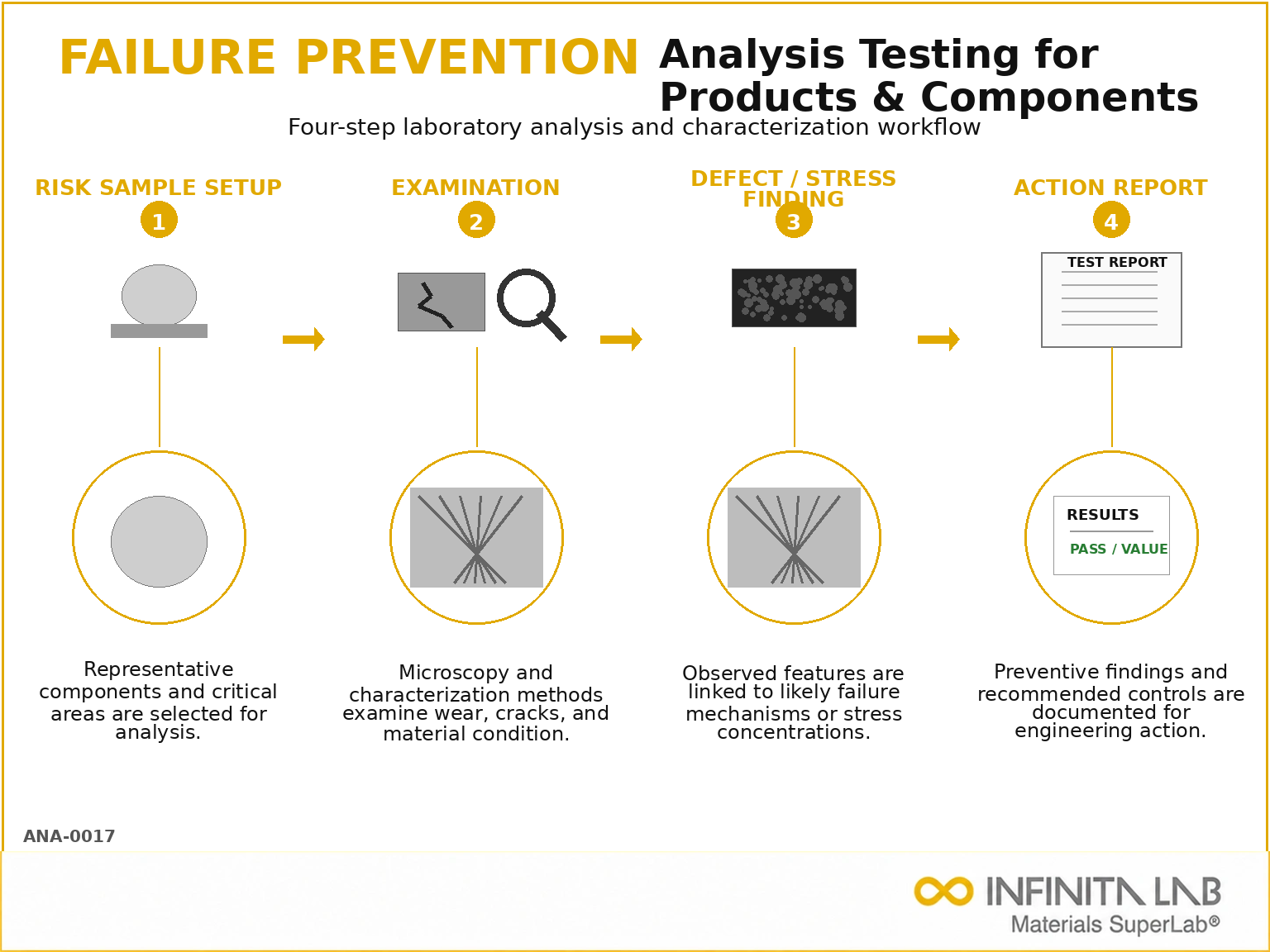
Our Testing Procedure
Risk Identification
Potential failure modes and critical stress points are identified based on design and usage conditions.
1Material and Component Evaluation
Samples are tested under simulated conditions to assess performance limits.
2Stress and Environmental Testing
Components are exposed to mechanical, thermal, or environmental stresses.
3Data Recording & Evaluation
Results are analyzed to identify weaknesses and recommend preventive measures.
4Test parameters and requirements
| Parameter | Details |
|---|---|
| Applicable Materials | Metals, polymers, composites, electronic components |
| Stress Range | Static to cyclic loading (up to 10⁶ cycles typical) |
| Temperature Range | -40°C to 150°C (application dependent) |
| Testing Methods | Fatigue, thermal, corrosion, and mechanical testing |
| Evaluation Criteria | Failure modes, stress limits, degradation behavior |
| Measured Outputs | Performance limits, defect identification, risk factors |


- Universal testing machine
- Fatigue testing system
- Environmental test chambers
- Microscopy and surface analysis tools
- Non-destructive testing equipment
- Data acquisition and monitoring systems
Equipment and Instrumentation Used for Testing
What You Receive: Test Report, Data, and Certification
- Identified failure modes and risk factors
- Material and component performance data
- Preventive action recommendations
- Comparative reliability analysis
- Test condition summary
- ASTM compliance report
Failure Prevention Analysis FAQs
Failure prevention analysis includes material selection, load conditions, environmental factors, design safety margins, and inspection intervals, helping identify risks and implement measures to avoid premature failure in components and systems.
Failure prevention ensures reliability, safety, and cost efficiency by identifying potential weaknesses early, reducing downtime, preventing accidents, and improving product lifespan across critical applications.
Failure prevention uses methods such as failure mode and effects analysis, root cause analysis, stress analysis, reliability testing, and predictive maintenance techniques.
Failure prevention is critical in aerospace, automotive, manufacturing, energy, and infrastructure industries where component reliability and safety are essential.
Failure prevention analysis relies on assumptions, historical data, and modeling, which may not fully capture unexpected conditions, requiring continuous monitoring and validation during actual service conditions.
Why Choose Infinita Lab for Failure Prevention Analysis Testing?
At the core of this breadth is our network of 2,000+ accredited laboratories across the USA, offering access to over 10,000 testing methods and analytical services. From advanced materials characterization (SEM, TEM, RBS, XPS) to mechanical, chemical, environmental, biological, and standardized ASTM/ISO-compliant testing, we deliver unmatched flexibility, specialization, and scale. You are never limited by geography, facility, or methodology — Infinita Lab connects you to the right expertise and testing solution, every time.

Looking for an Accredited Partner for Failure Prevention Analysis Testing?
Send query us at hello@infinitalab.com or call us at (888) 878-3090 to learn more about our services and how we can support you.



Request a Quote
Submit your material details and receive testing procedures, pricing, and turnaround time within 24 hours.
 Quick Turnaround and Hasslefree process
 Confidentiality Guarantee
 Free, No-obligation Consultation
 100% Customer Satisfaction
