


Ceramic Trans Thickness Tensile Strength Testing Services
The test for trans-thickness tensile strength of advanced ceramics is a mechanical testing method used to evaluate the tensile strength of a ceramic material perpendicular to its plane or trans-thickness direction. This type of test is important for assessing the performance of ceramic materials in applications that require high trans-thickness strength, such as in armor or cutting tools.
TRUSTED BY


Ceramic Trans-Thickness Tensile Strength
- Overview
- Scope, Applications, and Benefits
- Test Process
- Specifications
- Instrumentation
- Results and Deliverables
Ceramic Trans-Thickness Tensile Strength Overview
Trans-thickness tensile (TTT) strength testing measures the stress required to fracture a ceramic specimen when tension is applied perpendicular to its primary plane – through the thickness of a flat plate or coating layer. This loading direction is distinct from the in-plane tensile and flexural tests more commonly applied to ceramics, and it characterizes a failure mode that is critical for layered ceramic structures, thermal barrier coatings, ceramic laminates, and bonded ceramic assemblies where delamination or through-thickness fracture is the governing failure mode.
The test is performed by bonding the flat faces of a ceramic disc or rectangular specimen to cylindrical loading fixtures using a high-strength adhesive, then applying uniaxial tensile force perpendicular to the ceramic face until fracture. The measured failure load divided by the bonded area gives the trans-thickness tensile strength. Because the adhesive bond must be stronger than the ceramic in order to obtain a valid ceramic fracture, adhesive selection and surface preparation are critical aspects of the test setup. Invalid tests where the adhesive rather than the ceramic fails must be excluded from the dataset.
Trans-thickness tensile strength is particularly relevant for thermal barrier coatings applied to turbine components, multilayer ceramic electronic substrates, ceramic armor plates, ceramic-to-metal bonded assemblies, and ceramic foam and honeycomb structures. In all these cases, the through-thickness direction experiences tensile stresses from thermal gradients, mechanical pressure, or processing residual stresses, and the TTT strength governs whether delamination or layer separation will occur.

Applications and Benefits of Ceramic Trans Thickness Tensile Strength Testing
Scope
Trans-thickness tensile testing applies to monolithic technical ceramics, ceramic coatings and thermal barrier systems, layered ceramic laminates, and ceramic-to-metal bonded assemblies where the through-thickness tensile strength is a design or qualification parameter. Evaluation areas include:
- Through-thickness tensile strength of monolithic ceramic plates and discs
- Tensile adhesion strength of ceramic thermal barrier coatings
- Delamination resistance of ceramic laminates and multilayer systems
- Bond strength of ceramic-to-metal brazed or adhesive-bonded joints
- Effect of sintering and processing conditions on TTT strength
- Strength retention after thermal cycling and environmental exposure
Applications
- Thermal barrier coating qualification for turbine and combustor components
- Ceramic armor plate bonded assembly evaluation
- Electronic ceramic substrate and LTCC laminate characterization
- Ceramic-to-metal brazed joint qualification
- Ceramic foam and honeycomb structural core evaluation
- Research and development for new layered ceramic material systems
Benefits
- Measures the failure mode specific to through-thickness and delamination loading
- Identifies processing defects and weak interfaces not detectable by in-plane tests
- Directly relevant to thermal barrier coating and ceramic laminate service conditions
- Provides design data for through-thickness stress allowable calculations
- Failure mode examination distinguishes ceramic fracture from interface failure
- Applicable to coatings, bulk ceramics, and layered assemblies
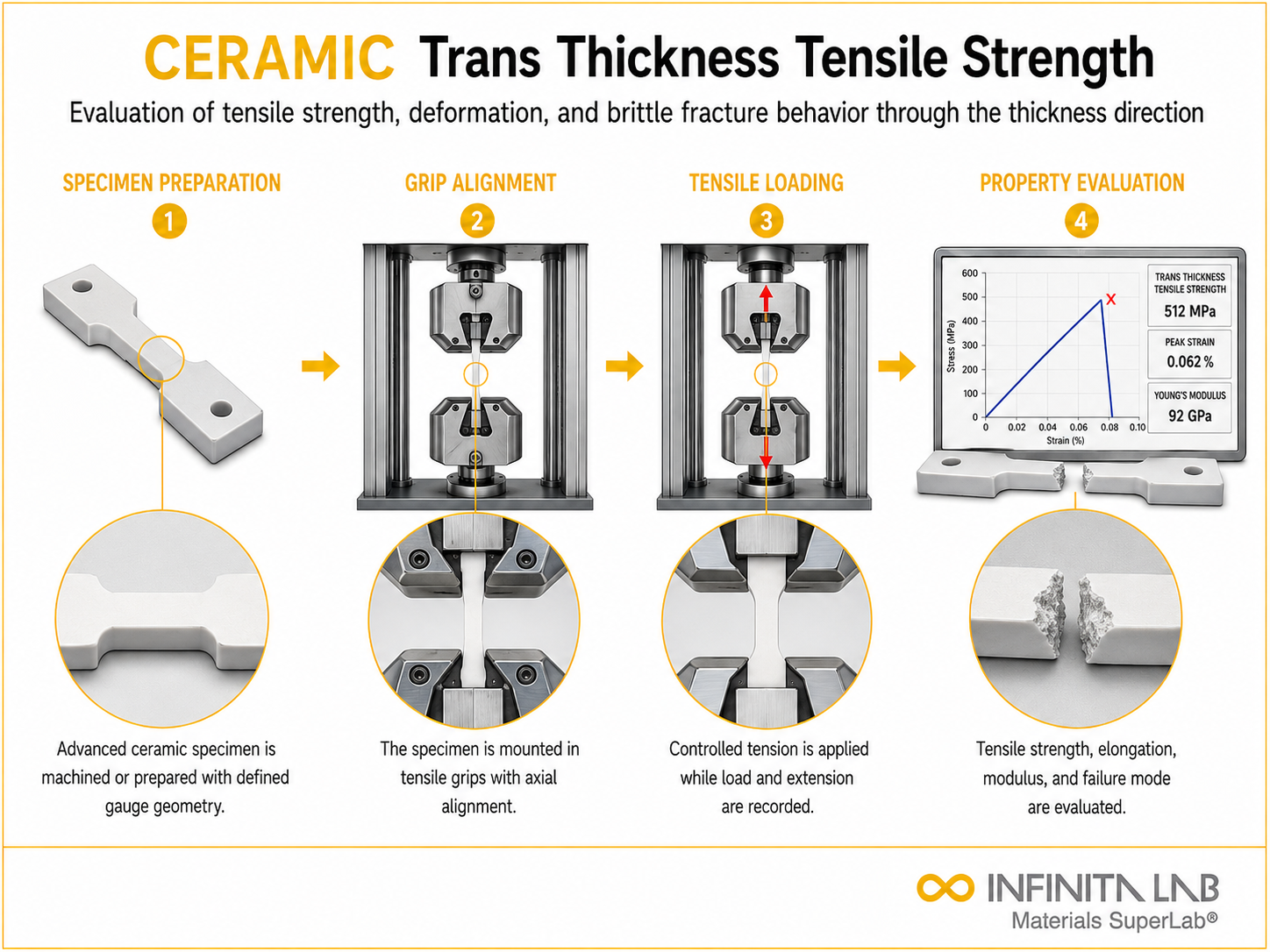
Our Testing Procedure
Specimen Preparation
Ceramic specimens are machined to flat-parallel disc or rectangular form.
1Fixture Bonding
High-strength adhesive is applied between the ceramic faces and the cylindrical loading fixtures.
2Tensile Loading to Fracture
The bonded assembly is mounted in the tensile testing machine and loaded at the specified crosshead speed until fracture.
3Failure Mode Verification
Fractured surfaces are examined to confirm that fracture occurred within the ceramic or at the ceramic interface
4Test parameters and requirements
| Parameter | Details |
|---|---|
| Loading Direction | Perpendicular to the primary plane of the ceramic specimen (through-thickness) |
| Applicable Standards | ASTM C1399 (adapted), manufacturer and aerospace OEM procedures |
| Applicable Materials | Monolithic ceramics, ceramic coatings, ceramic laminates, ceramic-to-metal joints |
| Bonding Adhesive | High-strength structural adhesive with strength exceeding ceramic TTT strength |
| Output Units | MPa (force per unit bonded area) |
| Validity Criterion | Fracture must occur in ceramic or at ceramic interface, not in adhesive |


- Universal tensile testing machine with precision load cell
- Cylindrical loading fixtures with bonding faces
- Lapping and polishing equipment for specimen face preparation
- Adhesive bonding assembly fixtures for alignment control
- Optical microscope for failure mode characterization
- Data acquisition software
Equipment and Instrumentation Used for Testing
What You Receive: Test Report, Data, and Certification
- Trans-thickness tensile strength for each valid specimen
- Failure mode classification (ceramic fracture, interface delamination, or invalid adhesive failure)
- Photographic documentation of fracture surfaces
- Statistical summary and Weibull analysis where population data is available
- Specimen geometry and surface preparation records
- Quality assurance documentation
Ceramic Trans Thickness Tensile Strength FAQs
It measures the tensile strength of advanced ceramics perpendicular to their plane, ensuring reliability for demanding applications.
Continuous fiber-reinforced ceramic matrix composites and other advanced ceramics.
A mechanical testing machine or hydraulic press with appropriate mounting and load application fixtures.
It ensures material performance in critical applications like armor or cutting tools.
Axial tensile strength, elastic modulus, flexibility, and failure modes.
Why Choose Infinita Lab for Ceramic Trans Thickness Tensile Strength Testing?
At the core of this breadth is our network of 2,000+ accredited laboratories across the USA, offering access to over 10,000 testing methods and analytical services. From advanced materials characterization (SEM, TEM, RBS, XPS) to mechanical, chemical, environmental, biological, and standardized ASTM/ISO-compliant testing, we deliver unmatched flexibility, specialization, and scale. You are never limited by geography, facility, or methodology — Infinita Lab connects you to the right expertise and testing solution, every time.

Looking for an Accredited Partner for Ceramic Trans Thickness Tensile Strength Testing?
Send query us at hello@infinitalab.com or call us at (888) 878-3090 to learn more about our services and how we can support you.



Request a Quote
Submit your material details and receive testing procedures, pricing, and turnaround time within 24 hours.
 Quick Turnaround and Hasslefree process
 Confidentiality Guarantee
 Free, No-obligation Consultation
 100% Customer Satisfaction
