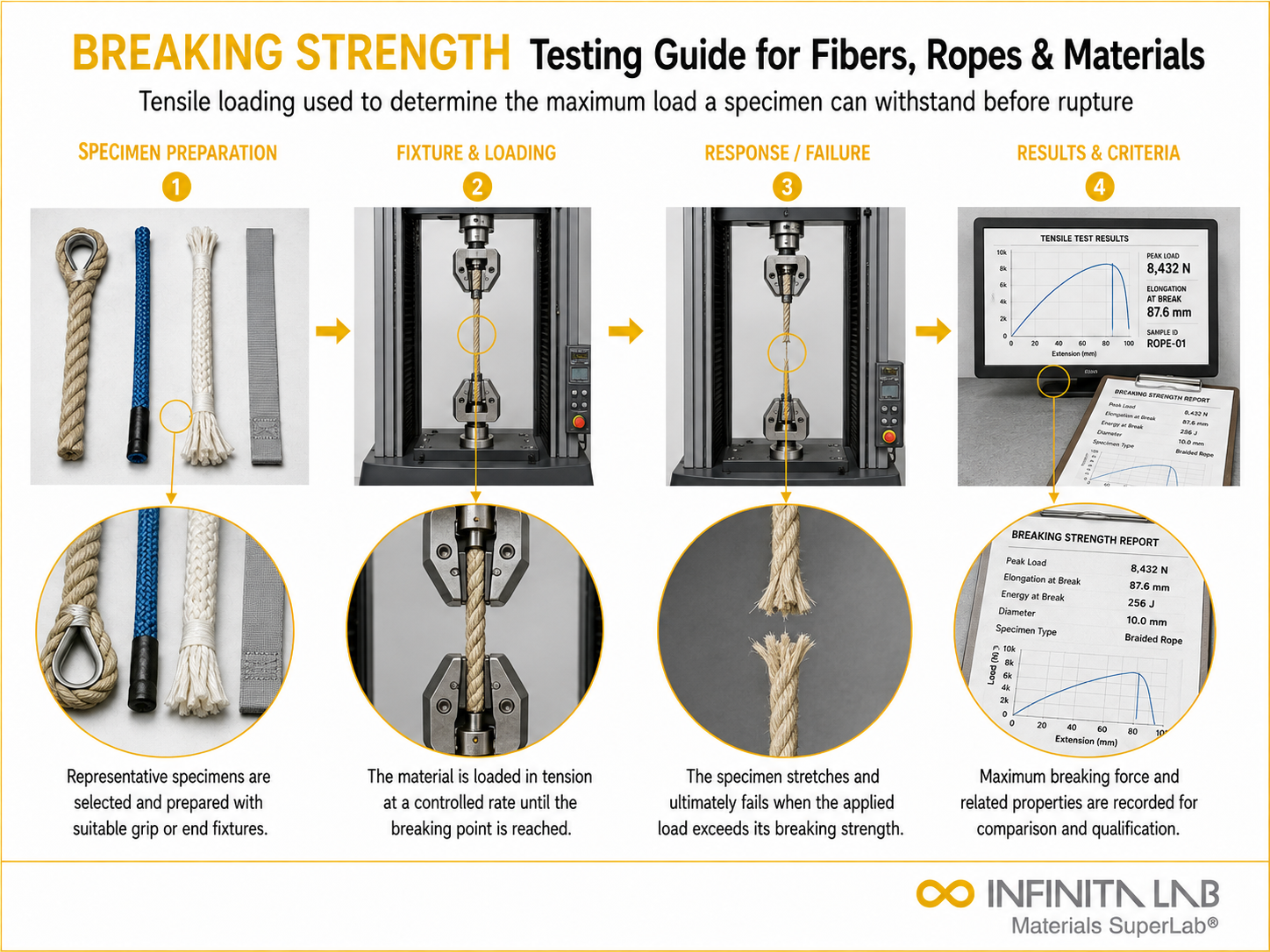


What Is Breaking Strength Guide?
Breaking strength is a fundamental mechanical property that defines the maximum load a material can withstand before failure or rupture. It is widely used to evaluate the strength and reliability of materials such as textiles, polymers, metals, and composites under tensile or applied stress conditions.
The test provides critical insight into material performance under load, helping determine suitability for structural, industrial, and consumer applications. It is essential for quality control, product development, and ensuring safety in load-bearing applications.

Applications and Benefits of Breaking Strength Guide Testing
Scope
Breaking strength testing defines a procedure to measure the maximum force required to break a material specimen under controlled loading conditions. It evaluates the ultimate strength and failure behavior of materials subjected to tensile or mechanical stress.
The method supports comparison of material strength and performance across different samples and conditions.
- Measurement of maximum load before material failure
- Evaluation of tensile strength and rupture behavior
- Assessment of material durability under applied stress
- Comparison of strength across different materials
- Determination of structural integrity and reliability
- Standardized mechanical performance evaluation
Applications
- Textile and fabric strength testing
- Plastic and polymer material evaluation
- Metal wire and cable testing
- Packaging material strength assessment
- Composite material performance evaluation
- Quality control in manufacturing
- Product durability and safety validation
Benefits
- Provides critical data on material load-bearing capacity
- Helps ensure product safety and reliability
- Supports material selection and design optimization
- Enables comparison of different material types
- Improves quality control processes
- Reduces risk of mechanical failure in applications
Our Testing Procedure
Sample Preparation
Specimens are cut and conditioned to specified dimensions to ensure uniformity and repeatability.
1Fixture Setup
The sample is mounted in grips of a testing machine, ensuring proper alignment to avoid uneven stress distribution.
2Load Application
A controlled tensile load is applied at a constant rate until the material reaches failure.
3Failure Recording
The maximum force at rupture is recorded as the breaking strength of the material.
4Breaking Strength Test – Technical Specification
| Parameter | Details |
|---|---|
| Standard | Based on material-specific standards |
| Method | Tensile loading until rupture |
| Measurement Type | Maximum load (breaking strength) |
| Sample Type | Textiles, polymers, metals, composites |
| Loading Type | Uniaxial tensile loading |
| Measurement Basis | Force at point of failure |
| Units | Newton (N), kilogram-force (kgf), or pound-force (lbf) |


- Universal Testing Machine (UTM)
- Tensile grips or clamps
- Load cell for force measurement
- Extensometer (optional for elongation)
- Specimen cutting tools
- Alignment fixtures
- Data acquisition system
Equipment and Instrumentation Used for Testing
What You Receive: Test Report, Data, and Certification
- Breaking strength value (maximum load)
- Load vs elongation curve
- Failure mode analysis
- Material comparison data
- Test report as per applicable standard
- Quality control documentation
- Product performance evaluation
- Recommendations for material improvement
Breaking Strength Guide FAQs
Breaking strength refers to the maximum load a specimen withstands before failure, while tensile strength is normalized by cross-sectional area. Thus, tensile strength reflects material property, whereas breaking strength depends on specimen geometry.
Without accounting for area, breaking strength cannot be compared across samples. Larger cross-sections naturally sustain higher loads, so normalization is required for material-level comparisons.
Higher strain rates can increase apparent strength due to limited time for molecular or microstructural rearrangement, while slower rates may allow creep or defect growth, reducing measured strength.
Ductile materials deform significantly before failure, redistributing stress, while brittle materials fail abruptly. This affects both the measured strength and the failure mode observed during testing.
A high breaking strength material can withstand large loads before failure, typically exhibiting strong bonding, minimal defects, and optimized microstructure for load-bearing applications.
A breaking strength test measures the maximum force a material or component can withstand before it fractures or ruptures. A specimen is secured in a testing machine, and force is applied at a controlled rate until failure occurs. The maximum recorded force indicates breaking strength and helps assess material durability, product quality, and suitability for its intended application.
Breaking strength is commonly expressed in newtons (N), kilonewtons (kN), or pounds-force (lbf), depending on the material and testing method. When strength is calculated relative to a specimen's cross-sectional area, it is expressed as stress, typically in megapascals (MPa) or pounds per square inch (psi). The appropriate unit depends on whether the result represents total breaking force or strength per unit area.
Break strength represents the maximum force a material can withstand before it breaks under specified testing conditions. A specimen is subjected to a controlled tensile, tear, or other relevant load until failure occurs. The recorded breaking force helps assess material strength, durability, and suitability for its intended application. For example, textile breaking strength is commonly measured using a tensile testing machine under standards such as ASTM D5034.
Why Choose Infinita Lab for Breaking Strength Guide Testing
When your Breaking Strength Guide results have to hold up - for compliance, a customer audit, or an engineering decision - accuracy and an unbiased third-party report matter more than price. Infinita Lab routes your breaking strength guide testing to ISO/IEC 17025-accredited U.S. partner labs with hands-on method experience, so you get defensible data, transparent reporting, and turnaround times built around your project deadline - not ours.

Looking for an Accredited Partner for Breaking Strength Guide Testing?
Send query us at hello@infinitalab.com or call us at (888) 878-3090 to learn more about our services and how we can support you.





