


ASTM F218: Glass Optical Retardation Stress Testing Services
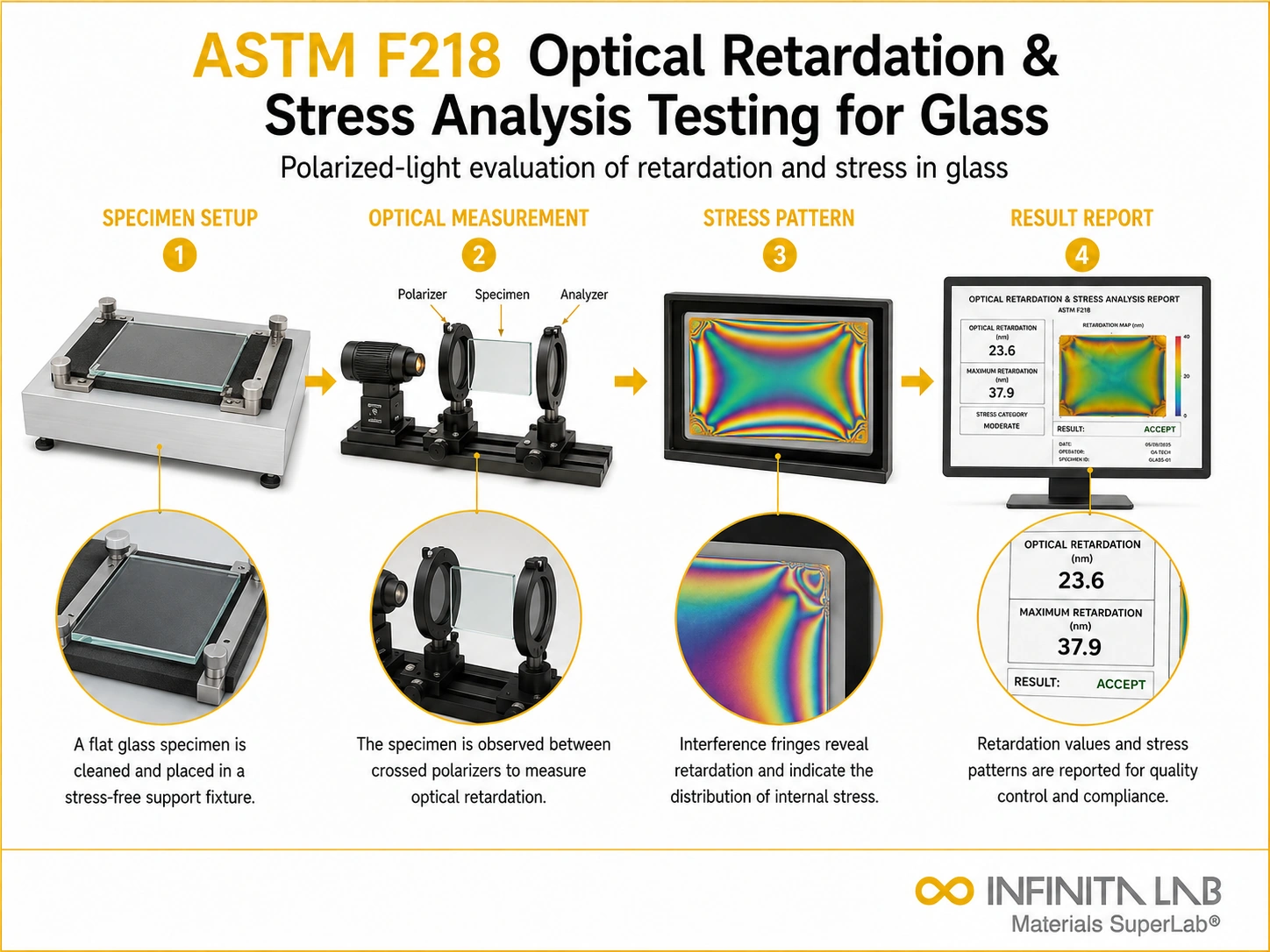
ASTM F218 provides the analysis of stress in glass using a polarimeter. Stress is estimated as a function of optical retardation, expressed as the angle of rotation of an analyzing polarizer that affects extinction in the glass. In this test procedure, a Polarimeter is used for analyzing stress & optical retardation.
TRUSTED BY


Get ASTM F218 compliant results — request your glass optical retardation stress testing quote
- Overview
- Scope, Applications, and Benefits
- Test Process
- Specifications
- Instrumentation
- Results and Deliverables
What Is ASTM F218 Glass Optical Retardation Stress?
ASTM F218 is used to evaluate optical retardation in glass to determine internal stress distribution. The test measures the change in light transmission through glass under polarized light, which reveals stress patterns caused by manufacturing processes such as cooling, forming, or tempering.
This method is widely used for quality control and failure analysis of glass products. By identifying stress concentrations and birefringence effects, the test helps ensure that glass components maintain structural integrity and optical performance in service.

Applications and Benefits of ASTM F218 Glass Optical Retardation Stress Testing
Scope
ASTM F218 evaluates internal stresses in glass by measuring optical retardation using polarized light techniques. The test determines the stress magnitude and distribution by analyzing variations in the interference patterns of light within the glass specimen.
ASTM F218 evaluates:
- Optical retardation caused by internal stress in glass
- Stress distribution across glass components
- Birefringence effects under polarized light
- Residual stress from manufacturing processes
- Structural integrity related to internal stress levels
Applications
- Tempered and annealed glass products
- Optical glass and display panels
- Architectural and automotive glass
- Glass used in electronic devices
- Quality control in glass manufacturing
- Failure analysis of glass components
Benefits
- Provides a standardized evaluation of internal glass stress
- Helps identify stress concentrations and defects
- Supports quality control of glass manufacturing processes
- Assists in improving product reliability and durability
- Enables comparison of stress levels across glass materials
Our ASTM F218 Testing Procedure
Sample Preparation
Glass specimens are cleaned and positioned for optical analysis under controlled lighting conditions.
1Polarized Light Exposure
The specimen is placed between polarizing filters to reveal stress patterns through light interaction.
2Optical Measurement
Retardation values are measured based on light interference and birefringence effects.
3Data Recording & Evaluation
Stress distribution and magnitude are analyzed from optical retardation data.
4ASTM F218 Test Parameters and Requirements
| Parameter | Details |
|---|---|
| Applicable Materials | Glass and transparent materials |
| Measurement Method | Polarized light optical analysis |
| Specimen Condition | Clean, transparent glass specimen |
| Evaluation Basis | Optical retardation and birefringence |
| Analysis Output | Stress distribution and magnitude |
| Measured Outputs | Optical retardation values and stress patterns |


- Polarized light microscope or polariscope
- Light source with polarizing filters
- Optical measurement system
- Sample holding fixtures
- Calibration standards
- Data analysis software
Equipment and Instrumentation Used for ASTM F218 Testing
What You Receive: Test Report, Data, and Certification
- Optical retardation values
- Stress distribution analysis
- Birefringence pattern observations
- Glass integrity evaluation
- Test condition summary
- Compliance report
ASTM F218 Glass Optical Retardation Stress FAQs
ASTM F218 measures optical retardation in glass using polarized light, helping evaluate internal stresses by analyzing birefringence patterns and determining stress distribution within glass components under controlled optical testing conditions.
Stress in glass can lead to distortion, reduced strength, or failure. ASTM F218 helps identify internal stress patterns, ensuring glass components meet quality and safety requirements for structural and optical applications.
ASTM F218 evaluates optical retardation, birefringence, stress magnitude, and stress distribution within glass, providing quantitative and qualitative data for assessing internal stress conditions.
ASTM F218 is commonly applied to architectural glass, optical glass, tempered glass, and glass components used in electronics, automotive, and construction applications.
ASTM F218 evaluates stress using optical methods under controlled conditions and may not represent behavior under mechanical loading, temperature variations, or environmental factors affecting glass performance.
Why Choose Infinita Lab for Glass Optical Retardation Stress Testing?
At the core of this breadth is our network of 2,000+ accredited laboratories across the USA, offering access to over 10,000 testing methods and analytical services. From advanced materials characterization (SEM, TEM, RBS, XPS) to mechanical, chemical, environmental, biological, and standardized ASTM/ISO-compliant testing, we deliver unmatched flexibility, specialization, and scale. You are never limited by geography, facility, or methodology — Infinita Lab connects you to the right expertise and testing solution, every time.

Looking for an Accredited Partner for ASTM F218 Glass Optical Retardation Stress Testing?
Send query us at hello@infinitalab.com or call us at (888) 878-3090 to learn more about our services and how we can support you.



Request a Quote
Submit your material details and receive testing procedures, pricing, and turnaround time within 24 hours.
 Quick Turnaround and Hasslefree process
 Confidentiality Guarantee
 Free, No-obligation Consultation
 100% Customer Satisfaction
