


ASTM E9: E9 Compression Of Metallic Materials At Room Temperature Testing Services
In ASTM E9, a metal is compressed by an axial load at room temperature to determine the metal's behavior under compressive pressure. Standard values are stated in imperial units.
TRUSTED BY


Get ASTM E9 compliant results — request your E9 compression of metallic materials at room temperature testing quote
- Overview
- Scope, Applications, and Benefits
- Test Process
- Specifications
- Instrumentation
- Results and Deliverables
What Is ASTM E9 E9 Compression Of Metallic Materials At Room Temperature?
Compression testing in accordance with ASTM E9 is the test method for determining the compressive properties of metallic materials at room temperature. The test involves the measurement of the compressive strength and compressive stress-strain behavior of metallic materials. The test is conducted by applying uniaxial compressive loading to the metallic materials. The test is conducted in accordance with ASTM E9, which specifies specimen preparation and loading fixture configurations for accurate measurement of the compressive properties of metallic materials.

Applications and Benefits of ASTM E9 E9 Compression Of Metallic Materials At Room Temperature Testing
Scope
ASTM E9 is a standard test method for compressive properties of metallic materials using specified cylindrical or prismatic test pieces subjected to compressive load in a calibrated universal testing machine with continuous measurement of compressive load and deformation to produce the compressive stress-strain curve and compressive yield strength, compressive strength, and elastic modulus under room temperature uniaxial compressive loading.
ASTM E 9 compression testing evaluates:
- Compressive yield strength and ultimate compressive strength of metallic materials
- Compressive stress-strain behavior and elastic modulus under uniaxial loading conditions
- Comparative compressive performance of metallic materials and alloy systems
- Effect of material temper, heat treatment, and processing on compressive properties
- Compliance against compressive strength requirements for metallic material specifications
Applications
- Structural metallic materials requiring compressive property characterization for design programs
- Aerospace, automotive, and defense metallic components requiring compression data
- Powder metallurgy, cast, and sintered metallic materials require compressive strength data
- Metallic material research and development requires uniaxial compression property data
- Material suppliers and processors requiring ASTM E 9 compressive property test data
Benefits
- Provides reliable compressive property data for metallic material selection and design
- Supports material specification compliance and supplier assessment programs
- Identifies compressive strength deficiencies in metallic materials before production
- Delivers traceable compressive property test records for engineering and research submissions
- Reduces structural design risk by verifying metallic material compression performance early in approval
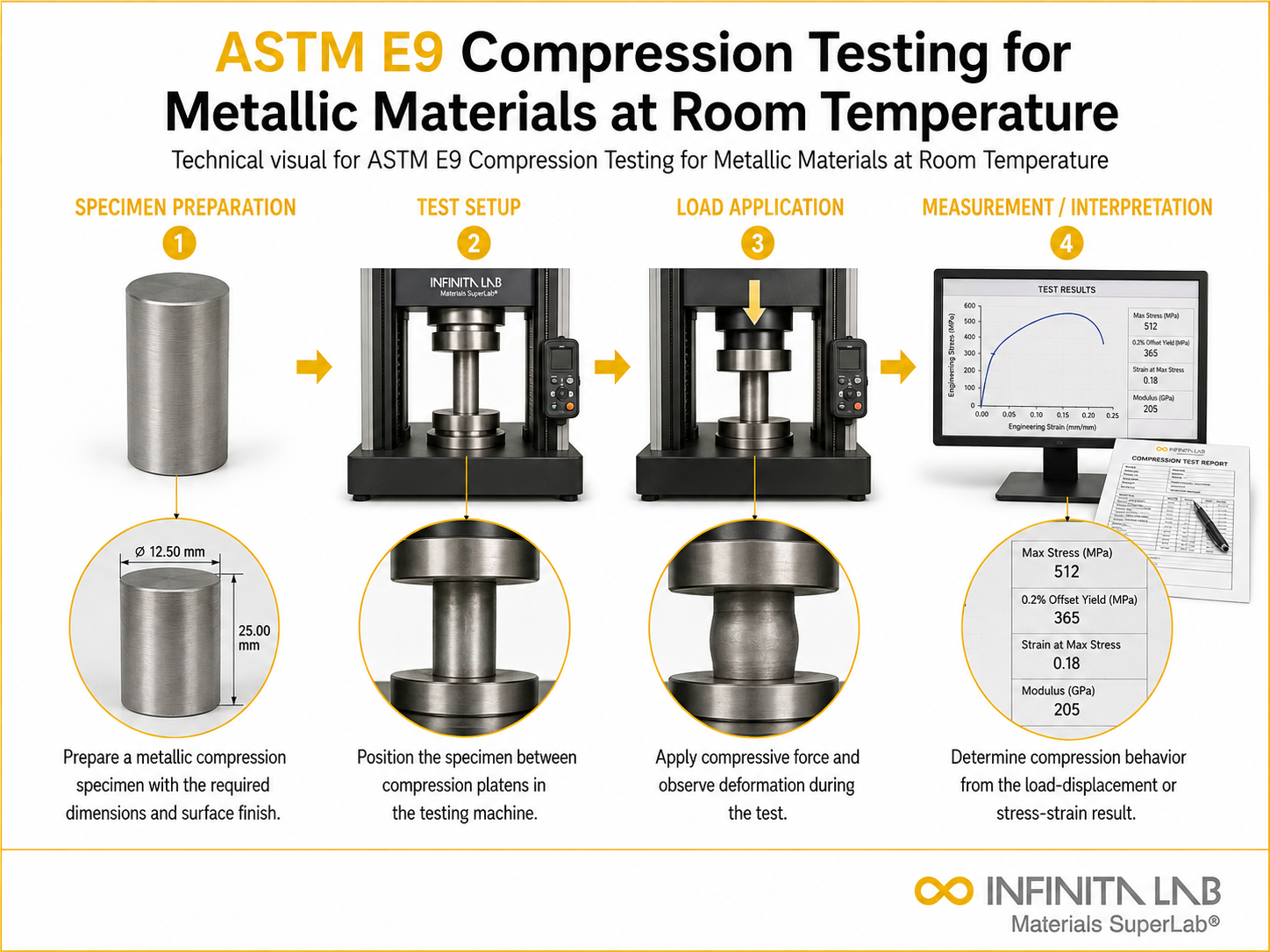
Our ASTM E9 Testing Procedure
Sample Preparation
Metallic specimens machined to defined cylindrical or prismatic geometry per ASTM E 9 requirements.
1Compression Loading
Specimen loaded between parallel platens at defined crosshead speed recording load and deformation.
2Stress-Strain Data Collection
Compressive stress-strain curve generated from continuous load and deformation measurement data.
3Data Analysis & Reporting
Compressive properties calculated from stress-strain data and assessed for test compliance result.
4ASTM E9 Test Parameters and Requirements
| Parameter | Details |
|---|---|
| Applicable Materials | Metallic materials including steel, aluminum, titanium, copper, and cast or sintered alloys |
| Specimen Geometry | Cylindrical or prismatic specimen with L/D ratio of 1.5 to 2.0 per ASTM E 9 requirements |
| Loading Conditions | Uniaxial compressive loading at defined crosshead speed per ASTM E 9 |
| Measured Parameters | Compressive yield strength, ultimate compressive strength, elastic modulus, and strain |
| Measured Outputs | Compressive stress-strain curve, yield strength, compressive strength, and test compliance result |


- Universal testing machine with defined compressive loading capacity and crosshead speed control
- Hardened parallel compression platens with spherical seat for load alignment
- Precision extensometer or strain gage for compressive deformation measurement
- Specimen preparation equipment for defined cylindrical or prismatic geometry machining
- Specialist stress-strain data acquisition and compressive property calculation software
- Data reporting and compressive stress-strain curve visualization system
Equipment and Instrumentation Used for ASTM E9 Testing
What You Receive: Test Report, Data, and Certification
- Compressive stress-strain curve data for all tested metallic specimens
- Compressive yield strength and ultimate compressive strength values per ASTM E 9
- Elastic modulus values determined from the linear compressive stress-strain region
- Statistical summary of compressive property results across the test specimen set
- Test compliance result assessed against the metallic material compressive specification requirements
- ASTM E 9 compression test report
ASTM E9 E9 Compression Of Metallic Materials At Room Temperature FAQs
ASTM E9 includes compressive load, specimen dimensions, strain measurement, loading rate, and deformation behavior. It evaluates compressive strength, yield behavior, and modulus of metallic materials under controlled room temperature testing conditions.
ASTM E9 typically uses cylindrical specimens that have a height-to-diameter ratio of about 2:1. This design helps distribute stress evenly and reduces the risk of buckling during compression tests of metal materials.
ASTM E9 applies compressive force at a controlled rate using testing machines. This process ensures gradual deformation of the specimen while recording stress and strain. This way, we can evaluate its mechanical behavior.
ASTM E9 provides compressive strength, yield strength, and modulus values in units like megapascals or pounds per square inch, depending on the testing system used.
This method is specifically designed for metallic materials and may not apply to non-metallic materials without modifications. Additionally, the test is conducted at room temperature, which may not reflect the material’s performance under different environmental conditions.
Why Choose Infinita Lab for E9 Compression Of Metallic Materials At Room Temperature Testing
At the core of this breadth is our network of 2,000+ accredited laboratories across the USA, offering access to over 10,000 testing methods and analytical services. From advanced materials characterization (SEM, TEM, RBS, XPS) to mechanical, chemical, environmental, biological, and standardized ASTM/ISO-compliant testing, we deliver unmatched flexibility, specialization, and scale. You are never limited by geography, facility, or methodology — Infinita Lab connects you to the right expertise and testing solution, every time.

Need ASTM E9 E9 Compression Of Metallic Materials At Room Temperature Testing You Can Rely On?
Send query us at hello@infinitalab.com or call us at (888) 878-3090 to learn more about our services and how we can support you.



Request a Quote
Submit your material details and receive testing procedures, pricing, and turnaround time within 24 hours.
 Quick Turnaround and Hasslefree process
 Confidentiality Guarantee
 Free, No-obligation Consultation
 100% Customer Satisfaction
