

What Is ASTM E736 Fireproofing Material Cohesion Adhesion?
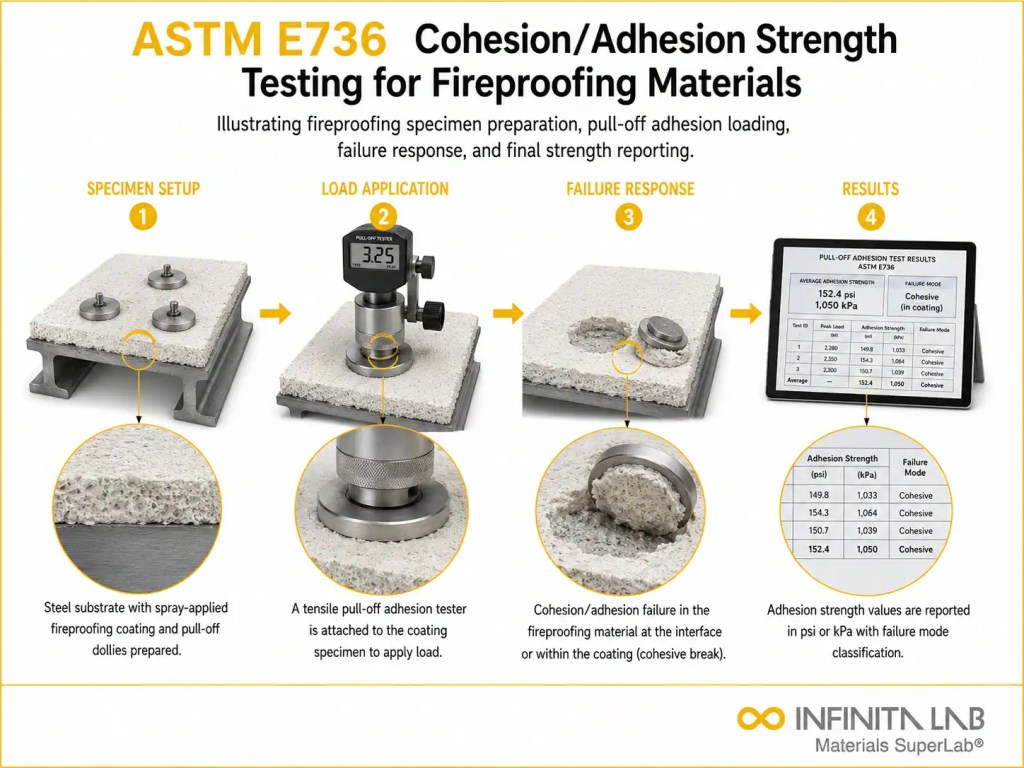
ASTM E736 defines a test method for evaluating the cohesion and adhesion strength of sprayed fire-resistive materials (SFRM) applied to structural substrates. The test measures the force required to detach or fracture the material, indicating its bonding performance and internal integrity.
This standard is essential for ensuring the durability and fire protection effectiveness of SFRM systems. Strong adhesion to the substrate and sufficient internal cohesion are critical for maintaining integrity under fire exposure, vibration, and environmental stress conditions.
Applications and Benefits of ASTM E736 Fireproofing Material Cohesion Adhesion Testing
Scope
ASTM E736 establishes procedures to determine the bond strength between sprayed fire-resistive materials and structural substrates, as well as the internal cohesion of the material itself. It evaluates performance under tensile pull-off loading conditions.
The method is applicable to both laboratory-prepared and field-applied fireproofing systems. It ensures that applied coatings meet required adhesion performance for fire resistance compliance.
- Applicable to sprayed fire-resistive materials (cementitious and fibrous)
- Measures cohesion within material and adhesion to substrate
- Evaluates pull-off bond strength under tensile loading
- Suitable for field inspection and laboratory testing
- Supports fire protection system performance verification
- Ensures compliance with structural fireproofing requirements
Applications
- Fireproofing quality control in construction
- Structural steel protection evaluation
- Inspection of applied SFRM systems
- Building safety compliance testing
- Maintenance and refurbishment of fireproofing layers
- Adhesion performance verification in field applications
- Material development for fire-resistive coatings
- Failure investigation of fireproofing systems
Benefits
- Ensures strong bonding of fireproofing materials
- Validates structural fire protection integrity
- Detects poor application or weak adhesion zones
- Improves long-term durability of SFRM systems
- Supports compliance with fire safety standards
- Reduces risk of fireproofing detachment
- Provides standardized strength evaluation method
- Enhances quality assurance in construction projects
Our ASTM E736 Testing Procedure
Test Area Preparation
Select and prepare surface by attaching loading fixtures (dollies) to cured SFRM using approved adhesive.
1Curing & Conditioning
Allow adhesive bond to stabilize under controlled environmental conditions before testing.
2Pull-Off Loading
Apply controlled tensile force perpendicular to surface until failure occurs in coating or at interface.
3Failure Analysis
Record failure mode and calculate adhesion or cohesion strength based on force at detachment.
4ASTM E736 Test Parameters and Requirements
| Parameter | Details |
|---|---|
| Material Tested | Sprayed-Applied Fire-Resistive Materials (SFRMs) |
| Test Orientation | Perpendicular (tensile pull-off) |
| Failure Modes Recorded | Cohesive, adhesive, or substrate failure |
| Measured Output | Maximum tensile force at failure |
| Result Expression | Cohesion/adhesion strength (stress) |
| Accuracy Requirement | As per ASTM E736 tolerances |


- Pull-off adhesion test apparatus
- Load application and force measurement system
- Bonding fixtures or dollies
- Core drill or cutting tools (for sample preparation)
- Measuring scale or depth gauge
- Data recording and analysis system
Equipment and Instrumentation Used for ASTM E736 Testing
What You Receive: Test Report, Data, and Certification
- Adhesion/cohesion strength values (kPa or MPa)
- Failure mode classification (cohesive, adhesive, or substrate failure)
- Load vs displacement data
- Test location mapping and conditions
- Surface preparation and curing details
- Final compliance and evaluation report
ASTM E736 Fireproofing Material Cohesion Adhesion FAQs
ASTM E736 identifies cohesion failure when fracture occurs within the fire-resistive material, while adhesion failure occurs at the interface with the substrate. This distinction helps determine whether material integrity or bonding performance is the limiting factor.
Strong adhesion ensures that SFRM remains bonded to structural elements during fire exposure, vibration, or environmental stress, preventing detachment that could expose steel or reduce fire resistance effectiveness.
The pull-off force replicates tensile stresses caused by structural movement, thermal expansion, or mechanical vibration, providing realistic evaluation of bonding performance.
Fiber distribution, binder quality, and porosity determine crack propagation paths, influencing whether failure occurs cohesively within the matrix or at the adhesive interface.
By quantifying bond integrity and identifying degradation trends, it helps predict long-term durability of fireproofing systems under mechanical stress, environmental exposure, and thermal cycling conditions.
Fireproofing cohesion inspection evaluates whether sprayed fire-resistive material (SFRM) has sufficient internal strength and adhesion to remain securely attached to structural surfaces. Inspectors assess the applied material for cracking, separation, loose areas, and other visible defects. Where required, ASTM E736 testing measures the tensile bond strength perpendicular to the surface by applying a controlled pulling force to the material. The results help determine whether the fireproofing meets project requirements and can remain securely in place.
ASTM E736/E736M measures the cohesion, adhesion, or tensile bond strength of sprayed fibrous and cementitious fire-resistive materials applied to rigid backing. A test specimen is subjected to a pulling force perpendicular to its surface until failure occurs. The force required to cause failure is used to determine the material's bond strength. The method can be used for both laboratory and field testing to assess the in-place serviceability of structural fireproofing.
Why Choose Infinita Lab for Fireproofing Material Cohesion Adhesion Testing
When your Fireproofing Material Cohesion Adhesion results have to hold up - for compliance, a customer audit, or an engineering decision - ASTM E736 accuracy and an unbiased third-party report matter more than price. Infinita Lab routes your ASTM E736 fireproofing material cohesion adhesion testing to ISO/IEC 17025-accredited U.S. partner labs with hands-on method experience, so you get defensible data, transparent reporting, and turnaround times built around your project deadline - not ours.

Need ASTM E736 Fireproofing Material Cohesion Adhesion Testing You Can Rely On?
Send query us at hello@infinitalab.com or call us at (888) 878-3090 to learn more about our services and how we can support you.



