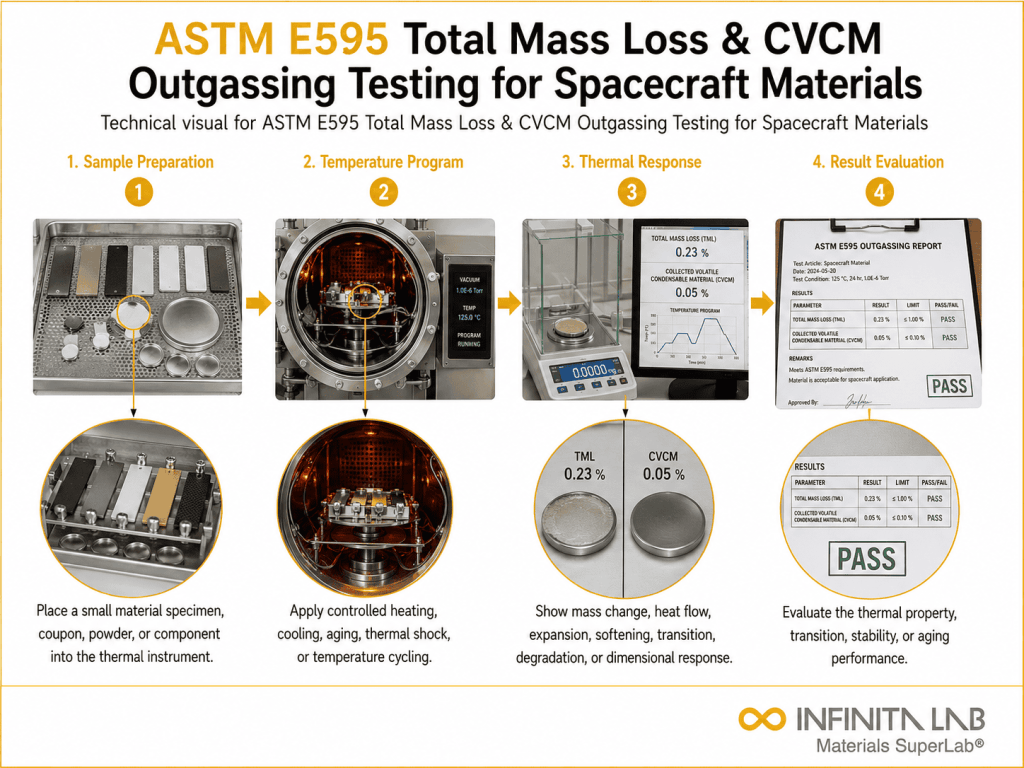


What Is ASTM E595 Spacecraft Material Total Mass Loss Outgassing?
ASTM E595 evaluates outgassing characteristics of materials in a vacuum environment by measuring mass loss and condensable volatile residues. The method determines how much volatile material is released when a sample is exposed to elevated temperature under low-pressure conditions.
This standard is critical for applications where contamination from outgassing can affect sensitive components, especially in vacuum or controlled environments. By quantifying total mass loss (TML) and collected volatile condensable materials (CVCM), ASTM E595 ensures material suitability and reliability.
Applications and Benefits of ASTM E595 Spacecraft Material Total Mass Loss Outgassing Testing
Scope
ASTM E595 defines procedures for measuring outgassing properties of materials under vacuum and elevated temperature conditions. It ensures accurate quantification of volatile emissions and condensable residues.
- Applicable to polymers, coatings, adhesives, and composite materials
- Measures mass loss and condensable volatiles
- Conducted under controlled vacuum and temperature conditions
- Suitable for contamination-sensitive environments
Applications
- Material screening for vacuum environments
- Contamination control in sensitive systems
- Polymer and coating evaluation
- Adhesive and composite qualification
- Research and material development
Benefits
- Identifies volatile emission behavior
- Prevents contamination-related failures
- Ensures material compatibility in vacuum
- Provides standardized evaluation metrics
- Supports high-reliability applications
Our ASTM E595 Testing Procedure
Specimen Preparation
Clean and condition specimens to the specified size and thickness.
1Vacuum Exposure
Expose samples to high vacuum and elevated temperature for a specified duration to induce outgassing.
2Condensable Collection
Capture volatile condensable materials on a cooled collector surface during testing.
3Mass Measurement & Calculation
Measure post-test mass loss and collected residue to calculate TML and CVCM values.
4ASTM E595 Test Parameters and Requirements
| Parameter | Details |
|---|---|
| Specimen Thickness | As specified in the applicable material standard |
| Specimen Condition | Clean, dry, free from surface defects and contaminants |
| Electrode Type | Standard flat or spherical electrodes as per test method |
| Voltage Type | AC or DC (as specified) |
| Test Environment | Controlled temperature and humidity |
| Breakdown Detection | Sudden increase in current or visible electrical failure |


- Vacuum chamber
- Temperature-controlled heating system
- Microbalance (high precision)
- Condensate collection plate
- Vacuum pumps and control system
Equipment and Instrumentation Used for ASTM E595 Testing
What You Receive: Test Report, Data, and Certification
- Total Mass Loss (TML %)
- Collected Volatile Condensable Materials (CVCM %)
- Water Vapor Regained (WVR %) if applicable
- Test conditions and parameters
- Final qualification and analysis report
ASTM E595 Spacecraft Material Total Mass Loss Outgassing FAQs
ASTM E595 separates total mass loss (TML) from condensable fractions (CVCM), recognizing that not all mass loss is harmful. CVCM specifically represents residues that can deposit on surfaces, making it the critical parameter for contamination-sensitive applications.
While TML indicates overall volatility, CVCM quantifies materials that can condense onto critical surfaces. These residues can impair optical, electrical, or thermal performance, making CVCM the key metric for contamination risk.
Low pressure accelerates volatilization by reducing external resistance to evaporation. This simulates real vacuum conditions and ensures accurate representation of material behavior in such environments.
It deals with only the outgassing characteristics of materials, which only partially provides a way of reviewing performance materials in vacuum environments.
Advanced vacuum systems, real-time mass spectrometry, and improved gravimetric accuracy enhance detection and characterization of volatile emissions.
CVCM (Collected Volatile Condensable Materials) testing measures the amount of material released as vapor that condenses on a cooler surface under vacuum conditions. According to ASTM E595, a specimen is heated to 125°C in a vacuum chamber for 24 hours, while a collector plate is maintained at 25°C. The condensed substances are collected and weighed to determine the CVCM percentage relative to the specimen's initial mass. This measurement helps evaluate the risk of contamination to sensitive spacecraft components, optical surfaces, and electronic equipment.
ASTM E595 evaluates the outgassing characteristics of materials under controlled vacuum and temperature conditions. A prepared specimen is exposed to 125°C at a pressure below 7 × 10⁻³ Pa for 24 hours. The specimen's mass before and after exposure is measured to calculate Total Mass Loss (TML), while a cooler collector captures condensable vapors to determine CVCM. The test helps assess material suitability for spacecraft, satellites, and other vacuum-sensitive applications.
TML (Total Mass Loss) and CVCM (Collected Volatile Condensable Materials) are two measurements used in ASTM E595 to evaluate material outgassing. TML represents the percentage of the specimen's initial mass lost during vacuum exposure, while CVCM represents the percentage of that initial mass collected as condensate on a cooler surface. TML indicates the overall amount of material released, whereas CVCM identifies the portion capable of condensing under the test conditions. Both values help determine the potential contamination risk of materials used in space applications.
Why Choose Infinita Lab for Spacecraft Material Total Mass Loss Outgassing Testing
When your Spacecraft Material Total Mass Loss Outgassing results have to hold up - for compliance, a customer audit, or an engineering decision - ASTM E595 accuracy and an unbiased third-party report matter more than price. Infinita Lab routes your ASTM E595 spacecraft material total mass loss outgassing testing to ISO/IEC 17025-accredited U.S. partner labs with hands-on method experience, so you get defensible data, transparent reporting, and turnaround times built around your project deadline - not ours.

Looking for an Accredited Partner for ASTM E595 Spacecraft Material Total Mass Loss Outgassing Testing?
Send query us at hello@infinitalab.com or call us at (888) 878-3090 to learn more about our services and how we can support you.