


ASTM E1559: Spacecraft Material Outgassing Contamination Testing Services
ASTM E1559 aims to determine a method that explains how to gather data to characterize the kinetics of the release of outgassing products from different materials. It basically specifies test apparatus and related procedures for measuring mass flux and its deposition on the surface at different temperatures. Its values are stated in SI units.
TRUSTED BY


Get ASTM E1559 compliant results — request your spacecraft material outgassing contamination testing quote
- Overview
- Scope, Applications, and Benefits
- Test Process
- Specifications
- Instrumentation
- Results and Deliverables
What Is ASTM E1559 Spacecraft Material Outgassing Contamination?
ASTM E1559 is a test method for identifying the outgassing kinetics of spacecraft materials, quantifying the amount of gas they release under vacuum, and assessing their impact on the surface. These characteristics play a crucial role in preventing issues such as optical degradation on a satellite by using a vacuum chamber, quartz crystal microbalances, and effusion cells.
It defines a test apparatus with associated procedures for measuring mass flux and its deposition onto the surface at various temperatures. The measurement is in SI units.

Applications and Benefits of ASTM E1559 Spacecraft Material Outgassing Contamination Testing
Scope
ASTM E1559 focuses on measuring the amount and nature of outgassed materials under controlled vacuum and temperature conditions. It helps assess contamination risks in spacecraft environments.
The test evaluates:
- Total mass loss (TML)
- Collected volatile condensable materials (CVCM)
- Outgassing rate and behavior
- Contamination potential
- Suitability for vacuum applications
Applications
- Spacecraft materials and components
- Satellite systems
- Optical instruments and sensors
- Aerospace materials testing
- Vacuum environment applications
Benefits
- Prevents contamination of sensitive components
- Ensures reliability of spacecraft systems
- Supports material selection for space missions
- Improves long-term performance
- Enables compliance with aerospace standards
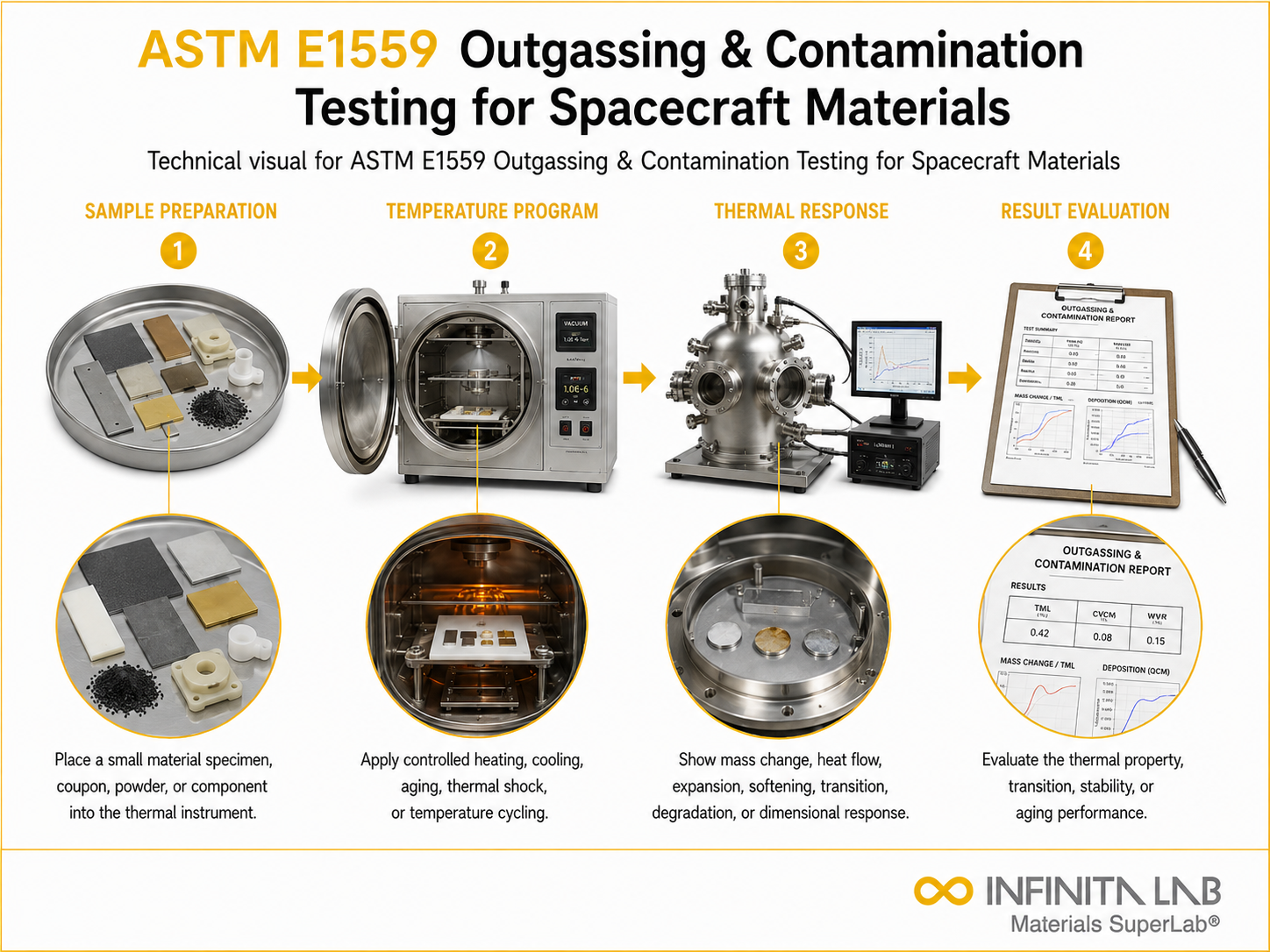
Our ASTM E1559 Testing Procedure
Sample Preparation
Clean, condition, and weigh the test specimen as specified.
1Vacuum Exposure
Place the specimen in a vacuum chamber under controlled temperature and pressure.
2Condensable Collection
Collect outgassed condensable materials on cooled collector surfaces.
3Measurement & Evaluation
Measure mass loss and deposited contaminants to assess outgassing behavior.
4ASTM E1559 Test Parameters and Requirements
| Parameter | Details |
|---|---|
| Test Environment | High vacuum |
| Measured Properties | Total Mass Loss (TML), Collected Volatile Condensable Materials (CVCM) |
| Test Temperature | 125 ± 5 °C |
| Specimen Mass | As specified by the standard |
| Data Output | TML (%) and CVCM (%) |
| Cooling Method | Under vacuum |


- High-vacuum test chamber
- Precision microbalance
- Temperature-controlled heating system
- Cold collector plates or quartz crystal microbalance (QCM)
- Vacuum measurement and control system
- Data acquisition and analysis system
Equipment and Instrumentation Used for ASTM E1559 Testing
What You Receive: Test Report, Data, and Certification
- ASTM E1559-09 is a critical method for evaluating contamination outgassing characteristics of spacecraft materials.
- Measures mass flux and deposition of outgassed contaminants on surfaces
- Evaluates contamination behavior at different temperatures
- Helps predict the evolution and transport of molecular contaminants in spacecraft environments
ASTM E1559 Spacecraft Material Outgassing Contamination FAQs
ASTM E1559 is a standard test method used to evaluate contamination and outgassing characteristics of spacecraft materials, assessing volatile emissions that may condense on sensitive surfaces.
ASTM E1559 is important because outgassing can contaminate optical instruments and surfaces, affecting mission performance, so materials must be evaluated to ensure cleanliness and reliability in space environments.
ASTM E1559 involves heating materials in a vacuum chamber and measuring released volatile compounds that condense on cooled collectors, simulating space conditions and contamination risks.
ASTM E1559 requires a vacuum chamber, temperature-controlled heating system, cold collectors, and analytical instruments to measure and quantify outgassed materials precisely.
Results are reported as collected volatile condensable material and outgassing rates, helping determine suitability of materials for spacecraft use and minimizing contamination risks in sensitive environments.
Why Choose Infinita Lab for Spacecraft Material Outgassing Contamination Testing?
At the core of this breadth is our network of 2,000+ accredited laboratories across the USA, offering access to over 10,000 testing methods and analytical services. From advanced materials characterization (SEM, TEM, RBS, XPS) to mechanical, chemical, environmental, biological, and standardized ASTM/ISO-compliant testing, we deliver unmatched flexibility, specialization, and scale. You are never limited by geography, facility, or methodology — Infinita Lab connects you to the right expertise and testing solution, every time.

Need ASTM E1559 Spacecraft Material Outgassing Contamination Testing You Can Rely On?
Send query us at hello@infinitalab.com or call us at (888) 878-3090 to learn more about our services and how we can support you.



Request a Quote
Submit your material details and receive testing procedures, pricing, and turnaround time within 24 hours.
 Quick Turnaround and Hasslefree process
 Confidentiality Guarantee
 Free, No-obligation Consultation
 100% Customer Satisfaction
