


ASTM E505: Aluminum Magnesium Die Casting Radiographic Testing Services
Accredited ASTM E505 aluminium magnesium die casting radiographic testing from Infinita Lab, performed to the exact standard requirements - accurate, reproducible results with full documentation for compliance, R&D, and quality control programs.
TRUSTED BY


Get ASTM E505 compliant results - request your aluminium magnesium die casting radiographic testing quote
- Overview
- Scope, Applications, and Benefits
- Test Process
- Specifications
- Instrumentation
- Results and Deliverables
What Is ASTM E505 Aluminum Magnesium Die Casting Radiographic?
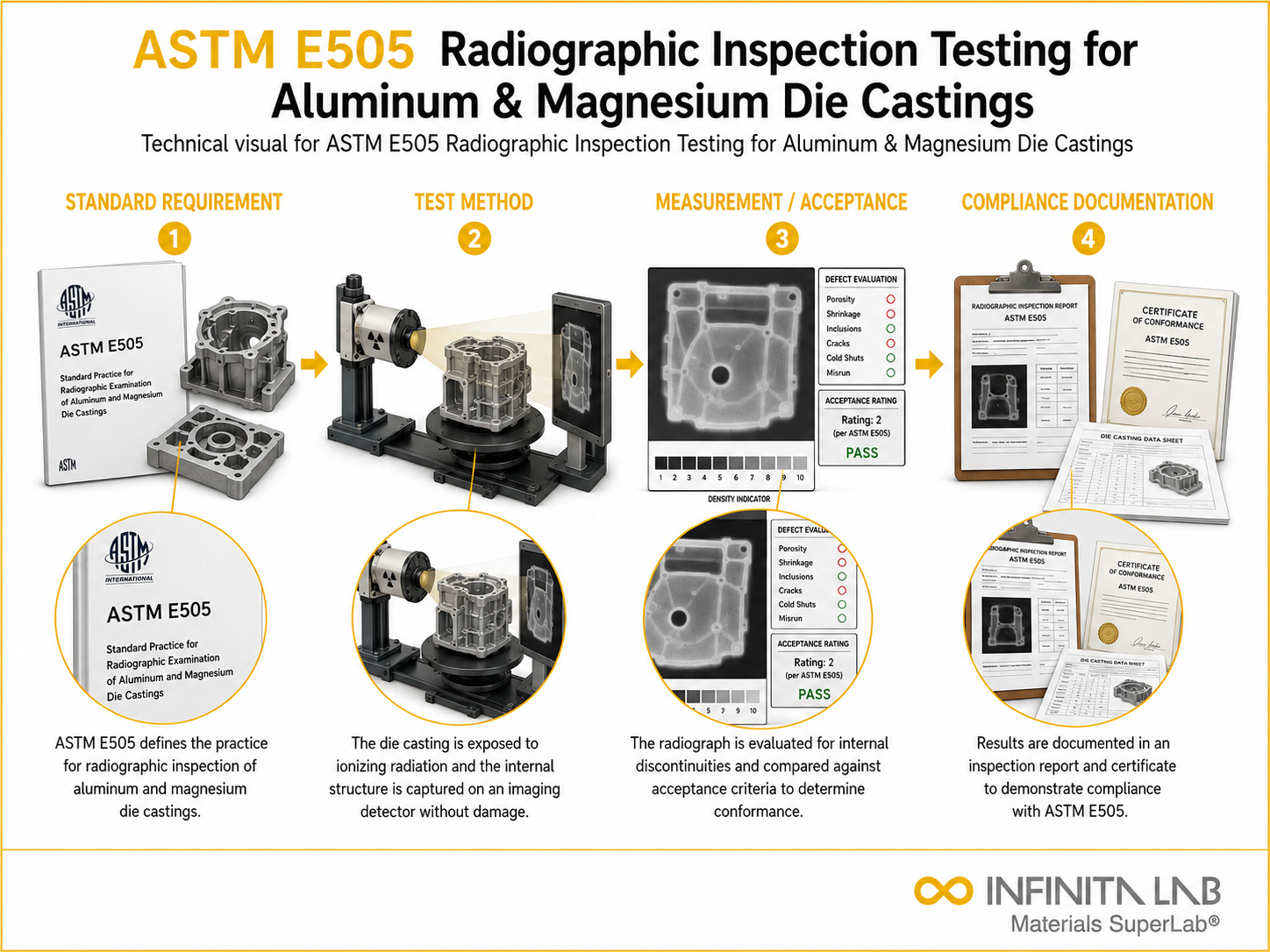
ASTM E505, “Standard Reference Radiographs for Inspection of Aluminium and Magnesium Die Castings,” is not a test method in the way many engineers expect. It doesn’t tell a technician how to set up an X-ray source or how long to expose a film. Instead, it’s a reference set – a bound collection of film radiographs showing real internal discontinuities at graded levels of severity. Inspectors use it side by side with a radiographic examination procedure, most commonly ASTM E94 or ASTM E1742/E1742M, which govern how the radiograph of the actual part gets produced in the first place. E505 is what you compare that image against once it exists.
The reference set illustrates categories of discontinuity common to die-cast aluminium and magnesium parts, including gas porosity, shrinkage, cold fill (sometimes called cold shuts), and foreign material or inclusions. The graded categories are shown across four levels of increasing severity, so an inspector looking at a production radiograph can hold it up against the applicable reference image and make a defensible call about whether the casting falls within an acceptable grade or exceeds it. This visual, apples-to-apples comparison removes a lot of the guesswork and subjectivity that would otherwise creep into radiographic acceptance decisions, and it gives engineering, purchasing, and quality teams a shared vocabulary when specifying acceptance criteria on drawings or in purchase specifications.
Because die castings are thin-walled, geometrically complex, and produced at high volume, they’re prone to internal defects that don’t show up from the outside. E505-based inspection is a practical way to catch those issues before parts reach an engine bay, an airframe, or a safety-critical automotive assembly. At Infinita Lab, we connect manufacturers with accredited partner labs experienced in reading E505-graded radiographs correctly and consistently.

Applications and Benefits of ASTM E505 Aluminum Magnesium Die Casting Radiographic Testing
Scope
- ASTM E505 supplies reference radiographs, not a stand-alone inspection procedure, so it’s always applied together with a radiographic examination practice such as ASTM E94 or E1742/E1742M.
- The set covers aluminium-alloy and magnesium-alloy die castings across a range of section thicknesses relevant to typical die-cast components.
- Discontinuities are grouped into categories – porosity, cold fill, and shrinkage among them – each shown at four progressively increasing severity levels.
- A separate, ungraded section illustrates foreign material and inclusion-type indications for visual reference rather than numeric grading.
- Reference images were produced in accordance with ASTM Guide E94, tying the comparison set to an established radiographic technique.
- For parts inspected digitally rather than on film, ASTM E2973 provides the corresponding digital reference images, since E505’s film-based illustrations aren’t meant for direct digital comparison.
- Acceptance grades established through E505 comparison are typically called out on engineering drawings, purchase orders, or customer specifications.
- The standard supports both incoming inspection of purchased castings and in-process quality checks during production.
- It applies equally to sand-cast tooling development work and high-volume die-cast production runs where internal soundness matters.
- Proper use assumes the radiograph being evaluated was produced with sensitivity and technique consistent with the governing examination standard, so image quality indicators still matter.
Applications
- Automotive manufacturers rely on E505 comparisons to verify that structural die-cast components such as brackets, housings, and suspension parts meet internal soundness requirements.
- Aerospace suppliers use the standard when qualifying cast aluminium or magnesium parts destined for airframe or engine-adjacent assemblies.
- Foundries and die casters apply it as a process-control tool to catch porosity or shrinkage trends before parts ship to customers.
- Tier 1 and Tier 2 suppliers reference E505 grades in incoming inspection to confirm castings from external vendors meet agreed specifications.
- Engineering teams use the graded imagery during design reviews to set realistic, achievable acceptance criteria for new die-cast parts.
- Quality auditors and third-party inspectors use the reference set to standardise how discontinuities are classified across multiple production lots.
- Equipment manufacturers in industries like power tools, consumer electronics housings, and industrial machinery use it wherever die-cast structural integrity is a concern.
Benefits
- Comparison against a fixed reference set removes much of the subjectivity that can creep into radiographic acceptance decisions.
- It gives buyers and suppliers a common, standardised language for describing discontinuity severity instead of relying on inconsistent verbal descriptions.
- Early detection of internal porosity or shrinkage helps prevent costly field failures or warranty claims downstream.
- The graded approach lets manufacturers set tiered acceptance criteria appropriate to a part’s criticality, rather than a single pass/fail threshold.
- Using an established ASTM reference set supports traceability and defensibility if a quality dispute or audit ever arises.
- It integrates cleanly with existing radiographic inspection workflows, so labs don’t need to reinvent evaluation criteria for every new die-cast part.
Our ASTM E505 Testing Procedure
Specimen Preparation
Die casting specimens cleaned and positioned for radiographic exposure per applicable radiographic procedure requirements.
1Radiographic Exposure
X-ray or gamma-ray exposure performed to produce diagnostic radiographic images of casting internal sections.
2Reference Grade Comparison
Production radiographic images compared against ASTM E505 reference radiograph grade sets for discontinuity type and severity classification.
3Evaluation & Reporting
Discontinuities are graded against acceptance criteria and documented for casting acceptance or rejection.
4ASTM E505 Test Parameters and Requirements
| Parameter | Details |
|---|---|
| Applicable Materials | Aluminum alloy and magnesium alloy die castings per ASTM E505 reference radiograph applicability |
| Discontinuity Categories | Gas porosity, shrinkage porosity, cold shuts, inclusions, and oxide film discontinuities per ASTM E505 classification |
| Reference Grade System | Graded reference radiograph image sets representing increasing discontinuity severity from Grade 1 (least severe) to higher severity grades |
| Radiographic Source | X-ray or gamma-ray radiographic sources per applicable radiographic procedure and casting section thickness requirements |
| Measured Outputs | Discontinuity type classification, severity grade assignment, section location, and casting acceptance or rejection result |


- X-ray generator or radiographic source – produces the penetrating radiation used to image internal casting structure.
- Industrial radiographic film or digital detector array – captures the image used for interpretation and comparison.
- Image quality indicators (penetrometers) – confirm the radiograph meets the sensitivity needed to reveal relevant discontinuities.
- E505 reference radiograph set – the physical comparison standard used to grade porosity, cold fill, and shrinkage indications.
- Film illuminator or digital viewing workstation – provides controlled, consistent viewing conditions for accurate interpretation.
- Densitometer – measures film density to confirm radiographs fall within the required exposure range.
- Positioning and fixturing equipment – holds castings at the correct geometry and source-to-film distance during exposure.
Equipment and Instrumentation Used for ASTM E505 Testing
What You Receive: Test Report, Data, and Certification
- A formal inspection report documenting the discontinuity categories identified and the severity grade assigned to each.
- Copies of the radiographic images, whether film or digital, supporting the reported findings.
- A clear acceptance or rejection determination measured against the customer’s specified E505 grade limits.
- Traceability records linking each radiograph to the specific casting, lot, or production batch it represents.
- Interpreter qualifications and certification details, confirming the evaluation was performed by qualified NDT personnel.
- Recommendations for disposition when a casting falls outside the agreed acceptance criteria, supporting engineering or quality follow-up.
ASTM E505 Aluminum Magnesium Die Casting Radiographic FAQs
ASTM E505 is the standardized reference radiograph method for evaluating internal discontinuities in aluminum and magnesium die castings — comparing production radiographic images against graded reference sets to classify discontinuity severity and determine casting acceptance.
ASTM E505 covers gas porosity, shrinkage porosity, cold shuts, inclusions, and oxide film discontinuities in aluminum and magnesium die casting sections across defined severity grade classifications.
Production casting radiographic images are compared visually against ASTM E505 graded reference radiograph sets representing increasing discontinuity severity — assigning the closest matching severity grade and evaluating against the drawing-specified acceptance grade.
ASTM E505 applies to aluminum alloy and magnesium alloy die castings across structural, pressure-containing, and non-structural applications requiring standardized internal discontinuity severity grading and radiographic acceptance evaluation.
Internal discontinuities in die castings affect structural integrity, pressure tightness, and fatigue performance — making standardized radiographic severity grading essential for qualifying castings against design requirements before machining and assembly.
ASTM E505 provides reference radiographs for inspecting aluminum and magnesium die castings. Level 2 refers to a specified severity level of casting defects, such as porosity and shrinkage, used for comparison during radiographic inspection.
ASTM E505 works by comparing X-ray images of die castings with standard reference radiographs to identify and assess defects such as porosity, cold fills, and shrinkage. The results are evaluated against acceptance criteria specified by the customer or applicable specification.
Why Choose Infinita Lab for Aluminum Magnesium Die Casting Radiographic Testing
When your Aluminium Magnesium Die Casting Radiographic results have to hold up - for compliance, a customer audit, or an engineering decision - ASTM E505 accuracy and an unbiased third-party report matter more than price. Infinita Lab routes your ASTM E505 aluminum magnesium die casting radiographic testing to ISO/IEC 17025-accredited U.S. partner labs with hands-on method experience, so you get defensible data, transparent reporting, and turnaround times built around your project deadline - not ours.

Need ASTM E505 Aluminum Magnesium Die Casting Radiographic Testing You Can Rely On?
Send query us at hello@infinitalab.com or call us at (888) 878-3090 to learn more about our services and how we can support you.



Request a Quote
Submit your material details and receive testing procedures, pricing, and turnaround time within 24 hours.
 Quick Turnaround and Hasslefree process
 Confidentiality Guarantee
 Free, No-obligation Consultation
 100% Customer Satisfaction
