


ASTM E359: Soda Ash Sodium Carbonate Analysis Testing Services
Accredited ASTM E359 soda ash sodium carbonate analysis testing from Infinita Lab, performed to the exact standard requirements - accurate, reproducible results with full documentation for compliance, R&D, and quality control programs.
TRUSTED BY


Get ASTM E359 compliant results - request your soda ash sodium carbonate analysis testing quote
- Overview
- Scope, Applications, and Benefits
- Test Process
- Specifications
- Instrumentation
- Results and Deliverables
What Is ASTM E359 Soda Ash Sodium Carbonate Analysis?
Soda ash, or sodium carbonate, is one of the most heavily traded industrial chemicals in the world, and its usefulness hinges almost entirely on purity. A shipment that reads high on paper but carries excess chloride, sulfate, or moisture can throw off a glass furnace’s chemistry, weaken a detergent formulation, or trip a buyer’s acceptance spec before the material ever reaches the production line. ASTM E359, Standard Test Methods for Analysis of Soda Ash (Sodium Carbonate), exists to settle exactly these questions with methods both producers and purchasers can trust. Maintained by ASTM Committee D16 (Subcommittee D16.12) on industrial chemicals, the standard bundles together the classical wet-chemical procedures the soda ash trade has relied on for decades: titrimetric determination of total alkalinity and sodium bicarbonate, gravimetric loss-on-heating and sodium sulfate analysis, a calculated moisture figure, titrimetric sodium chloride, photometric iron determination, and sieve analysis for particle sizing.
At Infinita Lab, we connect manufacturers, suppliers, and end users of soda ash with accredited laboratories equipped to run the full E359 method set, or just the specific determinations a contract calls for. Because we are not tied to a single lab, we can match your sample to a facility with the right instrumentation, current accreditation, and open capacity, instead of you waiting in line at whichever lab happens to be nearby. Our team manages logistics, sample handling instructions, and results formatting, so your quality or procurement group gets a clean, defensible report without chasing down a dozen moving pieces. Whether you’re qualifying a new supplier, running periodic QC on production lots, or resolving a specification dispute, E359 testing through Infinita Lab gives you data you can act on with confidence.

Applications and Benefits of ASTM E359 Soda Ash Sodium Carbonate Analysis Testing
Scope
ASTM E359-10 outlines procedures for determining the composition of soda ash by chemical analysis. It evaluates:
- ASTM E359 covers the analytical procedures typically required to evaluate commercial soda ash, from bulk alkalinity down to trace impurities.
- Total alkalinity is determined by acid-base titration and expressed relative to the sodium carbonate content of the sample.
- Sodium bicarbonate content is measured titrimetrically, which matters for grades where residual bicarbonate affects downstream processing.
- Loss on heating is run gravimetrically to capture volatile material driven off under controlled heating conditions.
- Moisture content is derived by calculation from the loss-on-heating and bicarbonate data rather than measured as a standalone step.
- Sodium chloride is quantified by titration, a check that matters because chloride is corrosive to processing equipment downstream.
- Sodium sulfate is determined gravimetrically, giving producers a way to track a common byproduct impurity in the manufacturing process.
- Iron content is measured photometrically, since even small amounts of iron can discolour glass, paper, and other end products.
- A sieve analysis rounds out the method set, characterising particle size distribution for handling and processing behaviour.
- Because the standard predates modern instrumental chemistry, the procedures rely on classical wet-chemical techniques rather than spectroscopic shortcuts, which keeps results comparable across decades of trade history.
Applications
- Glass manufacturers use E359 data to confirm that incoming soda ash won’t introduce iron staining or chloride-driven corrosion into furnace refractories.
- Detergent and household chemical producers rely on alkalinity and impurity results to keep formulations consistent from batch to batch.
- Chemical manufacturers that use soda ash as a feedstock lean on the standard for incoming raw material acceptance testing.
- Water treatment operations use soda ash for pH adjustment and alkalinity control, so purity data protects downstream treatment chemistry.
- Soda ash producers apply E359 methods internally as manufacturing control, catching drift in the process before product ships.
- Purchasers and traders reference E359 results when negotiating contracts or settling disputes over shipment quality.
- Pulp, paper, and other bulk chemical users depend on consistent alkalinity to keep their own processes running predictably.
Benefits
- Results generated with methods the entire soda ash supply chain already recognises and accepts, with no argument over methodology.
- Producers gain an early warning system for process drift, catching impurity creep before it becomes a customer complaint.
- Purchasers get objective, third-party data to hold suppliers to spec, which strengthens your negotiating position.
- Consistent testing protects capital equipment downstream, since chloride and sulfate carryover can shorten the life of processing equipment.
- A documented testing history builds a paper trail that’s useful for audits, certifications, and contract renewals alike.
- Working through Infinita Lab means one point of contact handling lab selection and logistics, rather than you managing several vendor relationships directly.
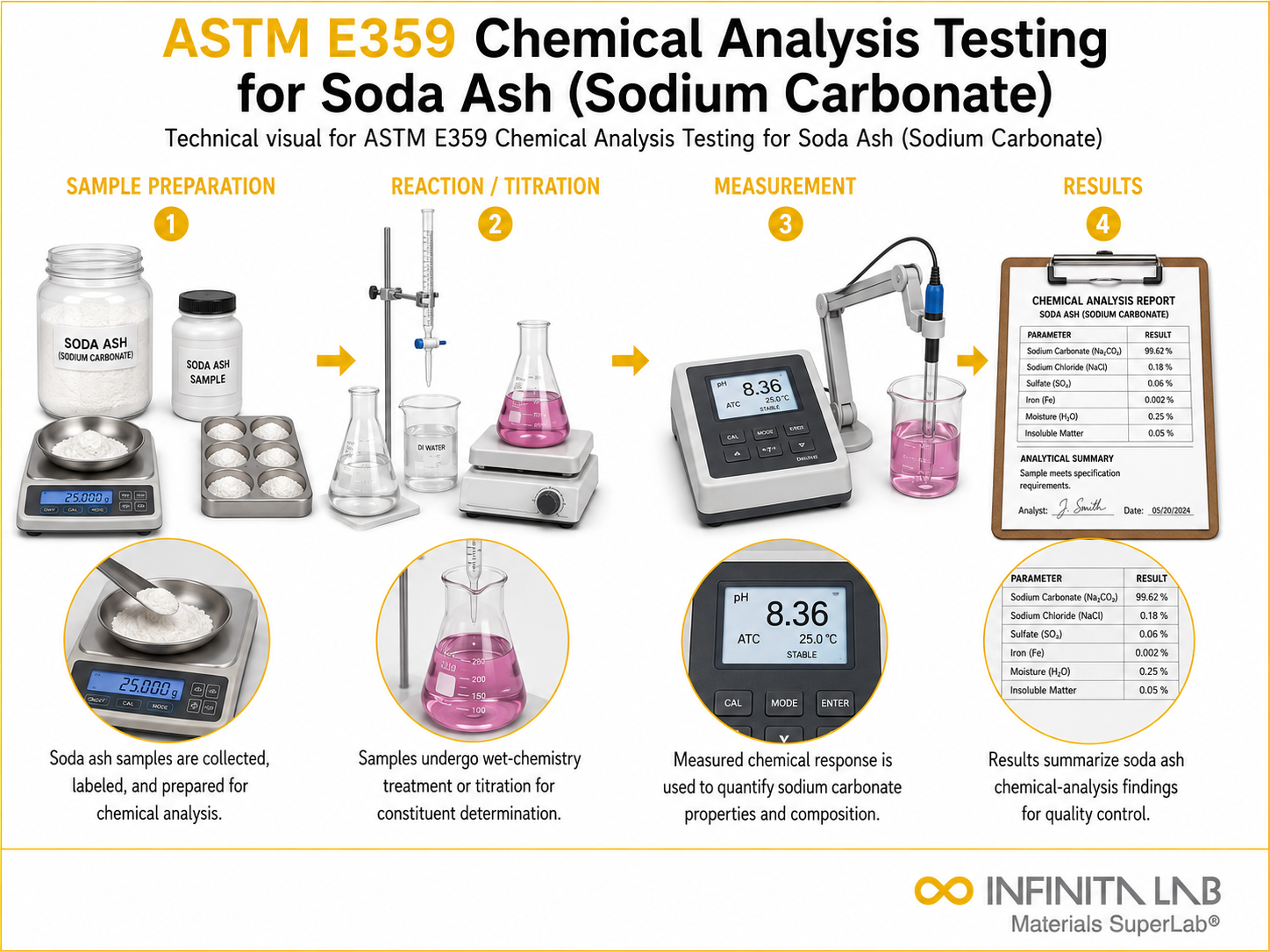
Our ASTM E359 Testing Procedure
Sample Preparation
Soda ash sample is weighed and dissolved in distilled water to prepare a homogeneous solution.
1Titration Setup
Appropriate reagents are added for acid-base titration of carbonate and bicarbonate content.
2Chemical Analysis
The solution is titrated to determine sodium carbonate concentration and impurities.
3Calculation & Reporting
Results are calculated and reported as % Na₂CO₃ and impurity levels.
4ASTM E359 Test Parameters and Requirements
| Parameter | Details |
|---|---|
| Applicable Materials | Soda ash (light and dense sodium carbonate) |
| Sample Type | Solid powder dissolved in solution |
| Measured Outputs | Na₂CO₃ (%), NaHCO₃ (%), impurities (Cl⁻, SO₄²⁻) |
| Reagents Used | Standard acid solutions (e.g., HCl), indicators |
| Detection Range | Major (%) to minor impurity levels |


- Analytical Balances – Deliver the precision weighing that gravimetric methods like loss on heating and sodium sulfate determination depend on.
- Titration Systems – Used for total alkalinity, sodium bicarbonate, and sodium chloride determinations, whether run manually or on automated titrators.
- Spectrophotometers – Provide the photometric measurement used to quantify trace iron content in the sample.
- Drying Ovens / Muffle Furnaces – Supply the controlled heating conditions the loss-on-heating procedure calls for.
- Test Sieves & Shakers – Perform the particle size distribution analysis specified in the standard.
- Laboratory Glassware & Volumetric Equipment – Support accurate solution preparation and titrant delivery across every wet-chemical step.
- Sample Preparation Equipment – Homogenises and conditions incoming soda ash so every aliquot tested is representative of the bulk material.
Equipment and Instrumentation Used for ASTM E359 Testing
What You Receive: Test Report, Data, and Certification
- A detailed test report listing results for every determination performed, referenced against ASTM E359 methodology.
- Clear pass/fail context against any customer or contract specification limits you’ve provided for the shipment.
- Raw data and calculation backup available on request for audits, customer reviews, or internal quality investigations.
- A single point of contact at Infinita Lab for questions on results, retesting, or scope adjustments after the report is issued.
- Fast turnaround aligned to your production or shipment schedule, so testing doesn’t become the bottleneck.
- Secure handling of your sample and data throughout the process, from intake through final report delivery.
ASTM E359 Soda Ash Sodium Carbonate Analysis FAQs
It determines the purity and composition of soda ash by measuring sodium carbonate content along with bicarbonate and impurities such as chlorides and sulfates, ensuring accurate evaluation for industrial applications and quality control processes.
The standard primarily uses acid-base titration techniques to quantify sodium carbonate and related compounds, providing reliable and accurate chemical analysis suitable for both laboratory and industrial quality control applications.
Soda ash quality directly impacts processes like glass manufacturing and detergents, making accurate analysis essential for ensuring product performance, maintaining consistency, and preventing defects caused by impurities or incorrect composition.
Both light and dense soda ash samples can be analyzed using ASTM E359-10, ensuring flexibility in testing materials used across various industrial applications and chemical processing environments.
Industries such as glass manufacturing, detergents, chemical processing, and water treatment use ASTM E359-10 to verify soda ash quality, maintain process efficiency, and ensure compliance with specifications for consistent production outcomes.
A sodium carbonate test determines the purity and chemical composition of sodium carbonate (Na₂CO₃), typically by titration with a standardized acid.
Na₂CO₃ testing determines sodium carbonate concentration and purity and may also measure impurities such as chloride, sulfate, iron, and moisture.
Soda ash purity is determined by measuring the Na₂CO₃ content in the sample, commonly through acid-base titration. Higher Na₂CO₃ content indicates higher soda ash purity.
Why Choose Infinita Lab for Soda Ash Sodium Carbonate Analysis Testing
When your Soda Ash Sodium Carbonate Analysis results have to hold up - for compliance, a customer audit, or an engineering decision - ASTM E359 accuracy and an unbiased third-party report matter more than price. Infinita Lab routes your ASTM E359 soda ash sodium carbonate analysis testing to ISO/IEC 17025-accredited U.S. partner labs with hands-on method experience, so you get defensible data, transparent reporting, and turnaround times built around your project deadline - not ours.

Looking for an Accredited Partner for ASTM E359 Soda Ash Sodium Carbonate Analysis Testing?
Send query us at hello@infinitalab.com or call us at (888) 878-3090 to learn more about our services and how we can support you.



Request a Quote
Submit your material details and receive testing procedures, pricing, and turnaround time within 24 hours.
 Quick Turnaround and Hasslefree process
 Confidentiality Guarantee
 Free, No-obligation Consultation
 100% Customer Satisfaction
