


ASTM E1450: Cryogenic Liquid Helium Tensile Testing Services
Accredited ASTM E1450 cryogenic liquid helium tensile testing from Infinita Lab, performed to the exact standard requirements - accurate, reproducible results with full documentation for compliance, R&D, and quality control programs.
TRUSTED BY


Get ASTM E1450 compliant results - request your cryogenic liquid helium tensile testing quote
- Overview
- Scope, Applications, and Benefits
- Test Process
- Specifications
- Instrumentation
- Results and Deliverables
What Is ASTM E1450 Cryogenic Liquid Helium Tensile?
ASTM E1450, the Standard Test Method for Tension Testing of Structural Alloys in Liquid Helium, specifies exactly how to pull a structural alloy to failure while it’s fully submerged in liquid helium at roughly 4 K. The current edition, E1450-24, builds the whole procedure around a purpose-built cryostat: specimen, grips, and extensometer all go in together, fully immersed, and stay that way for the entire test. Nothing gets loaded until the specimen reaches thermal equilibrium in the bath.
Here’s the detail that actually defines the method. E1450 requires crosshead displacement control, not load control, at a nominal strain rate of 10⁻³ mm/mm/s or slower. That’s not a minor procedural preference. Force control and high strain rates both fall outside the standard’s scope entirely, because plastic flow can go unstable the moment yielding starts at liquid helium temperature, and load control can’t react in time. A cryogenic-rated extensometer and load cell track the specimen throughout the pull, capturing the full stress-strain curve, and the method specifically calls for watching two phenomena that show up almost exclusively in this regime: discontinuous, or serrated, yielding, and localized adiabatic heating, where rapid plastic deformation briefly warms the specimen mid-test.
From that curve, E1450 defines four measured properties: yield strength, ultimate tensile strength, elongation, and reduction of area. The scope broadly covers structural metallic alloys, specimen geometry draws on established tension-test practice sized to fit cryostat chambers, and for elastic modulus work, the standard references ASTM E111 as the companion practice typically run alongside it. Taken together, that’s what E1450 actually hands engineers: a validated, repeatable methodology for characterizing tensile behaviour at the one temperature that matters for superconducting magnets, fusion hardware, and other liquid helium service.

Applications and Benefits of ASTM E1450 Cryogenic Liquid Helium Tensile Testing
Scope
ASTM E1450 covers the tensile testing of structural metallic materials in liquid helium environments. It ensures accurate determination of mechanical properties at cryogenic temperatures.
- Covers uniaxial tension testing on structural alloys submerged in normal liquid helium, at roughly 4 K.
- Testing has to run under crosshead displacement control, at a nominal strain rate of 10⁻³ mm/mm/s or slower. Not load control.
- High strain rate testing and force-controlled loading are both excluded, since metals can go unstable in plastic flow once yielding starts at liquid helium temperature.
- A dedicated tensile cryostat holds the specimen, grips, and extensometer fully immersed for the whole test.
- Yield strength, ultimate tensile strength, elongation, and reduction of area are the properties this standard addresses for structural alloys in this environment.
- Discontinuous, or serrated, yielding gets specific attention here. Many alloys show this behaviour at cryogenic temperatures, and the method gives guidance on recognizing and reporting it correctly.
- Adiabatic heating is covered too: rapid plastic deformation generates heat that can locally and temporarily raise the specimen’s temperature mid-test.
- Specimen configuration draws on established tension-test practice, including the smaller geometries that fit cryostat test chambers.
- For elastic modulus work, ASTM E111 is the companion practice referenced here, often run alongside E1450 when modulus data matters too.
- Broadly, the procedures apply to structural metallic alloys in any application needing adequate strength and ductility at liquid helium temperature.
Applications
- Qualifying structural alloys and weldments for superconducting magnet systems, including fusion energy research and particle accelerator builds.
- Cryogenic storage vessels, piping, and support structures that sit in direct contact with liquid helium need this kind of material verification too.
- Aerospace and space-hardware programs rely on it when metallic components have to retain strength and toughness through extreme low-temperature exposure.
- R&D groups studying how alloy composition and microstructure shape strength, ductility, and failure behavior near absolute zero.
- Lot-acceptance and QA testing for alloys going to cryogenic equipment manufacturers and national research labs.
- Failure analysis, when a cryogenic service failure needs to be traced back to actual low-temperature tensile behavior rather than assumptions.
- Big science infrastructure depends on this too: MRI magnet systems, particle physics detectors, anything that needs components running reliably at 4 K.
Benefits
- Tensile data generated at the actual service temperature, not extrapolated from room-temperature or liquid-nitrogen numbers.
- Cryogenic-specific behaviors, like discontinuous yielding and adiabatic heating, get captured here instead of slipping past unnoticed in standard tensile testing.
- Better-informed material selection for safety-critical, high-value cryogenic hardware.
- Standardized, repeatable results that the cryogenic engineering and superconducting magnet communities already recognize.
- Lower risk of in-service material failure for equipment that has to perform at liquid helium temperature.
- Documented, traceable data ready for design qualification files, regulatory submissions, or customer specs.
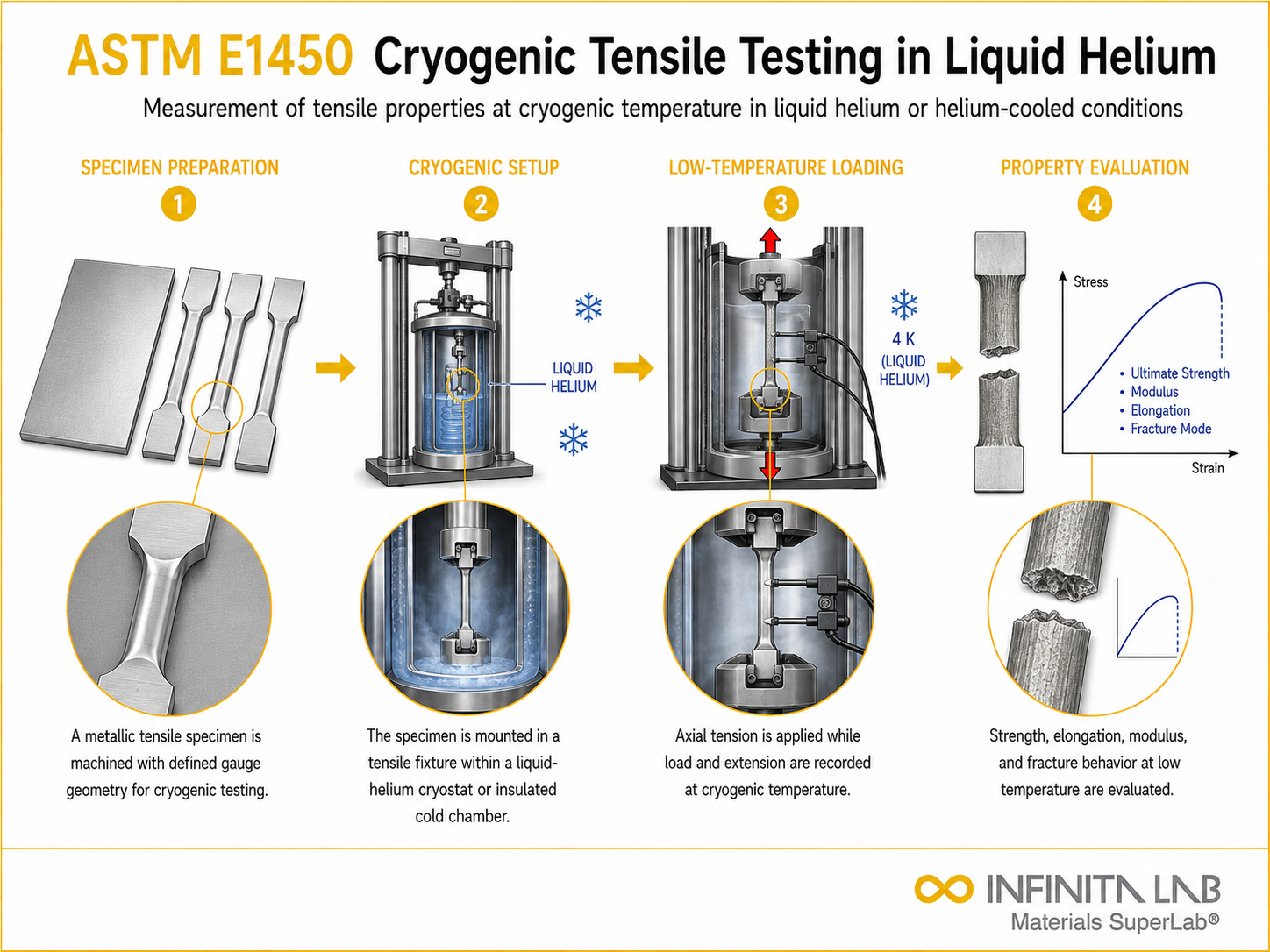
Our ASTM E1450 Testing Procedure
Specimen Preparation
Machine tensile specimens to the specified geometry; ensure smooth surface finish and dimensional accuracy.
1Equipment Setup
Install a calibrated tensile testing machine with a cryostat capable of operation in liquid helium.
2Data Analysis
Calculate yield strength, ultimate tensile strength, elongation, and reduction of area.
3Reporting
Document test conditions, temperature, loading rate, specimen details, and results.
4ASTM E1450 Test Parameters and Requirements
| Parameter | Details |
|---|---|
| Test Medium | Liquid helium |
| Test Temperature | `4 K |
| Material | Structural metallic alloys |
| Strain Rate | Controlled constant rate |
| Results | YS, UTS, elongation, RA |
| Reporting | Test conditions and results |
| Temperature Control | Precise cryogenic stabilization |
| Specimen Geometry | Standard tensile specimen dimensions |


- Tensile Cryostat – holds the specimen, grips, and extensometer fully immersed in liquid helium for the whole test.
- Cryogenic Load Frame – applies controlled crosshead displacement while handling the demands of cryogenic operation.
- Cryogenic Extensometer – reads specimen strain while submerged, feeding the stress-strain curve.
- Liquid Helium Supply and Dewar System – stores and delivers liquid helium to the cryostat, keeping the roughly 4 K environment stable throughout.
- Load Cell – measures tensile force with the precision strength calculations need.
- Temperature Sensors – confirm thermal equilibrium and catch adiabatic heating when it happens mid-pull.
- Data Acquisition System – records load, strain, displacement, and temperature continuously, so the full test history holds up under review.
Equipment and Instrumentation Used for ASTM E1450 Testing
What You Receive: Test Report, Data, and Certification
- A detailed test report with yield strength, ultimate tensile strength, elongation, and reduction of area for each specimen tested.
- Full stress-strain curves showing specimen behavior through the pull, including discontinuous yielding events.
- Photographic documentation of fracture surfaces and specimen condition after testing.
- Supporting data on test temperature, strain rate, and cryostat conditions, confirming the run met E1450 requirements.
- Raw data files, available on request, for further engineering analysis or long-term archiving.
- A clear pass/fail call against customer or project specifications, when that applies.
ASTM E1450 Cryogenic Liquid Helium Tensile FAQs
Tensile testing at liquid helium temperature reveals how materials behave under extreme cryogenic conditions. Many alloys become brittle at low temperatures, and this test ensures that the material maintains sufficient strength and ductility for critical applications like space systems and superconducting technologies.
Most structural alloys exhibit Increased yield and ultimate tensile strength at liquid helium temperatures due to reduced atomic vibration and increased dislocation resistance. They also show reduced flexibility, as cryogenic temperatures limit the mobility of slip systems. The specific impact depends on the alloy composition and microstructure. ASTM E1450 helps quantify these effects for safe material selection.
Liquid helium provides the lowest practical testing temperature, close to absolute zero. It allows accurate evaluation of material behavior in extreme environments such as space or advanced scientific systems, ensuring reliable performance data.
Challenges include maintaining temperature stability, accurate strain measurement at low temperatures, and preventing thermal gradients. Specialized equipment and careful calibration are required to obtain reliable results.
Tensile strength typically increases at lower temperatures due to reduced atomic mobility, but this is often accompanied by reduced ductility, which can affect toughness.
Why Choose Infinita Lab for Cryogenic Liquid Helium Tensile Testing
When your Cryogenic Liquid Helium Tensile results have to hold up - for compliance, a customer audit, or an engineering decision - ASTM E1450 accuracy and an unbiased third-party report matter more than price. Infinita Lab routes your ASTM E1450 cryogenic liquid helium tensile testing to ISO/IEC 17025-accredited U.S. partner labs with hands-on method experience, so you get defensible data, transparent reporting, and turnaround times built around your project deadline - not ours.

Need ASTM E1450 Cryogenic Liquid Helium Tensile Testing You Can Rely On?
Send query us at hello@infinitalab.com or call us at (888) 878-3090 to learn more about our services and how we can support you.



Request a Quote
Submit your material details and receive testing procedures, pricing, and turnaround time within 24 hours.
 Quick Turnaround and Hasslefree process
 Confidentiality Guarantee
 Free, No-obligation Consultation
 100% Customer Satisfaction
