

What Is ASTM E110 For Rockwell And Brinell Hardness Of Metallic Materials By Portable Hardness Testers?
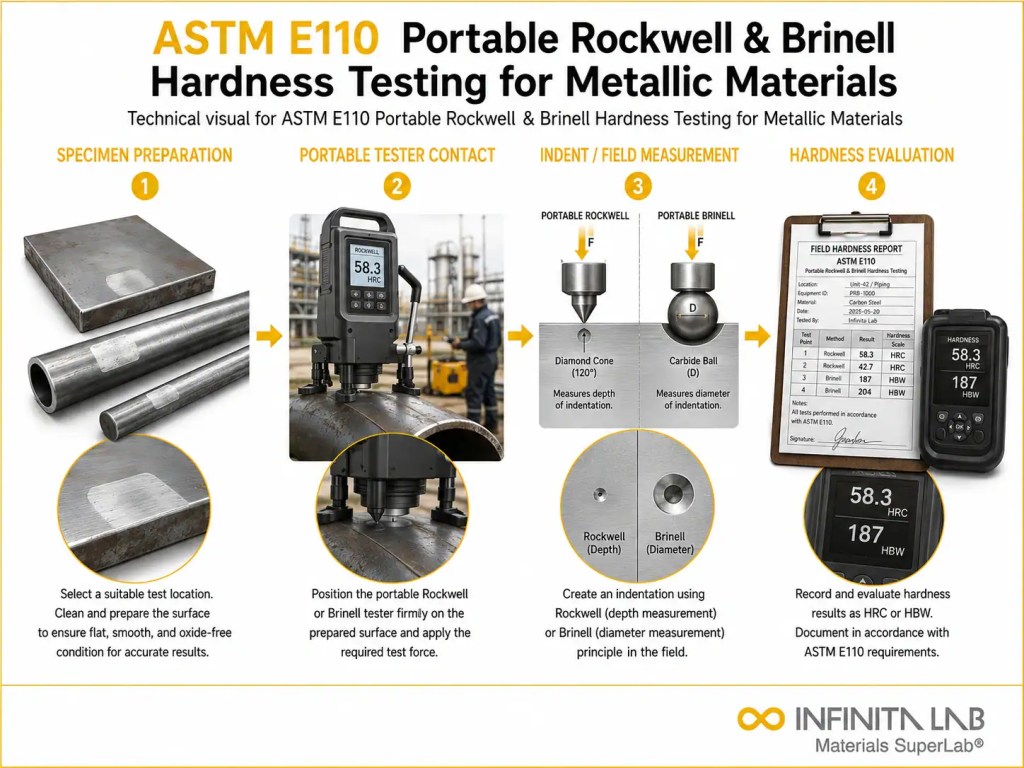
ASTM E110-14 is a Standard Test Method for Rockwell and Brinell hardness of metallic materials. This test method is applicable to defining procedures for using portable devices to measure Rockwell and Brinell hardness of large, immovable objects or in-situ metals when lab testing isn’t feasible or reliable, while ensuring field results align with fixed-tester results.
ASTM E110-14 is the revision of the ASTM E110 standard. Included herein are the modifications and improvements made to the original version. ASTM E110-14 refers to the fact that this edition was published in 2014. Updates to standards might relate to the following:
Applications and Benefits of ASTM E110 For Rockwell And Brinell Hardness Of Metallic Materials By Portable Hardness Testers Testing
Scope
The ASTM E110-14 standard test method is used to determine Rockwell and Brinell hardness of metallic materials using a portable hardness tester. The test is essential when samples are too bulky or heavy to be assessed by traditional, immobile instruments. This standard provides procedures for testing hardness in configurations where standard lab configurations cannot be used. This will ensure that hardness test results are obtained with reasonable accuracy and reliability, even under non-standard laboratory conditions. This standard addresses the requirements for test equipment, specimen preparation, and data interpretation.
Applications
- Architectural glazing and building glass.
- Automotive glass components.
- Heat-resistant and safety glass evaluation.
- Glass is used in appliances and industrial equipment.
- Research and development of new glass compositions.
Benefits
- Provides a standardized method for determining the thermal shock resistance of glass.
- Helps predict glass performance under sudden temperature changes.
- Improves the safety and reliability assessment of glass products.
- Supports quality control during glass manufacturing.
- Assists in material selection for thermally demanding environments.
Our ASTM E110 Testing Procedure
Portable Hardness Tester
Used for Rockwell and Brinell hardness testing
1Indenters
Carbide balls or diamond cones for indentation.
2Calibration Blocks
Hardness Calibration Material for Instrument Verification.
3Microscope/Optical Device
To measure the diameter of the indentation.
4ASTM E110 Test Parameters and Requirements
| Parameter | Details |
|---|---|
| Test Purpose | Thermal shock resistance of flat glass |
| Applicable Materials | Flat glass products |
| Key Variable | Temperature differential (ΔT) |
| Failure Criteria | Cracks or breakage |
| Test Result | Maximum ΔT without failure |
| Reporting | Glass type, thickness, temperatures, and failure point |


- Hardness testing machine (Rockwell and/or Brinell
- Diamond cone and hardened steel or carbide ball indenters
- Load the application and control system
- Optical measurement system (for Brinell indentation)
- Specimen support and anvil
- Data display or recording system
Equipment and Instrumentation Used for ASTM E110 Testing
What You Receive: Test Report, Data, and Certification
- Determines the hardness of metals using portable hardness testers
- Applicable to Rockwell and Brinell off-site (off-quarry) test methods
- Ideal for large, heavy, or fixed components, not suitable for bench testers
- Provides guidelines for equipment calibration
- Specifies specimen preparation requirements
- Defines data calculation and standard formulae for hardness values
- Supports industrial quality control and material evaluation applications
ASTM E110 For Rockwell And Brinell Hardness Of Metallic Materials By Portable Hardness Testers FAQs
ASTM E110-14 is used for measuring the indentation hardness of metallic materials using portable hardness testers. Portable hardness testers are commonly used in field and laboratory settings where fixed testers are impractical.
The method is prevalent in hardness testing of huge, heavy, or immovable objects such as manufacturing plants, machinery, and especially steel structures.
ASTM E110-14 applies to metallic materials, including steel, aluminum, and other alloys.
The standard addresses various hardness scales, such as Rockwell, Brinell, and Vickers, ensuring compatibility and comparability with different testing methods.
The latest active edition is ASTM E110-14(2023), reapproved in 2023. Its full title is Standard Test Method for Rockwell and Brinell Hardness of Metallic Materials by Portable Hardness Testers. It establishes procedures for measuring the indentation hardness of metallic materials using portable hardness testing instruments. The standard also covers instrument verification, calibration requirements, precision, and bias to support reliable hardness measurements in field and laboratory environments.
ASTM E110 evaluates the Rockwell or Brinell hardness of metallic materials using portable hardness testing equipment. The test begins with preparing a clean, smooth testing surface and verifying the instrument using appropriate reference blocks. A specified indenter is pressed against the metal surface under controlled test forces. The instrument measures the resulting indentation depth or size and converts it into a Rockwell or Brinell hardness value. Multiple readings may be taken to assess material consistency. The results help evaluate metal hardness in field locations, large components, and parts that cannot be tested using conventional stationary equipment.
Portable hardness testing standards establish procedures for measuring the hardness of metallic materials directly at manufacturing sites, construction locations, or inspection facilities. Depending on the selected method, a portable tester applies a controlled force through an indenter onto the material surface and measures the resulting indentation or rebound response. The instrument converts the measurement into a hardness value, which is recorded for material evaluation and quality control. ASTM E110 specifically covers portable Rockwell and Brinell hardness testers, while other methods, such as ASTM A956/A956M, cover Leeb hardness testing. The appropriate standard depends on the testing principle and material requirements.
Why Choose Infinita Lab for For Rockwell And Brinell Hardness Of Metallic Materials By Portable Hardness Testers Testing
When your For Rockwell And Brinell Hardness Of Metallic Materials By Portable Hardness Testers results have to hold up - for compliance, a customer audit, or an engineering decision - ASTM E110 accuracy and an unbiased third-party report matter more than price. Infinita Lab routes your ASTM E110 for rockwell and brinell hardness of metallic materials by portable hardness testers testing to ISO/IEC 17025-accredited U.S. partner labs with hands-on method experience, so you get defensible data, transparent reporting, and turnaround times built around your project deadline - not ours.

Need ASTM E110 For Rockwell And Brinell Hardness Of Metallic Materials By Portable Hardness Testers Testing You Can Rely On?
Send query us at hello@infinitalab.com or call us at (888) 878-3090 to learn more about our services and how we can support you.