


ASTM D897: Adhesive Bond Tensile Properties Testing Services
Accredited ASTM D897 adhesive bond tensile properties testing from Infinita Lab, performed to the exact standard requirements - accurate, reproducible results with full documentation for compliance, R&D, and quality control programs.
TRUSTED BY


Get ASTM D897 compliant results - request your adhesive bond tensile properties testing quote
- Overview
- Scope, Applications, and Benefits
- Test Process
- Specifications
- Instrumentation
- Results and Deliverables
What Is ASTM D897 Adhesive Bond Tensile Properties?
ASTM D897 is the standard test method engineers reach for when they need to know how well an adhesive holds two metal parts together under pure tensile pull. Maintained by ASTM Committee D14 on Adhesives, it remains active and a trusted benchmark for evaluating bond strength between rigid metal substrates pulled apart in tension. The test isn’t meant to hand you an adhesive’s absolute, standalone performance number – it’s comparative by design, built to reveal how variables like surface preparation, primer selection, adhesive formulation, and environmental exposure influence bond strength under carefully controlled, repeatable conditions.
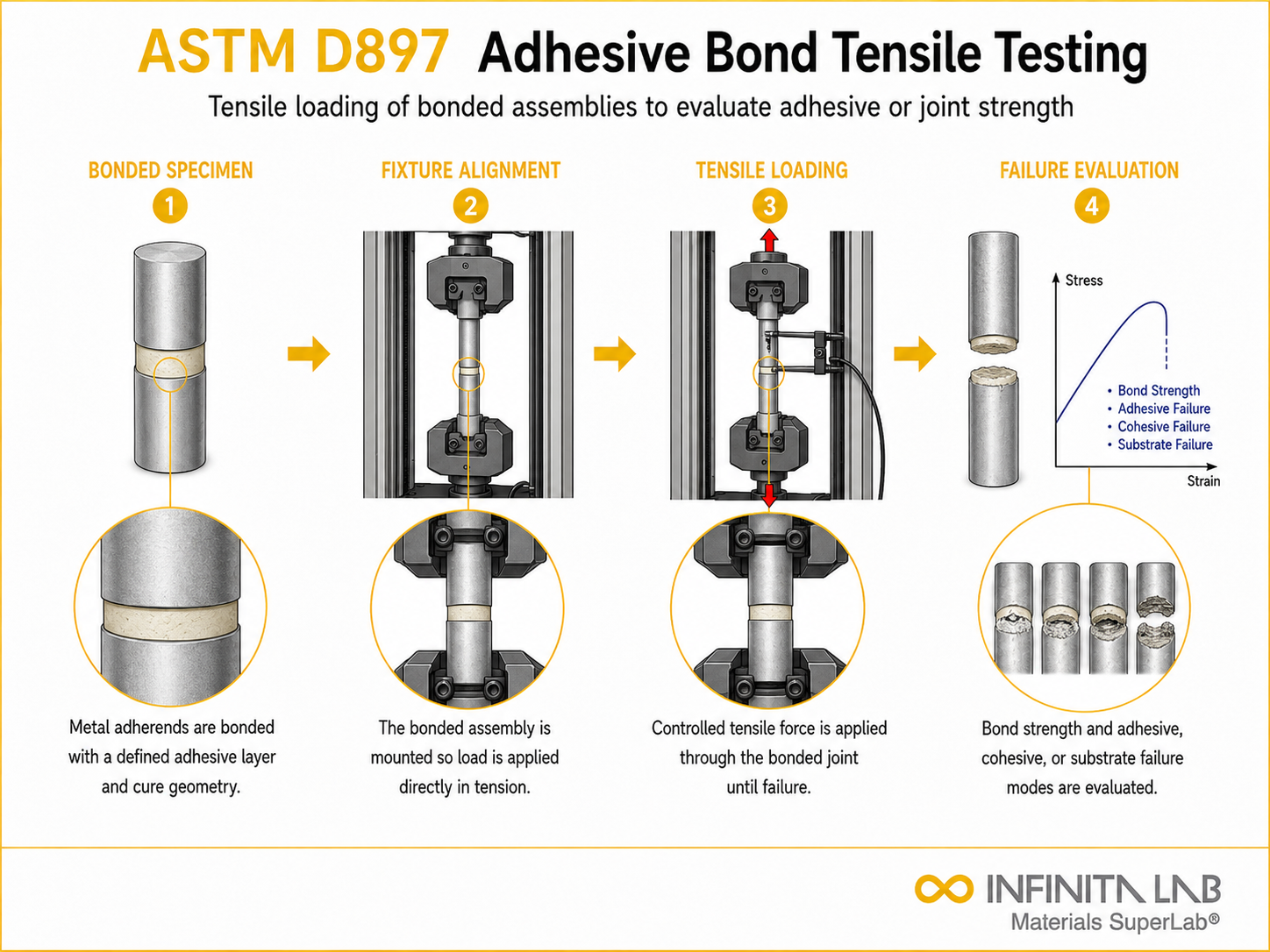
Here’s how it plays out in practice: two cylindrical metal adherends are bonded face to face over a defined area, then mounted in self-aligning grips and pulled apart on a universal testing machine until the joint fails. That breaking load gets converted into a tensile strength value, usually expressed in psi or MPa, and the failure mode – cohesive, adhesive, or a mix of both – is documented too, since it tells engineers nearly as much about bond quality as the strength number does on its own. Because specimen geometry and fixturing are standardized, results from one lab or one formulation can be meaningfully compared against another. That’s exactly why manufacturers rely on this method when qualifying new adhesives, validating surface treatments, or troubleshooting bond failures out in the field.
At Infinita Lab, we support manufacturers across metal fabrication, automotive, aerospace, and industrial equipment sectors with ASTM D897 testing, giving them confidence that their bonded assemblies will perform as designed – whether that’s a one-off qualification project or an ongoing production quality control program.

Applications and Benefits of ASTM D897 Adhesive Bond Tensile Properties Testing
Scope
ASTM D897 evaluates:
- The standard defines a comparative procedure for evaluating the tensile strength of adhesive bonds formed between metal and metal adherends.
- Standardized cylindrical specimens are bonded together at their flat faces, creating a defined bonded area for testing.
- Controlled conditions of specimen pre-treatment, temperature, and testing machine speed keep results comparable across labs and formulations.
- Breaking load at failure is recorded, and tensile strength is calculated from it, typically reported in psi or MPa.
- Failure mode is documented alongside the strength value, distinguishing cohesive failure within the adhesive, adhesive failure at the interface, and substrate failure of the adherend itself.
- Since it’s a comparative rather than an absolute test, results are most meaningful when used to rank or screen adhesive systems, surface treatments, or process variables against one another.
- This method is intended primarily for rigid metal-to-metal bonded assemblies, not flexible adhesives or elastomeric joints.
- As for specimen preparation – surface grinding and the bonding procedure itself – it follows the adhesive manufacturer’s instructions, so variables stay consistent between test sets.
Applications
- Qualifying structural and semi-structural adhesives for metal-to-metal bonded assemblies
- Evaluating surface preparation methods, such as grit blasting, chemical etching, or anodizing, before bonding
- Comparing primer systems and adhesive formulations side by side during product development
- Supporting quality control and batch verification in adhesive manufacturing
- Getting to the root of field bond failures and validating corrective repair procedures
- Assessing how environmental exposure or aging affects bonded joint durability
- Common across automotive, aerospace, metal fabrication, and industrial equipment manufacturing
Benefits
- Delivers objective, repeatable data for comparing adhesive and surface-prep options
- Identifies failure mode, offering insight that goes beyond a single strength number
- Standardized specimen geometry makes apples-to-apples comparisons possible across suppliers and labs
- Supports informed material and process selection during product design
- Catches weak bonding processes before they reach production or the field
- Produces documentation useful for specification compliance and customer qualification packages
Our ASTM D897 Testing Procedure
Specimen Preparation & Surface Treatment
Metal adherends are prepared, surface-treated, and bonded using selected adhesives.
1Adhesive Application & Curing
Adhesive is applied and cured as per the manufacturer's recommendations.
2Specimen Mounting & Tensile Loading
Bonded specimens are mounted, and a controlled tensile load is applied.
3Measurement, Analysis & Reporting
Maximum load is recorded, the failure mode is identified, and the results are reported.
4ASTM D897 Test Parameters and Requirements
| Parameter | Details |
|---|---|
| Applicable Materials | Adhesively bonded metals |
| Number of Specimens | 10 specimens |
| Adhesive Layer Thickness | 0.025 mm (0.001 in.) |
| Loading Control | Adjustable test speed |
| Output Units | g/mm², psi |


- Universal Testing Machine – applies a controlled tensile load and records force and displacement throughout the test
- Self-Aligning Threaded Grips – hold the cylindrical specimens in the base and crosshead so loading stays purely axial, without bending
- Load Cell – measures the force applied to the specimen right up to the point of bond failure
- Environmental Chamber – an optional accessory brought in when specimens need elevated, reduced, or humidity-controlled conditioning before or during testing
- Surface Preparation Equipment – grinding, abrasive blasting, or etching equipment that standardizes adherend surfaces before bonding
- Data Acquisition Software – captures load and displacement data, then calculates tensile strength and failure statistics
- Optical Inspection Tools – used to examine fracture surfaces and classify the failure mode
Equipment and Instrumentation Used for ASTM D897 Testing
What You Receive: Test Report, Data, and Certification
- Tensile strength values for each specimen, reported in psi or MPa
- Average and standard deviation across the specimen set
- Failure mode classification (cohesive, adhesive, or mixed) with supporting documentation
- Raw load and displacement data available for engineering review
- A detailed test report suitable for specification compliance or customer qualification files
- Recommendations on surface preparation or adhesive selection when requested
ASTM D897 Adhesive Bond Tensile Properties FAQs
ASTM D897 determines the comparative tensile properties of adhesive bonds, measuring the force required to separate bonded metal adherends under controlled test conditions.
ASTM D897 is specifically intended for metal-to-metal adhesive bonds prepared as standard-shaped specimens. It is useful for evaluating different adhesive systems, surface treatments, primers, and bonding conditions.
Testing is performed under defined conditions of adherend surface pretreatment, specimen preparation, temperature, conditioning, and testing-machine speed. Maintaining consistent conditions is important because the results are primarily comparative.
The test provides data on the tensile strength of the adhesive bond, allowing comparison of bond performance among different adhesives, surface-preparation methods, primers, or processing conditions. Failure characteristics may also provide useful information about bond performance.
ASTM D897 testing can support adhesive development, quality control, surface-treatment optimization, environmental durability evaluation, and specification acceptance. It is particularly useful for identifying variations in surface preparation and adhesive systems and comparing their resulting bond strength.
Why Choose Infinita Lab for Adhesive Bond Tensile Properties Testing
When your Adhesive Bond Tensile Properties results have to hold up - for compliance, a customer audit, or an engineering decision - ASTM D897 accuracy and an unbiased third-party report matter more than price. Infinita Lab routes your ASTM D897 adhesive bond tensile properties testing to ISO/IEC 17025-accredited U.S. partner labs with hands-on method experience, so you get defensible data, transparent reporting, and turnaround times built around your project deadline - not ours.

Need ASTM D897 Adhesive Bond Tensile Properties Testing You Can Rely On?
Send query us at hello@infinitalab.com or call us at (888) 878-3090 to learn more about our services and how we can support you.



Request a Quote
Submit your material details and receive testing procedures, pricing, and turnaround time within 24 hours.
 Quick Turnaround and Hasslefree process
 Confidentiality Guarantee
 Free, No-obligation Consultation
 100% Customer Satisfaction
