


ASTM D822: Filtered Carbon Arc Paint Weathering Testing Services
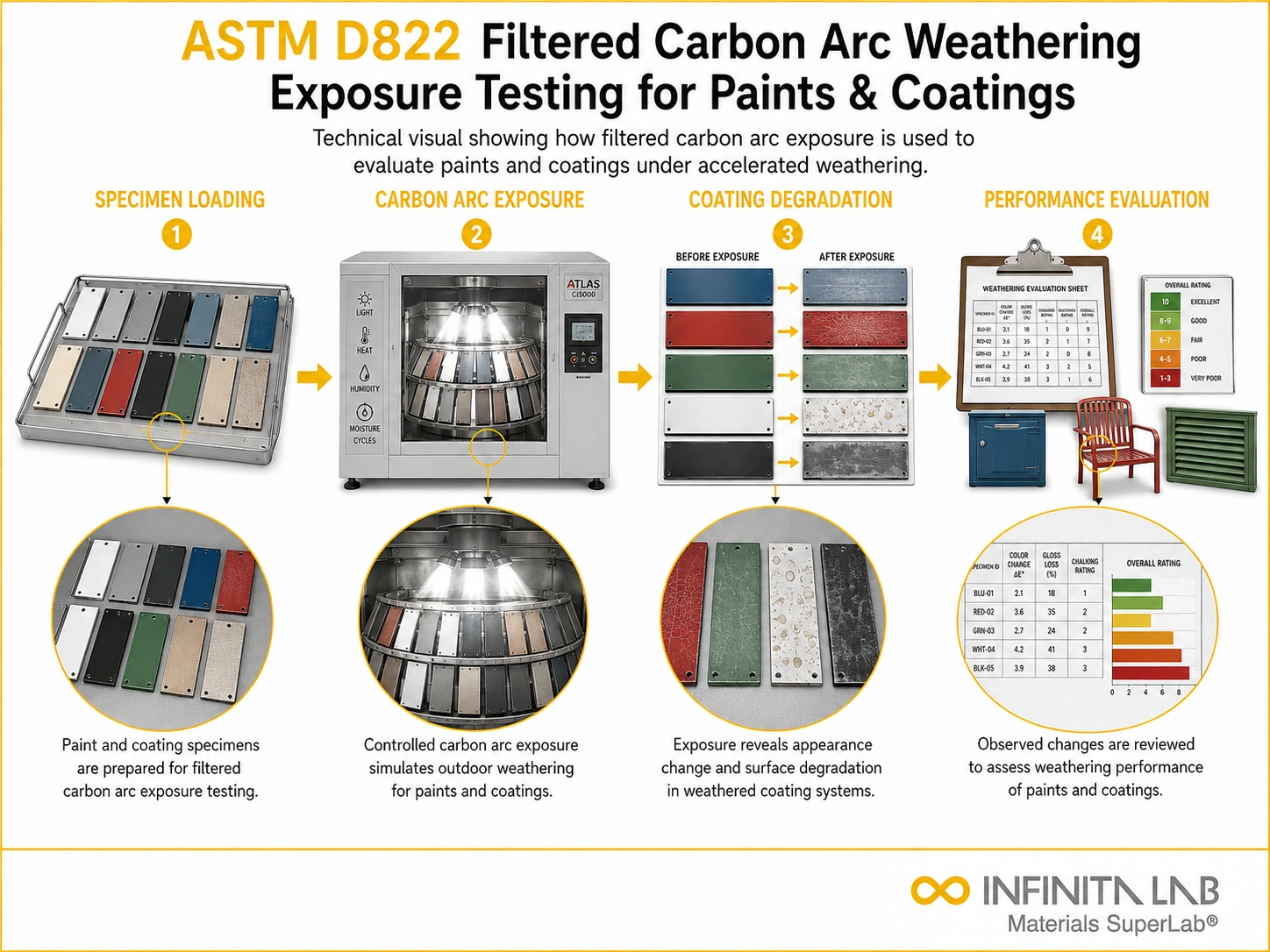
ASTM D822/D822M provides guidelines for conducting accelerated exposure testing of coatings in filtered open-flame carbon-arc devices as per Practices G151 and G152. It also covers the preparation of test specimens, the test conditions suited for coatings, and the evaluation of test results.
TRUSTED BY


Get ASTM D822 compliant results — request your filtered carbon arc paint weathering testing quote
- Overview
- Scope, Applications, and Benefits
- Test Process
- Specifications
- Instrumentation
- Results and Deliverables
What Is ASTM D822 Filtered Carbon Arc Paint Weathering?
ASTM D822/D822M describes a standard practice for exposing paint and related coatings to filtered, open-flame carbon-arc radiation to evaluate their weathering and light stability. The carbon arc simulates the UV and visible radiation components of natural sunlight in an accelerated laboratory environment, causing photodegradation, color change, gloss loss, and chalking similar to outdoor exposure.
While modern accelerated weathering increasingly uses xenon arc and UV fluorescent (QUV) sources, carbon arc weathering per ASTM D822 remains relevant for legacy specification compliance, comparative studies, and applications where its specific spectral output is defined in product standards.

Applications and Benefits of ASTM D822 Filtered Carbon Arc Paint Weathering Testing
Scope
ASTM D822 evaluates:
- Color change and fading of paints and coatings under carbon arc irradiation
- Gloss retention after accelerated light exposure
- Chalking and film degradation behavior
- Relative UV stability ranking of coating formulations
Applications
- Architectural exterior coating light stability evaluation
- Industrial protective coating UV resistance testing
- Comparative light stability testing of pigment systems
- Legacy specification compliance for products requiring carbon arc testing
- Paint and coating R&D for photodegradation mechanism studies
Benefits
- Well-established reference method with decades of comparative data
- Enables legacy specification compliance
- Rapid relative ranking of coating light stability
- Applicable to a wide range of coating types and substrates
- Can be correlated to outdoor weathering data for established systems
Our ASTM D822 Testing Procedure
Panel Preparation
Coating specimens are prepared on appropriate substrates at the specified dry film thickness and fully cured before exposure; baseline color and gloss are measured.
1Arc Lamp Setup
The filtered open-flame carbon arc is configured per ASTM D822 requirements; irradiance and temperature are verified before sample loading.
2Exposure Cycling
Panels undergo continuous light exposure or alternating light/dark and light/water spray cycles per the specified program; exposure hours are recorded.
3Post-Exposure Assessment
At defined intervals, panels are removed and assessed for color change (ΔE), gloss change, chalking, cracking, and adhesion; results are documented and reported.
4ASTM D822 Test Parameters and Requirements
| Parameter | Details |
|---|---|
| Light Source | Filtered open-flame carbon arc |
| Irradiance | As specified per ASTM D822 |
| Cycle | Continuous light or light/water spray alternating |
| Color Measurement | CIELab (ASTM D2244) |
| Gloss Measurement | ASTM D523 (60°) |


- Open-flame carbon arc weatherometer (ASTM D822 compliant)
- Calibrated glossmeter (60°)
- Calibrated spectrophotometer (color)
- Film thickness gauge
- Chalking assessment kit (ASTM D4214)
- Exposure log and irradiance monitoring
Equipment and Instrumentation Used for ASTM D822 Testing
What You Receive: Test Report, Data, and Certification
- ΔE color change at defined exposure intervals
- Gloss values (pre- and post-exposure)
- Chalking rating (ASTM D4214)
- Visual defect documentation (photographs)
- Comparative stability ranking of tested formulations
- Full exposure report per ASTM D822
ASTM D822 Filtered Carbon Arc Paint Weathering FAQs
Carbon arc testing per ASTM D822 remains relevant for compliance with legacy product specifications, older industry standards, and comparative studies where historical carbon arc data exist. For new product development, xenon arc (ASTM G155) and fluorescent UV (ASTM G154) are generally preferred for their more realistic solar spectrum simulation.
The filtered carbon arc produces a spectrum weighted toward shorter UV wavelengths (peak ~360 nm) compared to natural sunlight at ground level (~295 nm cutoff). This makes it more aggressive for UV-sensitive pigments but less representative of the full solar spectrum than a xenon arc source.
Typical exposures range from 200 to 2000 hours depending on coating type and durability expectations. Correlation to years of outdoor exposure depends on the coating system, geography, and exposure angle — generally 500–1000 carbon arc hours correspond to 1–2 years of moderate outdoor exposure.
The alternating water spray cycle simulates condensation and rain exposure, accelerating adhesion failures, blistering, and moisture-induced degradation in addition to UV photodegradation. It represents a more comprehensive weathering stress than light-only exposure.
Qualitative correlations exist for established coating types with historical outdoor data. However, precise quantitative correlation is difficult due to differences in spectral distribution, irradiance level, temperature, and humidity cycling between laboratory arc exposure and real outdoor environments.
Why Choose Infinita Lab for Filtered Carbon Arc Paint Weathering Testing?
At the core of this breadth is our network of 2,000+ accredited laboratories across the USA, offering access to over 10,000 testing methods and analytical services. From advanced materials characterization (SEM, TEM, RBS, XPS) to mechanical, chemical, environmental, biological, and standardized ASTM/ISO-compliant testing, we deliver unmatched flexibility, specialization, and scale. You are never limited by geography, facility, or methodology — Infinita Lab connects you to the right expertise and testing solution, every time.

Need ASTM D822 Filtered Carbon Arc Paint Weathering Testing You Can Rely On?
Send query us at hello@infinitalab.com or call us at (888) 878-3090 to learn more about our services and how we can support you.



Request a Quote
Submit your material details and receive testing procedures, pricing, and turnaround time within 24 hours.
 Quick Turnaround and Hasslefree process
 Confidentiality Guarantee
 Free, No-obligation Consultation
 100% Customer Satisfaction
