


ASTM D706 Cellulose Acetate Molding Compound Specification Testing
The ASTM D 706 Standard classification scheme and specification framework for cellulose acetate molding and extrusion compounds are set out in this standard. It classifies these compounds according to their properties, ensuring uniform manufacturing and use in various products, from textiles to plastics.
TRUSTED BY


Precision-driven testing for dimensional accuracy and compliance
- Overview
- Scope, Applications, and Benefits
- Test Process
- Specifications
- Instrumentation
- Results and Deliverables
Overview
ASTM D706 is a standard specification for cellulose acetate molding compounds. It is a thermoplastic compound that is derived from cellulose. The compounds have good toughness, transparency, and surface finish and can be molded for use in many applications.
The standard specifies requirements for the classification, composition, and performance characteristics of cellulose acetate molding compounds.

Scope, Applications, and Benefits
Scope
ASTM D706 provides guidelines for the classification and specification of cellulose acetate molding compounds used in thermoplastic molding processes. The standard ensures that the material meets defined physical and performance requirements.
It also includes procedures for evaluating material composition, processing behavior, and key physical properties required for producing quality molded products.
The scope includes:
Classification of cellulose acetate molding compounds
Evaluation of thermoplastic material properties
Quality control for CA molding materials
Standard requirements for molded plastic products
Laboratory testing of molded specimens
Applications
Consumer molded plastic products
Automotive interior components
Electrical and electronic parts
Packaging and transparent molded items
Industrial molded components
Benefits
Good toughness and impact resistance
Smooth surface finish and transparency
Easy processing and molding
Lightweight material
Good dimensional stability
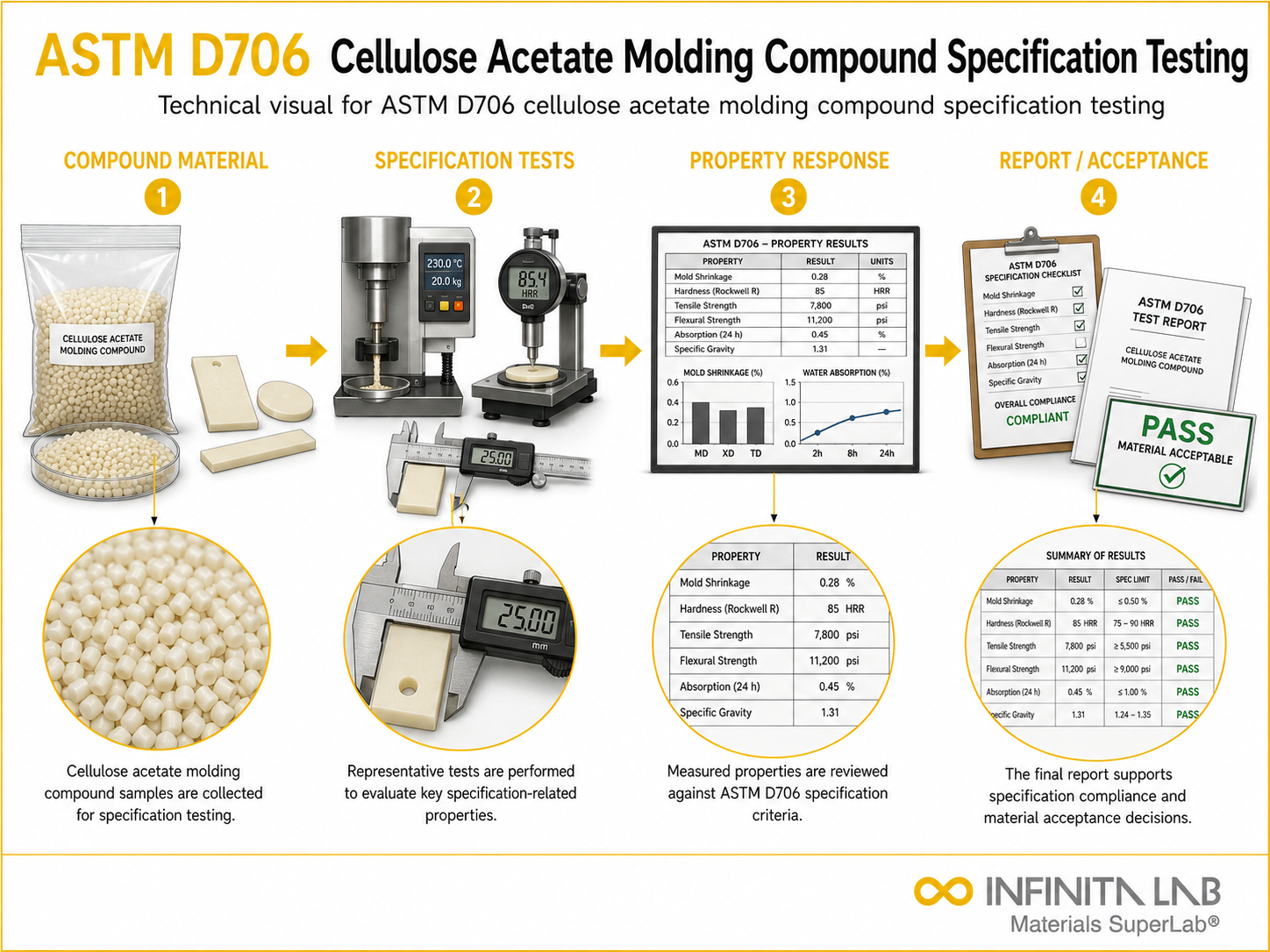
Test Process
Material Preparation
Cellulose acetate molding compound samples are prepared according to specified formulation requirements.
1Specimen Molding
Test specimens are produced using standard thermoplastic molding techniques.
2Property Evaluation
Physical and mechanical properties of molded specimens are tested under controlled conditions.
3Compliance Verification
Results are compared with ASTM D706 specification requirements.
4Technical Specifications
| Parameter | Details |
|---|---|
| Material Type | Cellulose acetate thermoplastic molding compounds. |
| Processing Method | Injection molding or compression molding processes. |
| Material Composition | Cellulose acetate resin combined with plasticizers and additives. |
| Properties Evaluated | Mechanical strength, transparency, toughness, and dimensional stability. |
| Specimen Preparation | Molded samples produced under controlled processing conditions. |
| Testing Environment | Standard laboratory testing conditions. |
| Performance Requirement | Materials must meet specified ASTM classification limits |


Injection Molding Machine
Compression Molding Press
Mechanical Testing Equipment
Hardness Testing Machine
Dimensional Measurement Tools
Instrumentation Used for Testing
Results and Deliverables
Material classification results
Mechanical and physical property evaluation
Processing performance analysis
Complete ASTM D706 test report
Frequently Asked Question
ASTM D706 is a standard specification covering cellulose acetate molding compounds used in thermoplastic molding applications.
These are thermoplastic materials derived from cellulose and acetic acid, commonly used for molded plastic products with good toughness and appearance.
It provides lightweight, durable, and visually attractive components suitable for many consumer and industrial products.
Factors include resin composition, plasticizer content, molding conditions, and additives used in the formulation.
Yes, cellulose acetate is a thermoplastic material, so it can be reheated and reprocessed under suitable conditions.
Why Choose Infinita Lab for Advanced Materials Testing and Characterization?
At the core of this breadth is our network of 2,000+ accredited laboratories across the USA, offering access to over 10,000 testing methods and analytical services. From advanced materials characterization (SEM, TEM, RBS, XPS) to mechanical, chemical, environmental, biological, and standardized ASTM/ISO-compliant testing, we deliver unmatched flexibility, specialization, and scale. You are never limited by geography, facility, or methodology — Infinita Lab connects you to the right expertise and testing solution, every time.

Looking for a Trusted Partner for Accurate and Reliable Testing Services?
Send query us at hello@infinitalab.com or call us at (888) 878-3090 to learn more about our services and how we can support you.



Request a Quote
Submit your material details and receive testing procedures, pricing, and turnaround time within 24 hours.
 Quick Turnaround and Hasslefree process
 Confidentiality Guarantee
 Free, No-obligation Consultation
 100% Customer Satisfaction
