


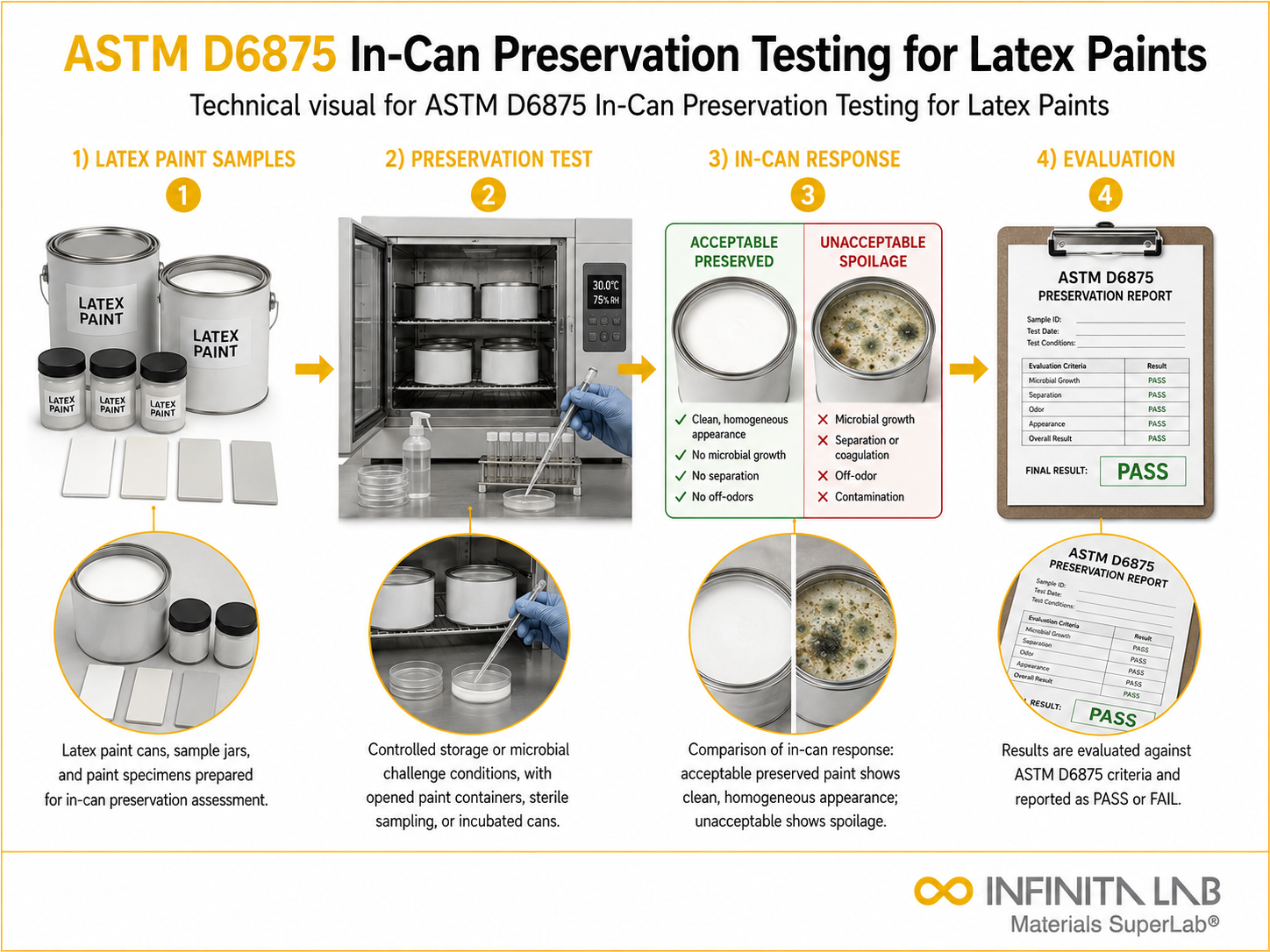
ASTM D6875: Latex Paint In Can Preservation Testing Services
ASTM D6875-12 method is used to measure the solidification point of most organic chemicals by using a thermistor. The maximum temperature at which the liquid phase of a substance is in appropriate equilibrium with a relatively small portion of the solid phase is noted in the result.
TRUSTED BY


Get ASTM D6875 compliant results — request your latex paint in can preservation testing quote
- Overview
- Scope, Applications, and Benefits
- Test Process
- Specifications
- Instrumentation
- Results and Deliverables
What Is ASTM D6875 Latex Paint In Can Preservation?
ASTM D6875-12 covers the determination of the shear strength of adhesive materials using thick adherend (block shear) specimens. Unlike thin lap-shear specimens, the thick-adherend design minimizes bending-moment effects, providing a more purely shear-stress state at the bondline and yielding more accurate adhesive shear-property data.
This test method is used in the aerospace, automotive, and construction industries where accurate adhesive shear strength data are required for structural design and qualification.

Applications and Benefits of ASTM D6875 Latex Paint In Can Preservation Testing
Scope
ASTM D6875-12 applies to structural adhesive joints with thick adherends of metallic and non-metallic materials. The method measures:
- Shear strength at failure
- Load-displacement behavior of the bond
- Modulus of rigidity of the adhesive layer
- Failure mode (cohesive, adhesive, or substrate)
Applications
- Structural adhesive qualification and selection
- Aerospace bonded joint design
- Automotive body and structural panel bonding
- Construction and civil engineering adhesive assessment
- Adhesive process control and batch testing
Benefits
- Minimizes bending-induced stress concentrations compared to thin lap shear
- Provides more accurate shear modulus and strength data
- Enables direct comparison of adhesive formulations
- Supports fracture mode identification for failure analysis
- Compatible with both rigid and semi-rigid adhesive systems
Our ASTM D6875 Testing Procedure
Specimen Preparation
Thick adherend bonded specimens are prepared with controlled bondline thickness and adhesive curing conditions.
1Fixture Setup
Specimens are loaded into specially designed thick adherend shear fixtures aligned in a universal testing machine.
2Shear Loading
Tensile load is applied at a controlled crosshead rate until bond failure occurs; load and displacement are recorded continuously.
3Analysis
Failure load, shear strength, modulus, and failure mode are calculated and documented.
4ASTM D6875 Test Parameters and Requirements
| Parameter | Details |
|---|---|
| Test Principle | Shear loading via thick adherend specimen geometry |
| Applicable Materials | Structural adhesives bonded to metal or rigid substrates |
| Loading Rate | As specified; typically 0.5–2 mm/min |
| Measured Outputs | Shear strength (MPa), shear modulus, failure mode |
| Minimum Specimens | 5 per test condition |


- Universal testing machine with appropriate load cell
- Thick adherend shear test fixture
- Displacement transducer or extensometer
- Specimen alignment and bonding jig
- Data acquisition system
Equipment and Instrumentation Used for ASTM D6875 Testing
What You Receive: Test Report, Data, and Certification
- Shear strength values and statistical summary
- Load-displacement curves
- Shear modulus of the adhesive layer
- Failure mode classification per specimen
- Complete test report for design or qualification use
ASTM D6875 Latex Paint In Can Preservation FAQs
ASTM D6875-12 is a standard test method used to determine ignition quality of diesel fuel oils using a constant volume combustion chamber, providing an estimate of cetane number.
ASTM D6875-12 is important because ignition quality affects combustion efficiency, engine performance, emissions, and starting behavior, helping ensure fuel meets required performance standards in diesel engines.
ASTM D6875-12 measures ignition delay of fuel injected into a controlled combustion chamber, correlating delay time with cetane number to indicate combustion characteristics.
ASTM D6875-12 requires a constant volume combustion chamber instrument, fuel injection system, temperature and pressure controls, and data acquisition systems for precise measurement.
Results are reported as derived cetane number, indicating ignition quality, helping refiners and users assess fuel suitability for efficient and reliable diesel engine operation.
Why Choose Infinita Lab for Latex Paint In Can Preservation Testing?
At the core of this breadth is our network of 2,000+ accredited laboratories across the USA, offering access to over 10,000 testing methods and analytical services. From advanced materials characterization (SEM, TEM, RBS, XPS) to mechanical, chemical, environmental, biological, and standardized ASTM/ISO-compliant testing, we deliver unmatched flexibility, specialization, and scale. You are never limited by geography, facility, or methodology — Infinita Lab connects you to the right expertise and testing solution, every time.

Looking for an Accredited Partner for ASTM D6875 Latex Paint In Can Preservation Testing?
Send query us at hello@infinitalab.com or call us at (888) 878-3090 to learn more about our services and how we can support you.



Request a Quote
Submit your material details and receive testing procedures, pricing, and turnaround time within 24 hours.
 Quick Turnaround and Hasslefree process
 Confidentiality Guarantee
 Free, No-obligation Consultation
 100% Customer Satisfaction
