


ASTM D6738: Precipitated Silica Volatile Content Testing Services
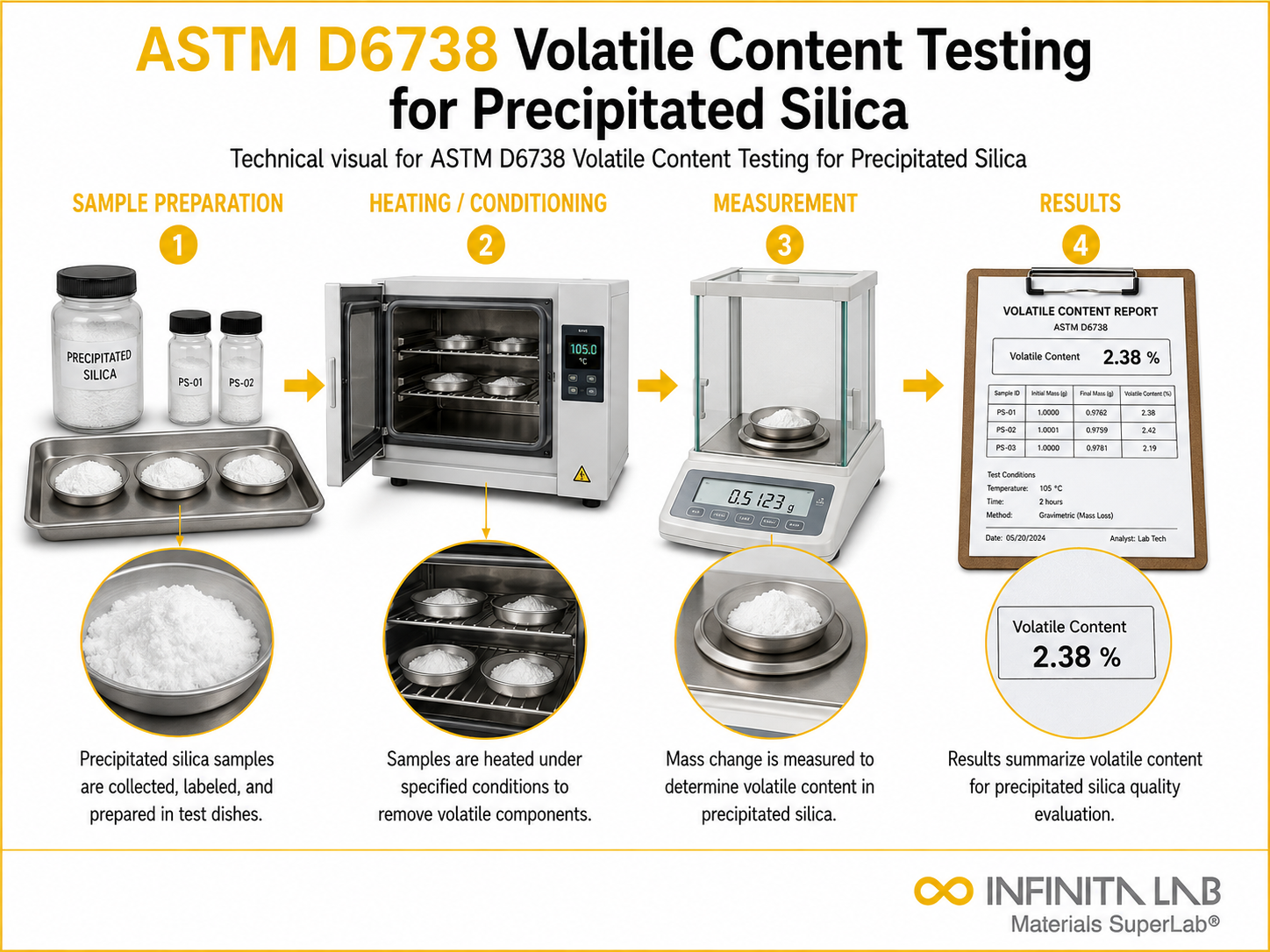
ASTM D6738 includes determining volatile content in precipitated silica. The volatile content of precipitated silica may affect the properties of a rubber mixture containing silica and the properties of the final product.
TRUSTED BY


Get ASTM E837 compliant results — request your hole drilling residual stress testing quote
- Overview
- Scope, Applications, and Benefits
- Test Process
- Specifications
- Instrumentation
- Results and Deliverables
What Is ASTM E837 Hole Drilling Residual Stress?
ASTM D6738 is a test method for determining the volatile content of precipitated hydrated silicas. The volatility is primarily due to excess water adsorbed on the surfaces of the silica particles.
This test method provides a convenient and accurate means of determining volatile matter content by measuring weight loss during controlled heating and cooling. The value is given as a percentage and rounded to the nearest 0.1%. ASTM D6738 is widely used in quality control and material characterization of silica materials.

Applications and Benefits of ASTM E837 Hole Drilling Residual Stress Testing
Scope
ASTM D6738 evaluates:
- Volatile content in precipitated hydrated silicas
- Surface-adsorbed moisture levels
- Material stability and consistency
- Quality variations in silica production
The method applies to precipitated silica materials with controlled particle-size distributions.
Applications
- Rubber and tire manufacturing
- Coatings and paints
- Adhesives and sealants
- Cosmetics and personal care products
- Chemical processing
- Quality control testing
- Research and development
Benefits
- Provides standardized volatile content data
- Supports process control
- Helps maintain consistent product quality
- Enables comparison between silica batches
- Cost-effective and straightforward testing method
- Improves material performance assessment
Our ASTM E837 Testing Procedure
Pan Weighing & Sample Addition
The empty pan is weighed (W₁), and the silica sample is added and reweighed (W₂).
1Heating
The sample is heated as specified to remove volatile content.
2Cooling & Final Weighing
Pan is cooled in a desiccator and reweighed after reaching room temperature (W₃).
3Calculation
Volatile content is calculated using the standard formula.
4ASTM E837 Test Parameters and Requirements
| Parameter | Details |
|---|---|
| Applicable Materials | Precipitated hydrated silicas |
| Particle Size Range | 20 nm to 200 nm |
| Conditioning | Controlled temperature reaction |
| Output Units | % Volatiles |


- Analytical balance
- Aluminum weighing pans
- Drying oven or heating apparatus
- Desiccator
- Temperature control system
- Data recording system
Equipment and Instrumentation Used for ASTM E837 Testing
What You Receive: Test Report, Data, and Certification
- Volatile content percentage
- Batch comparison reports
- Quality control documentation
- Material stability assessment
ASTM E837 Hole Drilling Residual Stress FAQs
ASTM D6738 determines the volatile content of precipitated hydrated silica. The measured volatiles are generally excess moisture adsorbed on the silica surface rather than water that is chemically bound within the silica structure.
The method is specifically intended for precipitated hydrated silicas, which are widely used as reinforcing and functional fillers, particularly in rubber formulations.
No. ASTM D6738 is designed to determine volatile content, generally associated with surface-adsorbed excess water. It does not determine the water of hydration chemically associated with the silica.
The volatile content can affect the processing behaviour of rubber compounds containing precipitated silica and can consequently influence properties of the finished rubber product. Monitoring it helps maintain consistency between silica batches and formulations.
Volatile-content testing can be used to evaluate batch consistency and verify material specifications for precipitated silica used in rubber and other applications. Controlling moisture-related variability can help improve formulation consistency and processing performance.
Why Choose Infinita Lab for Hole Drilling Residual Stress Testing
At the core of this breadth is our network of 2,000+ accredited laboratories across the USA, offering access to over 10,000 testing methods and analytical services. From advanced materials characterization (SEM, TEM, RBS, XPS) to mechanical, chemical, environmental, biological, and standardized ASTM/ISO-compliant testing, we deliver unmatched flexibility, specialization, and scale. You are never limited by geography, facility, or methodology — Infinita Lab connects you to the right expertise and testing solution, every time.

Need ASTM E837 Hole Drilling Residual Stress Testing You Can Rely On?
Send query us at hello@infinitalab.com or call us at (888) 878-3090 to learn more about our services and how we can support you.



Request a Quote
Submit your material details and receive testing procedures, pricing, and turnaround time within 24 hours.
 Quick Turnaround and Hasslefree process
 Confidentiality Guarantee
 Free, No-obligation Consultation
 100% Customer Satisfaction
