


ASTM D6731 Aerobic Aquatic Biodegradability Testing of Lubricants – Closed Respirometer
Under controlled laboratory settings, this ASTM D6731 measures the degree of biodegradability of lubricants or their components in an aerobic aqueous medium after exposure to an inoculum. The values are considered as a standard when expressed in SI units.
TRUSTED BY


Precision-driven testing for dimensional accuracy and compliance
- Overview
- Scope, Applications, and Benefits
- Test Process
- Specifications
- Instrumentation
- Results and Deliverables
Overview
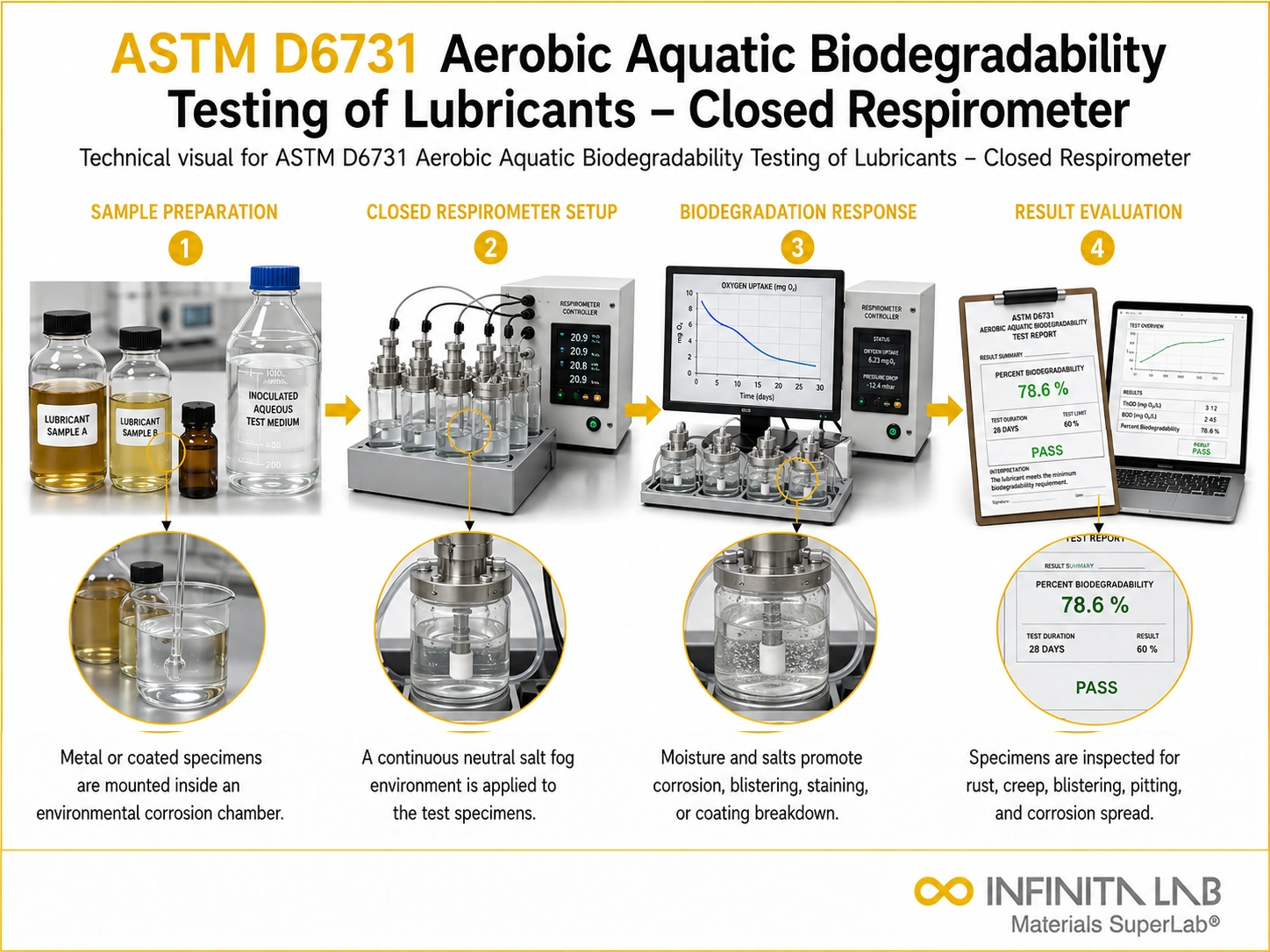
ASTM D6731 is a standard test method for determining the aerobic aquatic biodegradability of lubricants and lubricant components using a closed respirometer. The method measures the oxygen uptake of a microbial inoculum in the presence of the test lubricant substance under defined aerobic aquatic conditions, providing a quantitative measure of biodegradability.
Environmental regulations and eco-labeling programs increasingly require lubricants used in environmentally sensitive applications—such as forestry, marine, and agricultural equipment—to demonstrate a minimum level of aerobic biodegradability. ASTM D6731 provides a standardized test platform meeting these requirements.

Scope, Applications, and Benefits
Scope
ASTM D6731 evaluates:
- Percentage aerobic biodegradation of lubricants and lubricant components
- Oxygen consumption as a proxy for microbial carbon mineralization
- Biodegradation kinetics over a defined test period
- Comparison against reference compounds
Applications
- Environmentally acceptable lubricant (EAL) qualification
- Biodegradable hydraulic fluid and gear oil development
- Eco-labeling compliance (e.g., USDA BioPreferred, Blue Angel, Nordic Swan)
- Regulatory compliance for lubricants in environmentally sensitive zones
- Research and development of bio-based and synthetic ester lubricants
Benefits
- Provides standardized biodegradability data for regulatory submissions
- Supports eco-label qualification and green procurement requirements
- Enables comparison of lubricant formulations for environmental performance
- Identifies non-biodegradable components in lubricant blends
- Reduces environmental liability in sensitive application areas
Test Process
Inoculum Preparation
Activated sludge or surface water inoculum is prepared and pre-conditioned per the test protocol.
1Test Setup
Test vessels containing mineral medium, inoculum, and the lubricant test substance are sealed in the closed respirometer system.
2Incubation & O₂ Monitoring
Vessels are incubated at 20–25°C in the dark; oxygen consumption is measured continuously or at defined intervals over 28 days.
3Biodegradation Calculation
Percent biodegradation is calculated from O₂ uptake vs. ThOD and compared to the 60% pass threshold.
4Technical Specifications
| Parameter | Details |
|---|---|
| Standard | ASTM D6731 |
| Test Principle | Closed respirometry measuring aerobic O₂ uptake |
| Applicable Materials | Lubricants and lubricant base stocks/additives |
| Test Duration | 28 days |
| Incubation Temperature | 20–25°C |
| Biodegradation Threshold | ≥60% of ThOD for ready biodegradability |


- Closed respirometer system (electrolytic O₂ evolution or manometric)
- Temperature-controlled incubation system
- Dissolved oxygen sensors or pressure transducers
- Analytical balance and volumetric glassware
- TOC analyzer for theoretical oxygen demand calculation
Instrumentation Used for Testing
Results and Deliverables
- Percent biodegradation at day 28 (% of ThOD or ThCO₂)
- Oxygen uptake curves over time
- Reference compound validation (sodium benzoate control)
- Ready biodegradability pass/fail determination
- Environmental compliance and eco-label documentation
Frequently Asked Question
A substance is considered readily biodegradable if it achieves ≥60% biodegradation within a 28-day closed-bottle or respirometric test. This threshold is used by most environmental regulations and eco-labeling programs.
Vegetable oil-based lubricants, synthetic esters, polyalkylene glycols (PAGs), and other bio-based base fluids are commonly evaluated. Mineral oil-based lubricants generally show poor biodegradability.
A closed respirometer accurately measures all O₂ consumed by microbial activity without atmospheric exchange, providing more precise biodegradation quantification than open systems.
ASTM D6731 is closely modeled on and harmonized with the OECD 301F manometric respirometry test. Results from both methods are generally accepted by regulatory agencies and eco-labeling bodies.
Yes. The EPA VGP requires that lubricants used in oil-to-sea interfaces on vessels meet biodegradability standards, and ASTM D6731 (or equivalent OECD tests) are accepted as supporting documentation.
Why Choose Infinita Lab for Advanced Materials Testing and Characterization?
At the core of this breadth is our network of 2,000+ accredited laboratories across the USA, offering access to over 10,000 testing methods and analytical services. From advanced materials characterization (SEM, TEM, RBS, XPS) to mechanical, chemical, environmental, biological, and standardized ASTM/ISO-compliant testing, we deliver unmatched flexibility, specialization, and scale. You are never limited by geography, facility, or methodology — Infinita Lab connects you to the right expertise and testing solution, every time.

Looking for a Trusted Partner for Accurate and Reliable Testing Services?
Send query us at hello@infinitalab.com or call us at (888) 878-3090 to learn more about our services and how we can support you.



Request a Quote
Submit your material details and receive testing procedures, pricing, and turnaround time within 24 hours.
 Quick Turnaround and Hasslefree process
 Confidentiality Guarantee
 Free, No-obligation Consultation
 100% Customer Satisfaction
