


ASTM D6474: High Temperature GPC Polyolefins Testing Services
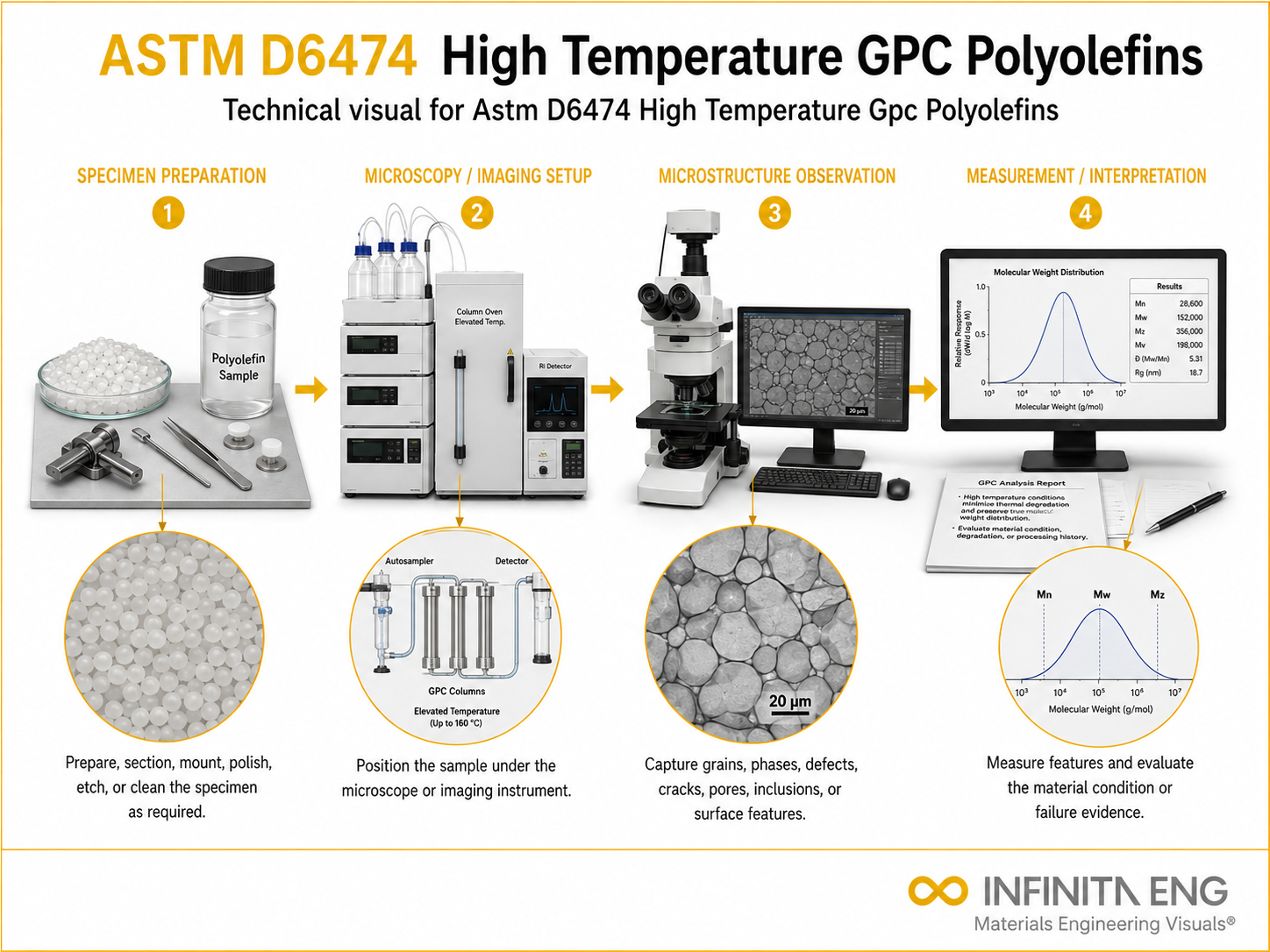
The determination of molecular weight distributions and molecular weight averages of linear polyolefins by high-temperature gel permeation chromatography is covered by ASTM D6474-12 test technique (GPC). The final results are expressed in SI units.
TRUSTED BY


Get ASTM D6474 compliant results — request your high temperature GPC polyolefins testing quote
- Overview
- Scope, Applications, and Benefits
- Test Process
- Specifications
- Instrumentation
- Results and Deliverables
What Is ASTM D6474 High Temperature GPC Polyolefins?
ASTM D6474 is the standard test method for determining the molecular weight distribution (MWD) and molecular weight averages of linear polyolefins by high-temperature gel permeation chromatography (GPC), also known as size exclusion chromatography (SEC). The method applies to polyethylene (except low-density polyethylene, LDPE) and polypropylene resins. Results are reported in SI units.
The molecular weight and the breadth of the molecular weight distribution are among the most influential properties a polyolefin has. They directly govern physical behavior such as melt flow, mechanical strength, processability, and final product performance. Two resins with the same average molecular weight but different distributions can behave very differently in processing and in service, which is why measuring the full distribution – not just an average – matters.
Because linear polyolefins do not dissolve at room temperature, the analysis must be run hot. The polymer is dissolved in a high-boiling solvent (typically 1,2,4-trichlorobenzene) at elevated temperature, and the entire chromatographic system – columns, detector, and flow path – is held at high temperature (around 140–150°C) throughout the run. This high-temperature requirement is what distinguishes the method from conventional ambient GPC and requires specialized instrumentation.

Applications and Benefits of ASTM D6474 High Temperature GPC Polyolefins Testing
Scope
ASTM D6474 covers the determination of molecular weight distribution and molecular weight averages of linear polyolefins by high-temperature GPC. The polymer is dissolved at elevated temperature and separated on a column set by hydrodynamic size, with the elution profile converted to a molecular weight distribution via calibration.
Key aspects of the test scope include:
- Applicable materials – polyethylene (HDPE, LLDPE; excluding LDPE due to its long-chain branching) and polypropylene resins
- Molecular weight averages reported – number-average (Mn), weight-average (Mw), z-average (Mz), and the polydispersity index (Mw/Mn) describing the breadth of the distribution
- Solvent and temperature – high-boiling solvent such as 1,2,4-trichlorobenzene (TCB), with dissolution and analysis carried out at approximately 140–150°C
- Separation principle – size exclusion; larger molecules elute earlier, smaller molecules later, with the elution volume related to molecular size
- Calibration – the column set is calibrated using narrow molecular weight distribution polystyrene standards, with universal calibration or Mark-Houwink constants applied to convert to polyolefin molecular weights
- Detection – typically refractive index (RI) detection at high temperature; light scattering and viscometry detectors may be added for absolute molecular weight and branching information
- Units – results reported in SI units (g/mol)
Applications
- Polyolefin resin quality control – measuring MWD and molecular weight averages as a core QC parameter for HDPE, LLDPE, and PP resins, since these properties determine downstream processing and product behavior
- Resin grade development – characterizing molecular weight distribution during development of new polyolefin grades and catalyst systems, where controlling MWD is central to achieving target properties
- Processing troubleshooting – relating processing problems (poor melt flow, inconsistent extrusion, film defects) back to molecular weight and distribution differences between resin lots
- Incoming material verification – confirming that purchased polyolefin resin matches the expected molecular weight distribution before it enters production
- Failure analysis – investigating whether a change in molecular weight or distribution (for example from thermal or oxidative degradation during processing) contributed to a product failure
- Catalyst and polymerization research – evaluating how catalyst type and polymerization conditions affect the molecular weight distribution of the resulting polymer
- Lot-to-lot consistency monitoring – tracking MWD across production batches to ensure consistent resin performance
Benefits
- Measures the full distribution, not just an average – GPC gives the complete molecular weight distribution curve along with Mn, Mw, Mz, and polydispersity, which is far more informative than a single melt flow or average value
- Directly explains processing and performance differences – because MWD governs melt flow, strength, and processability, the GPC result often explains behavior that other tests cannot account for
- High-temperature method handles otherwise-insoluble polyolefins – running hot in TCB is the only way to dissolve and analyze linear polyethylene and polypropylene, which will not dissolve at ambient temperature
- Supports advanced detection for branching and absolute MW – adding light scattering and viscometry detectors extends the method to absolute molecular weight and long-chain branching characterization
- Recognized standard for polyolefin MWD – as an established ASTM method, D6474 results provide a consistent, comparable basis for resin specification, development, and supplier verification
Our ASTM D6474 Testing Procedure
Dissolve the Sample
Dissolve the polyolefin resin in a high-temperature solvent until fully dissolved.
1Equilibrate and Calibrate
Stabilise the heated GPC system and calibrate it using suitable molecular weight standards.
2Inject and Separate
Inject the sample and separate the polymer molecules according to their hydrodynamic size.
3Analyse and Report
Calculate Mn, Mw, Mz, and polydispersity, and report the molecular weight distribution and test conditions.
4ASTM D6474 Test Parameters and Requirements
| Parameter | Details |
|---|---|
| Applicable Materials | Polyethylene (HDPE, LLDPE; excludes LDPE), polypropylene |
| Solvent | 1,2,4-trichlorobenzene (TCB), antioxidant-stabilized |
| Analysis Temperature | Approximately 140–150°C |
| Detection | Refractive index (RI); optional light scattering and viscometry |
| Calibration | Narrow polystyrene standards; universal calibration / Mark-Houwink |
| Reported Values | Mn, Mw, Mz, polydispersity (Mw/Mn), full MWD curve |


- High-temperature GPC/SEC system with heated columns, injector, and detector compartment
- Refractive index (RI) detector (high-temperature)
- Optional light scattering and/or viscometry detectors for absolute MW and branching
- High-temperature sample dissolution/preparation unit
- Size exclusion column set rated for high-temperature operation
- Narrow polydispersity polystyrene calibration standards
- Solvent delivery and degassing system (TCB-compatible)
- Data acquisition and MWD calculation software
Equipment and Instrumentation Used for ASTM D6474 Testing
What You Receive: Test Report, Data, and Certification
- GPC analysis report – molecular weight averages (Mn, Mw, Mz) and polydispersity index (Mw/Mn) reported in SI units
- Molecular weight distribution curve – full MWD plot showing the distribution shape, with the chromatogram
- Calibration data – the calibration standards and curve used, with the calibration approach (universal/Mark-Houwink) documented
- Analysis conditions – solvent, temperature, flow rate, column set, and detector used
- Comparison against specification (where provided) – measured averages and distribution against the target values or resin specification
- Sample records – resin identification, sample mass, dissolution conditions, and lot/batch information
ASTM D6474 High Temperature GPC Polyolefins FAQs
Many polyolefins are insoluble in common solvents at room temperature. Elevated temperatures are required to dissolve the polymer and keep it in solution throughout separation and analysis.
The test determines molecular-weight distribution and molecular-weight averages such as number-average and weight-average molecular weight. These results help characterise polymer chain length and distribution.
A dissolved polymer sample is passed through columns containing porous particles. Smaller molecules enter more pores and elute later, while larger polymer molecules pass through more quickly.
1,2,4-Trichlorobenzene, commonly abbreviated as TCB, is used to dissolve and transport the polyolefin sample. The solvent and instrument components are maintained at high temperature to prevent precipitation.
Molecular-weight distribution affects melt flow, strength, toughness, processability and product performance. Changes in the distribution can indicate polymer degradation, manufacturing variation or formulation differences.
Why Choose Infinita Lab for High Temperature GPC Polyolefins Testing
At the core of this breadth is our network of 2,000+ accredited laboratories across the USA, offering access to over 10,000 testing methods and analytical services. From advanced materials characterization (SEM, TEM, RBS, XPS) to mechanical, chemical, environmental, biological, and standardized ASTM/ISO-compliant testing, we deliver unmatched flexibility, specialization, and scale. You are never limited by geography, facility, or methodology — Infinita Lab connects you to the right expertise and testing solution, every time.

Need ASTM D6474 High Temperature GPC Polyolefins Testing You Can Rely On?
Send query us at hello@infinitalab.com or call us at (888) 878-3090 to learn more about our services and how we can support you.



Request a Quote
Submit your material details and receive testing procedures, pricing, and turnaround time within 24 hours.
 Quick Turnaround and Hasslefree process
 Confidentiality Guarantee
 Free, No-obligation Consultation
 100% Customer Satisfaction
