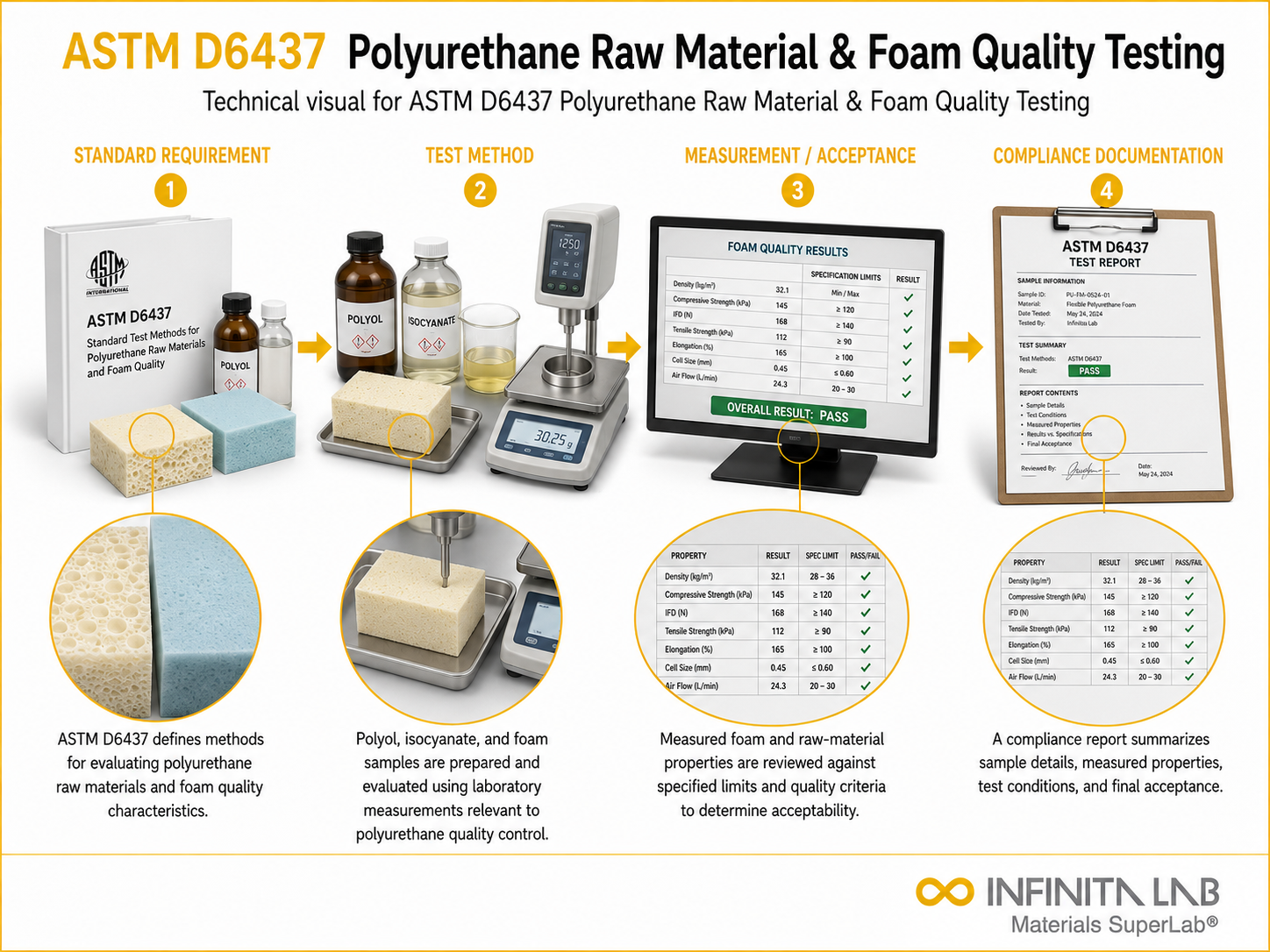


What Is ASTM D6437 Polyurethane Raw Material Foam Quality?
ASTM D6437 determines the alkalinity of low-alkalinity polyols by measuring their Capacity to Prevent Reversion (CPR) value. It evaluates the ability of polyols to resist acidic degradation, which is critical for ensuring stability in polyurethane systems.
The method is widely used in polymer and polyurethane industries to assess chemical stability, process reliability, and long-term performance. It helps identify trace alkaline or acidic impurities, ensuring consistent reactivity, improved product quality, and enhanced formulation control in sensitive applications.

Applications and Benefits of ASTM D6437 Polyurethane Raw Material Foam Quality Testing
Scope
This method quantifies alkalinity in polyols by determining their resistance to acid-induced degradation.
- Measurement of CPR values in low-alkalinity polyols
- Applicable to polyether and polyester polyols
- Evaluation of chemical stability against acid reversion
- Detection of trace acidic or basic impurities
- Used in polyurethane formulation control
- Supports quality assurance and material consistency
Applications
- Polyurethane foam manufacturing
- Coatings and adhesive production
- Elastomer and sealant formulation
- Industrial polymer processing
- Quality control of raw polyols
- Research and development in polymer chemistry
Benefits
- Ensures chemical stability of polyols
- Improves polyurethane performance
- Detects impurity-related degradation risks
- Enhances product consistency
- Supports formulation optimization
- Reduces long-term material failure
Our ASTM D6437 Testing Procedure
Sample Conditioning
Polyol samples are prepared and conditioned under controlled temperature and environmental conditions to ensure consistency.
1Reagent Addition
A standardized acidic reagent is introduced to the polyol sample to initiate controlled chemical interaction.
2Reaction Monitoring
The mixture is observed for changes indicating reversion or neutralization, reflecting alkalinity behavior.
3CPR Evaluation
The capacity to prevent reversion is calculated based on observed reaction data and quantified as the CPR value.
4ASTM D6437 Test Parameters and Requirements
| Parameter | Details |
|---|---|
| Sample type | Low-alkalinity polyols |
| Measurement parameter | CPR (Capacity to Prevent Reversion) |
| Reagent type | Standardized acid solution |
| Reaction condition | Controlled temperature and environment |
| Detection method | Chemical reaction observation |
| Measurement unit | CPR value (relative scale) |
| Test sensitivity | High sensitivity to trace impurities |
| Sample volume | Defined for repeatability |


- Analytical balance
- Titration setup
- Reaction vessels
- Temperature-controlled bath
- Pipettes and burettes
- Magnetic stirrer
- pH measurement system
Equipment and Instrumentation Used for ASTM D6437 Testing
What You Receive: Test Report, Data, and Certification
- CPR value of the polyol
- Alkalinity stability assessment
- Reaction profile data
- Chemical compatibility report
- Quality compliance evaluation
- Test documentation and analysis report
ASTM D6437 Polyurethane Raw Material Foam Quality FAQs
ASTM D6437 evaluates stability by measuring CPR values, which indicate the polyol’s resistance to acid-induced reversion. Higher CPR values suggest better stability, reduced degradation risk, and improved suitability for polyurethane systems requiring controlled reactivity.
Alkalinity influences chemical reactivity and stability. Excess alkalinity or acidity can lead to premature reactions or degradation, affecting polyurethane quality. Precise control ensures consistent curing behavior and reliable end-product performance.
It ensures that polyols used in polyurethane systems are chemically stable and do not degrade during processing or use, which is critical for foam quality, durability, and performance consistency.
Incorrect CPR values can lead to poor formulation decisions, resulting in unstable foams, inconsistent curing, and reduced mechanical properties in the final product.
Unlike general acidity tests, this method evaluates the polyol’s behavior under acid exposure, focusing on its resistance to reversion rather than just measuring pH or acid content.
Why Choose Infinita Lab for Polyurethane Raw Material Foam Quality Testing?
At the core of this breadth is our network of 2,000+ accredited laboratories across the USA, offering access to over 10,000 testing methods and analytical services. From advanced materials characterization (SEM, TEM, RBS, XPS) to mechanical, chemical, environmental, biological, and standardized ASTM/ISO-compliant testing, we deliver unmatched flexibility, specialization, and scale. You are never limited by geography, facility, or methodology — Infinita Lab connects you to the right expertise and testing solution, every time.

Looking for an Accredited Partner for ASTM D6437 Polyurethane Raw Material Foam Quality Testing?
Send query us at hello@infinitalab.com or call us at (888) 878-3090 to learn more about our services and how we can support you.





