


ASTM D629: Textile Quantitative Fiber Analysis Testing Services
Accredited ASTM D629 textile quantitative fiber analysis testing from Infinita Lab, performed to the exact standard requirements - accurate, reproducible results with full documentation for compliance, R&D, and quality control programs.
TRUSTED BY


Get ASTM D629 compliant results - request your textile quantitative fiber analysis testing quote
- Overview
- Scope, Applications, and Benefits
- Test Process
- Specifications
- Instrumentation
- Results and Deliverables
What Is ASTM D629 Textile Quantitative Fiber Analysis?
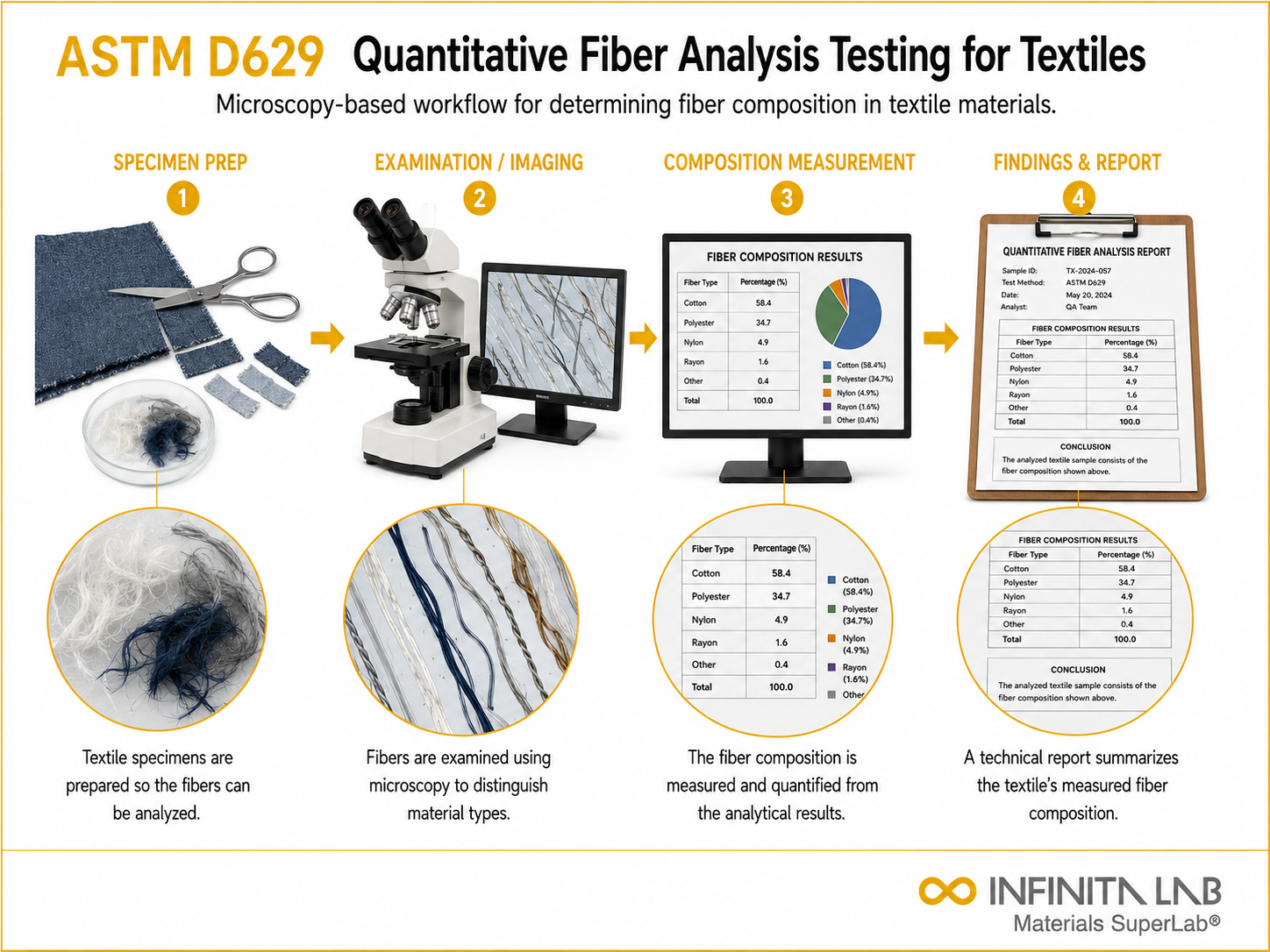
ASTM D629 is a standardized test method used for the quantitative analysis of textile materials, enabling the determination of fiber composition in blended or mixed fabrics. It provides systematic procedures to separate and identify different fiber types based on their chemical and physical properties.
This test is essential for textile manufacturers, quality control laboratories, and research facilities to verify material composition, ensure labeling accuracy, and maintain compliance with product specifications. It plays a critical role in confirming fiber percentages in blends such as cotton-polyester or wool-nylon textiles.

Applications and Benefits of ASTM D629 Textile Quantitative Fiber Analysis Testing
Scope
ASTM D629 outlines procedures for the quantitative determination of textile fiber composition using chemical, mechanical, or microscopic techniques. It applies to woven, knitted, and nonwoven fabrics and supports accurate identification of fiber percentages in blended materials.
Key scope elements include:
- Determination of fiber composition in blended textiles
- Use of chemical dissolution and separation techniques
- Applicability to natural and synthetic fibers
- Evaluation of woven, knitted, and nonwoven fabrics
- Support for regulatory compliance and labeling verification
Applications
- Textile manufacturing quality control
- Fiber blend verification and labeling compliance
- Raw material inspection and validation
- Research and development of textile products
- Import/export quality verification
- Apparel and technical textile testing
- Forensic textile analysis
- Certification and compliance testing
Benefits
- Ensures accurate fiber composition identification
- Supports compliance with labeling regulations
- Enhances product quality and consistency
- Reduces risk of mislabeling and disputes
- Enables reliable comparison of textile materials
- Assists in material selection and development
- Provides standardized and reproducible results
Our ASTM D629 Testing Procedure
Sample Preparation
Textile sample is cleaned and prepared to remove finishes or contaminants that may affect analysis.
1Fiber Separation
Fibers are separated using chemical dissolution, mechanical methods, or a combination depending on fiber types.
2Drying and Weighing
Separated fibers are dried and accurately weighed to determine individual fiber mass.
3Composition Calculation
Fiber percentages are calculated based on mass ratios to determine quantitative composition.
4ASTM D629 Test Parameters and Requirements
| Parameter | Details |
|---|---|
| Material Type | Natural and synthetic textile fibers |
| Method Type | Chemical, mechanical, or microscopic separation |
| Measurement Unit | Percentage composition (%) |
| Sample Type | Woven, knitted, nonwoven fabrics |
| Pre-treatment | Removal of finishes and contaminants required |
| Environmental Conditions | Controlled drying and conditioning |
| Fiber Identification | Based on chemical solubility or structure |
| Output | Percentage composition of each fiber type |


- Analytical balance
- Drying oven
- Chemical reagents and solvents
- Filtration apparatus
- Microscope
- Glassware and separation tools
Equipment and Instrumentation Used for ASTM D629 Testing
What You Receive: Test Report, Data, and Certification
- Percentage composition of each fiber
- Detailed test report with methodology
- Identification of fiber types present
- Compliance verification with specifications
- Observations on sample condition
- Supporting data for quality control
ASTM D629 Textile Quantitative Fiber Analysis FAQs
ASTM D629 aims to determine the quantitative composition of textile fibers in a sample. It helps identify the percentage of each fiber type present, ensuring accurate labeling, compliance with standards, and consistency in textile manufacturing and quality control processes.
Quantitative analysis ensures that fiber blends meet specified requirements and labeling claims. It prevents misrepresentation, supports regulatory compliance, and helps maintain consistent product quality, which is essential for customer trust and brand reputation in competitive textile markets.
Different fibers react differently to specific chemicals. By dissolving one component selectively, the remaining fibers can be isolated and measured. This selective solubility allows accurate identification and quantification of individual fibers in blended textile samples.
Yes, but it may require specific chemical reagents or microscopic analysis. Some fibers with similar properties need advanced techniques to differentiate them accurately, ensuring precise identification and quantification in complex blends.
Challenges include separating fibers with similar chemical properties, ensuring complete dissolution of targeted fibers, and avoiding loss of material during handling. Proper method selection and careful execution are essential to overcome these challenges.
ASTM D629 covers quantitative analysis of textile fiber blends using chemical separation, mechanical separation, and microscopic examination. The proportion of each fiber type is determined and reported as a percentage of the sample. Note: ASTM D629-15 was withdrawn in 2024 without replacement.
Fiber composition testing identifies and measures the different fibers in a textile sample. Depending on the blend, the laboratory uses microscopy, selective chemical dissolution, or mechanical separation to determine the percentage of each fiber type.
Why Choose Infinita Lab for Textile Quantitative Fiber Analysis Testing?
When your Textile Quantitative Fiber Analysis results have to hold up - for compliance, a customer audit, or an engineering decision - ASTM D629 accuracy and an unbiased third-party report matter more than price. Infinita Lab routes your ASTM D629 textile quantitative fiber analysis testing to ISO/IEC 17025-accredited U.S. partner labs with hands-on method experience, so you get defensible data, transparent reporting, and turnaround times built around your project deadline - not ours.

Need ASTM D629 Textile Quantitative Fiber Analysis Testing You Can Rely On?
Send query us at hello@infinitalab.com or call us at (888) 878-3090 to learn more about our services and how we can support you.



Request a Quote
Submit your material details and receive testing procedures, pricing, and turnaround time within 24 hours.
 Quick Turnaround and Hasslefree process
 Confidentiality Guarantee
 Free, No-obligation Consultation
 100% Customer Satisfaction
