


ASTM D6209: PAH Ambient Air Testing Services
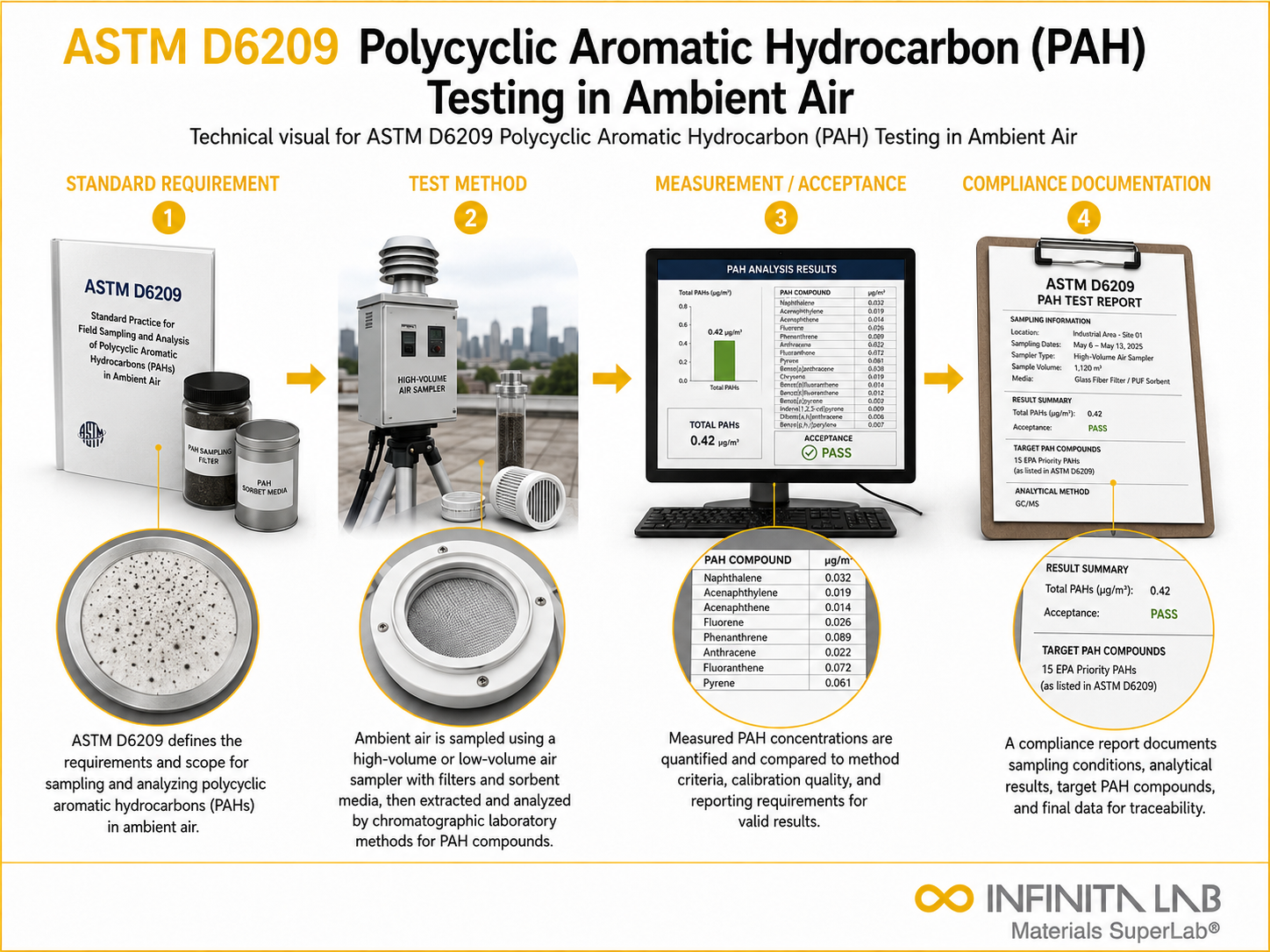
ASTM D6209-13 test method describes sampling, cleanup, and analysis procedures to measure the amount of polycyclic aromatic hydrocarbons (PAH) in ambient air. The air samples are collected using Sorbent-backed filters, and these samples are analyzed with Gas Chromatographic/Mass Spectrometry.
TRUSTED BY


Get ASTM D6209 compliant results — request your PAH ambient air testing quote
- Overview
- Scope, Applications, and Benefits
- Test Process
- Specifications
- Instrumentation
- Results and Deliverables
What Is ASTM D6209 PAH Ambient Air?
ASTM D6209-13 describes a standardized method for determining both gaseous and particulate polycyclic aromatic hydrocarbons (PAHs) in ambient air. PAHs are hazardous organic compounds formed during incomplete combustion processes and are commonly found in urban and industrial environments. This method enables accurate identification and quantification of PAHs to assess environmental and health risks.
The test involves collecting air samples using filters and adsorbents, followed by extraction and analysis using advanced chromatographic techniques. It supports regulatory monitoring, pollution source identification, and long-term air quality studies by providing reliable data on PAH concentrations in different atmospheric conditions.

Applications and Benefits of ASTM D6209 PAH Ambient Air Testing
Scope
ASTM D6209-13 defines procedures for sampling, extraction, and analysis of gaseous and particulate PAHs in ambient air environments. It ensures consistent and reproducible results across monitoring programs.
- Covers both vapor-phase and particle-bound PAHs
- Applicable to outdoor and environmental air monitoring
- Utilizes filter and adsorbent sampling techniques
- Suitable for trace-level PAH detection
- Includes laboratory extraction and analytical procedures
Applications
- Ambient air quality monitoring programs
- Environmental pollution assessment studies
- Industrial emission evaluation
- Urban air contamination analysis
- Regulatory compliance and reporting
- Research on atmospheric chemistry
- Health risk assessment studies
Benefits
- Accurate detection of trace PAHs in air
- Simultaneous analysis of gaseous and particulate phases
- High sensitivity and reliability
- Supports environmental compliance
- Helps identify pollution sources
- Standardized and reproducible methodology
Our ASTM D6209 Testing Procedure
Sample Collection
Ambient air is drawn through filters and adsorbent media to capture particulate and gaseous PAHs.
1Extraction
Collected samples are solvent-extracted to isolate PAHs from filters and adsorbents.
2Cleanup
Extracts are purified to remove interfering substances before analysis.
3Analysis
PAHs are quantified using chromatographic techniques such as GC-MS or HPLC.
4ASTM D6209 Test Parameters and Requirements
| Parameter | Details |
|---|---|
| Property Measured | Concentration of polycyclic aromatic hydrocarbons in both vapor and particulate phases. |
| Material Type | Ambient air containing organic pollutants from environmental and anthropogenic sources. |
| Measurement Unit | Reported in nanograms per cubic meter (ng/m³) of air. |
| Analytical Technique | Uses GC-MS or HPLC for accurate identification and quantification of PAHs. |
| Environment | Outdoor ambient air under controlled sampling and environmental monitoring conditions. |
| Output | Quantitative concentration of individual and total PAHs in gaseous and particulate fractions. |


- Air sampling pumps
- High-volume or low-volume air samplers
- Filter media and adsorbent cartridges
- Soxhlet or ultrasonic extraction system
- Gas Chromatograph-Mass Spectrometer (GC-MS)
- High-Performance Liquid Chromatography (HPLC)
- Analytical balance
- Flow calibration devices
Equipment and Instrumentation Used for ASTM D6209 Testing
What You Receive: Test Report, Data, and Certification
- Quantitative concentration of PAHs (ng/m³)
- Separation of gaseous and particulate PAH data
- Detailed analytical report
- Calibration and quality control data
- Chromatograms and spectral outputs
- Compliance assessment data
ASTM D6209 PAH Ambient Air FAQs
ASTM D6209-13 uses a dual-phase sampling approach combining filters for particulate-bound PAHs and adsorbents for gaseous compounds. This separation enables precise quantification of each phase, ensuring accurate total PAH concentration and improved environmental assessment reliability.
The method integrates high-volume sampling, efficient solvent extraction, and sensitive analytical techniques like GC-MS or HPLC, enabling detection of PAHs at very low concentrations, making it highly effective for trace-level environmental monitoring applications.
Phase separation is critical because PAHs distribute differently between gas and particulate phases depending on molecular weight and environmental conditions, and analyzing both phases ensures accurate exposure assessment and comprehensive air quality evaluation.
Temperature, humidity, and particulate concentration significantly affect PAH distribution between phases and sampling efficiency, requiring controlled conditions and proper calibration to maintain accuracy and ensure representative sampling of ambient air pollutants.
By analyzing the composition and concentration patterns of individual PAH compounds, the method helps identify pollution sources such as vehicle emissions, industrial combustion, or biomass burning, supporting environmental investigations and regulatory decision-making.
Why Choose Infinita Lab for PAH Ambient Air Testing?
At the core of this breadth is our network of 2,000+ accredited laboratories across the USA, offering access to over 10,000 testing methods and analytical services. From advanced materials characterization (SEM, TEM, RBS, XPS) to mechanical, chemical, environmental, biological, and standardized ASTM/ISO-compliant testing, we deliver unmatched flexibility, specialization, and scale. You are never limited by geography, facility, or methodology — Infinita Lab connects you to the right expertise and testing solution, every time.

Looking for an Accredited Partner for ASTM D6209 PAH Ambient Air Testing?
Send query us at hello@infinitalab.com or call us at (888) 878-3090 to learn more about our services and how we can support you.



Request a Quote
Submit your material details and receive testing procedures, pricing, and turnaround time within 24 hours.
 Quick Turnaround and Hasslefree process
 Confidentiality Guarantee
 Free, No-obligation Consultation
 100% Customer Satisfaction
