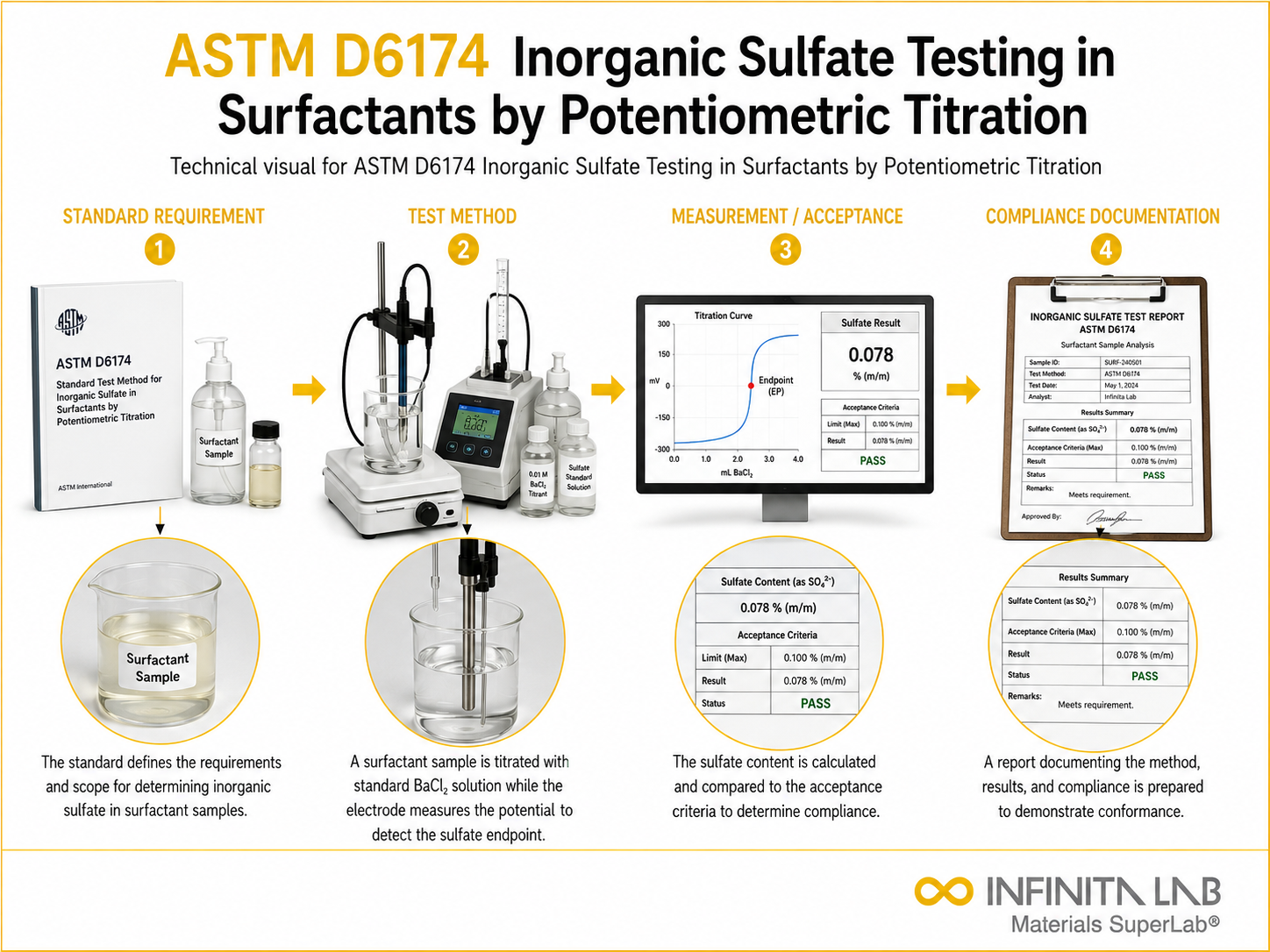


What Is ASTM D6174 Surfactant Inorganic Sulfate Potentiometric?
ASTM D6174 is a standardized analytical method used to determine inorganic sulfate content present in surfactant materials using potentiometric lead titration. Inorganic sulfate can originate from raw materials or manufacturing processes and may affect product performance, stability, and regulatory compliance.
This method provides accurate and reliable quantification of sulfate ions through selective titration and electrode-based endpoint detection. It is particularly valuable for ensuring formulation purity, optimizing processing conditions, and maintaining consistent quality in surfactant-based products across industrial and commercial applications.

Applications and Benefits of ASTM D6174 Surfactant Inorganic Sulfate Potentiometric Testing
Scope
This test method determines inorganic sulfate content in surfactants using potentiometric titration with a lead-based titrant for precise endpoint detection.
Includes:
- Quantitative determination of inorganic sulfate
- Use of potentiometric lead titration
- Applicability to surfactant formulations
- Detection using electrode-based measurement
- Support for quality control and purity assessment
Applications
- Detergents and cleaning products
- Personal care formulations
- Industrial surfactant manufacturing
- Raw material quality control
- Chemical processing industries
- Research and development laboratories
Benefits
- Accurate sulfate quantification
- Reliable endpoint detection
- Supports formulation purity control
- Improves product consistency
- Enables regulatory compliance
- Suitable for complex formulations
Our ASTM D6174 Testing Procedure
Sample Preparation
The surfactant sample is dissolved and prepared in a suitable medium for titration.
1Titrant Addition
Lead-based titrant is gradually added to react with sulfate ions in the sample.
2Endpoint Detection
The potentiometric electrode detects the endpoint through changes in electrical potential.
3Calculation
Sulfate concentration is calculated using titration volume and standardization data.
4ASTM D6174 Test Parameters and Requirements
| Parameter | Details |
|---|---|
| Technique | Potentiometric titration |
| Property Measured | Inorganic sulfate content |
| Titrant | Lead-based solution |
| Sample Type | Surfactant formulations |
| Measurement Unit | Percentage or ppm |
| Detection | Electrode-based endpoint |
| Output | Sulfate concentration |


- Potentiometric titrator
- Ion-selective or suitable electrode
- Burette or automatic titration system
- Magnetic stirrer
- Analytical balance
- Volumetric glassware
Equipment and Instrumentation Used for ASTM D6174 Testing
What You Receive: Test Report, Data, and Certification
- Inorganic sulfate concentration values
- Titration curve and endpoint data
- Calibration and standardization details
- Quality compliance assessment
- Formulation purity evaluation
- Detailed analytical report
ASTM D6174 Surfactant Inorganic Sulfate Potentiometric FAQs
Inorganic sulfate can influence product stability, foaming behavior, and overall performance. Excess sulfate may indicate incomplete reactions or impurities, making its accurate measurement essential for maintaining product quality and consistency.
ASTM D6174 uses potentiometric endpoint detection, eliminating subjective visual indicators. This ensures precise and reproducible measurement of sulfate content, even in complex or colored surfactant formulations.
The method involves reacting sulfate ions with a lead-based titrant while monitoring electrical potential changes. The endpoint is detected when the reaction is complete, ensuring accurate quantification.
Factors include improper calibration, electrode condition, sample preparation errors, and environmental variations. Proper procedures are essential for reliable results.
Testing is typically performed during formulation development, production, and routine quality checks to maintain consistency.
Why Choose Infinita Lab for Surfactant Inorganic Sulfate Potentiometric Testing?
At the core of this breadth is our network of 2,000+ accredited laboratories across the USA, offering access to over 10,000 testing methods and analytical services. From advanced materials characterization (SEM, TEM, RBS, XPS) to mechanical, chemical, environmental, biological, and standardized ASTM/ISO-compliant testing, we deliver unmatched flexibility, specialization, and scale. You are never limited by geography, facility, or methodology — Infinita Lab connects you to the right expertise and testing solution, every time.

Looking for an Accredited Partner for ASTM D6174 Surfactant Inorganic Sulfate Potentiometric Testing?
Send query us at hello@infinitalab.com or call us at (888) 878-3090 to learn more about our services and how we can support you.





