


ASTM D6130: Determination Of Silicon By Inductively Coupled Plasma Atomic Emission Spectroscopy Testing Services
Accredited ASTM D6130 determination of silicon by inductively coupled plasma atomic emission spectroscopy testing from Infinita Lab, performed to the exact standard requirements - accurate, reproducible results with full documentation for compliance, R&D, and quality control programs.
TRUSTED BY


Get ASTM D6130 compliant results - request your determination of silicon by inductively coupled plasma atomic emission spectroscopy testing quote
- Overview
- Scope, Applications, and Benefits
- Test Process
- Specifications
- Instrumentation
- Results and Deliverables
What Is ASTM D6130 Determination Of Silicon By Inductively Coupled Plasma Atomic Emission Spectroscopy?
ASTM D6130 is the standard test method used to determine silicon, along with other dissolved or dispersed elements, in engine coolant using inductively coupled plasma-atomic emission spectroscopy (ICP-AES). The method applies to both new, as-manufactured coolant concentrates and blends as well as in-service coolant drawn from operating cooling systems, giving formulators, fleet operators, and equipment manufacturers a reliable way to track elemental content over the life of the fluid. In the test, a coolant sample is diluted with an appropriate solvent, introduced into an argon plasma torch, and the characteristic emission wavelengths produced as excited atoms return to their ground state are measured and compared against calibration standards to calculate elemental concentrations, with silicon typically quantifiable down to approximately 5 ppm.
Silicon is important in coolant chemistry because silicate compounds are widely used as corrosion inhibitors, forming a protective oxide layer on metal surfaces, most notably aluminium radiators, water pumps, and cylinder heads, that helps insulate those components from electrochemical attack. Tracking silicon concentration lets formulators confirm that a coolant contains the intended level of silicate inhibitor and lets fleet and equipment operators monitor whether that protective additive is being depleted, contaminated, or is dropping out of solution, a condition associated with gel formation, water pump seal wear, and reduced heat transfer efficiency in some silicate-containing formulations. By pairing a sensitive, multi-element ICP-AES technique with a defined sample preparation and calibration procedure, ASTM D6130 gives coolant manufacturers, engine builders, and maintenance laboratories a consistent, defensible basis for quality control, additive verification, and in-service condition monitoring across automotive and heavy-duty cooling systems.

Applications and Benefits of ASTM D6130 Determination Of Silicon By Inductively Coupled Plasma Atomic Emission Spectroscopy Testing
Scope
- Covers the determination of silicon and other dissolved or dispersed elements in engine coolant by inductively coupled plasma-atomic emission spectroscopy (ICP-AES).
- Applies to both new, unused engine coolant concentrates and ready-to-use blends.
- Applies to in-service, used engine coolant sampled from operating cooling systems.
- Provides a means of measuring silicon-containing additives incorporated into certain coolant formulations.
- Can be used to determine other elements present in coolant in addition to silicon, using the same instrumental technique.
- Reports elemental concentrations on a mass or volume basis after appropriate sample dilution.
- Requires an ICP-AES instrument calibrated with certified reference standards traceable to recognised elemental standards.
- Is applicable across ethylene glycol and propylene glycol based coolant formulations.
- Supports quality control testing of finished coolant products prior to release.
- Supports periodic condition monitoring of coolant already in service in vehicles and equipment.
Applications
- Verifying that newly manufactured coolant batches meet formulation targets for silicon and other additive elements.
- Monitoring in-service coolant in passenger vehicles and light-duty fleets for additive depletion or contamination.
- Assessing coolant condition in heavy equipment, trucking, and off-highway fleets subject to demanding duty cycles.
- Supporting coolant manufacturers and blenders during product development and formulation comparison.
- Investigating cooling system complaints such as gel formation, water pump wear, or reduced heat transfer.
- Assisting OEMs and service organisations with warranty and root-cause investigations involving coolant chemistry.
- Providing supporting elemental data for broader used-coolant or used-oil analysis programs.
Benefits
- Delivers a sensitive, multi-element technique that quantifies silicon at low part-per-million levels.
- Offers a standardised, repeatable procedure that supports consistent results across laboratories.
- Helps confirm additive package integrity for silicate-inhibited coolant formulations.
- Supports proactive maintenance planning by flagging additive depletion before component damage occurs.
- Provides objective, third-party data useful for supplier qualification and warranty discussions.
- Applicable to both new-product quality control and in-service condition monitoring within a single method.
Our ASTM D6130 Testing Procedure
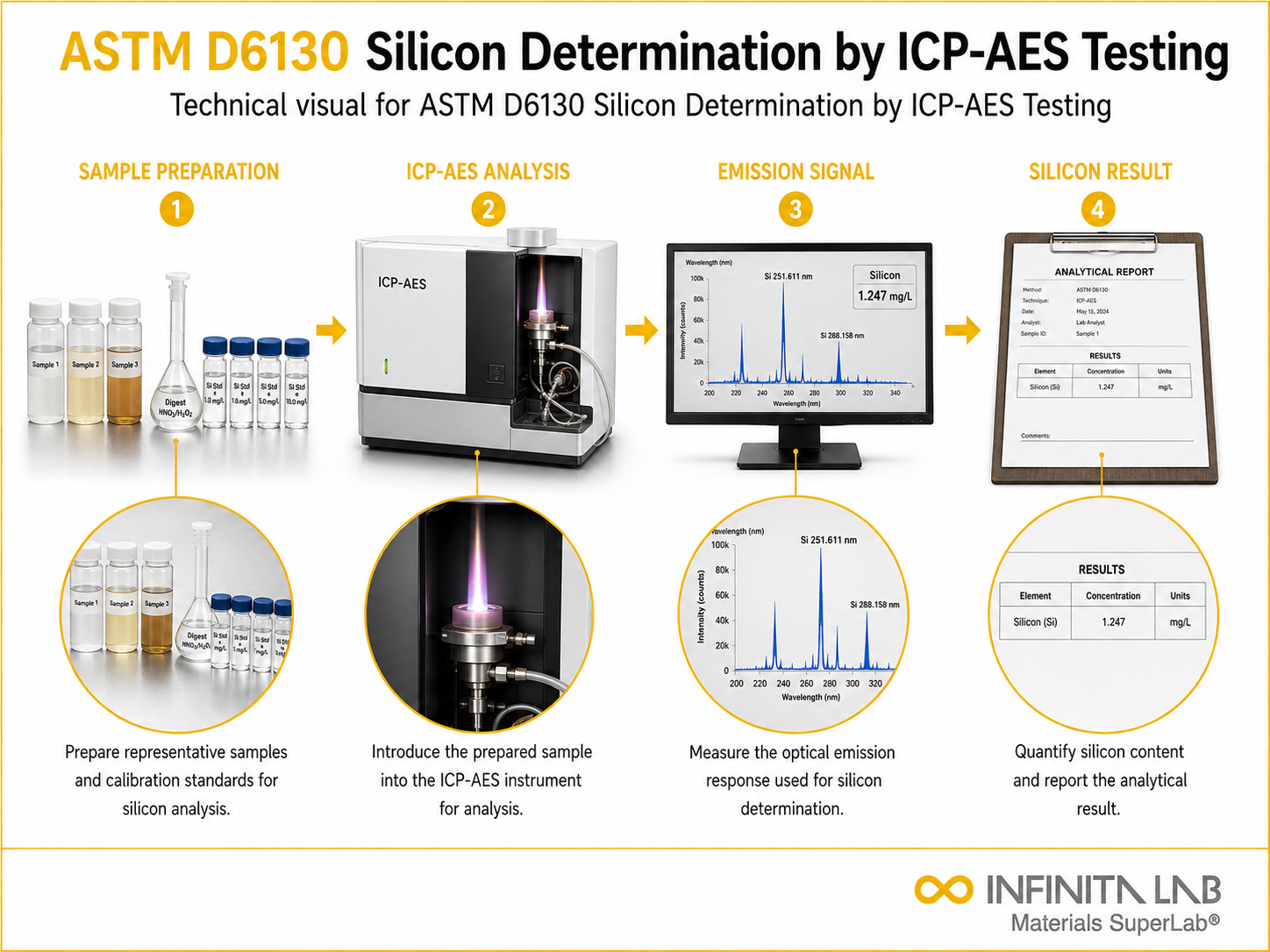
Sample Preparation & Dilution
The material is ground, acid-dissolved, and diluted with deionized water.
1Instrument Calibration
ICP-AES is calibrated using standard solutions.
2Sample Aspiration & Verification
Prepared sample is aspirated; blanks and standards are verified.
3Rinse Cycle & Run Completion
The instrument is rinsed with water between boron-containing samples.
4ASTM D6130 Test Parameters and Requirements
| Parameter | Details |
|---|---|
| Detection Limit | As low as 5 ppm |
| Applicable Materials | Coal, coke, combustion residues |
| Sample Conditioning | Typically 1000 mg/L |
| Output Units | ppm |
| Analysis Type | Multi-element |
| Sample Preparation | Acid digestion |


- ICP-AES Spectrometer – Generates and sustains the argon plasma, atomises the sample, and measures characteristic emission wavelengths to quantify silicon and other elements.
- Analytical Balance – Provides accurate mass measurements for sample and standard preparation.
- Sample Dilution and Preparation Equipment – Volumetric flasks, pipettes, and diluents used to bring samples within the instrument’s calibrated working range.
- Certified Reference Standards – Traceable multi-element and silicon-specific standards used to calibrate and verify the ICP-AES system.
- Deionized Water System – Supplies high-purity water for standard preparation, dilution, and rinsing between samples.
- Autosampler – Enables consistent, automated introduction of multiple prepared samples for higher-throughput analysis.
- Data Acquisition Software – Captures spectral intensities, applies calibration curves, and generates quantitative elemental results.
Equipment and Instrumentation Used for ASTM D6130 Testing
What You Receive: Test Report, Data, and Certification
- A detailed test report presenting the measured silicon concentration and any other requested elemental results.
- Reference to the applicable ASTM D6130 method and any deviations noted during testing.
- Documentation of calibration standards, quality control checks, and instrument conditions used during analysis.
- Sample identification, test date, and chain-of-custody information for traceability.
- Results delivered in a format suitable for internal quality records, regulatory files, or customer-facing documentation.
- Access to laboratory personnel for result interpretation or follow-up technical questions.
ASTM D6130 Determination Of Silicon By Inductively Coupled Plasma Atomic Emission Spectroscopy FAQs
ASTM D6130 is a standardized test method for determining the concentration of trace elements in coal, coke, combustion residues, and engine coolants using inductively coupled plasma-atomic emission spectrometry (ICP-AES).
This method applies to various samples, including coal, coke, combustion residues, and new and used engine coolants.
ASTM D6130 can detect a wide range of elements, including but not limited to aluminum, calcium, iron, magnesium, and silicon.
This test method is widely used in quality control, regulatory compliance, and research across various industries.
It requires specialized equipment & expertise to perform correctly. The method's accuracy can also be affected by complex matrices or interferences in the sample, which may require additional steps to mitigate.
Why Choose Infinita Lab for Determination Of Silicon By Inductively Coupled Plasma Atomic Emission Spectroscopy Testing
When your Determination Of Silicon By Inductively Coupled Plasma Atomic Emission Spectroscopy results have to hold up - for compliance, a customer audit, or an engineering decision - ASTM D6130 accuracy and an unbiased third-party report matter more than price. Infinita Lab routes your ASTM D6130 determination of silicon by inductively coupled plasma atomic emission spectroscopy testing to ISO/IEC 17025-accredited U.S. partner labs with hands-on method experience, so you get defensible data, transparent reporting, and turnaround times built around your project deadline - not ours.

Need ASTM D6130 Determination Of Silicon By Inductively Coupled Plasma Atomic Emission Spectroscopy Testing You Can Rely On?
Send query us at hello@infinitalab.com or call us at (888) 878-3090 to learn more about our services and how we can support you.



Request a Quote
Submit your material details and receive testing procedures, pricing, and turnaround time within 24 hours.
 Quick Turnaround and Hasslefree process
 Confidentiality Guarantee
 Free, No-obligation Consultation
 100% Customer Satisfaction
