


ASTM D5508: Residual Acrylonitrile SAN NBR Testing Services
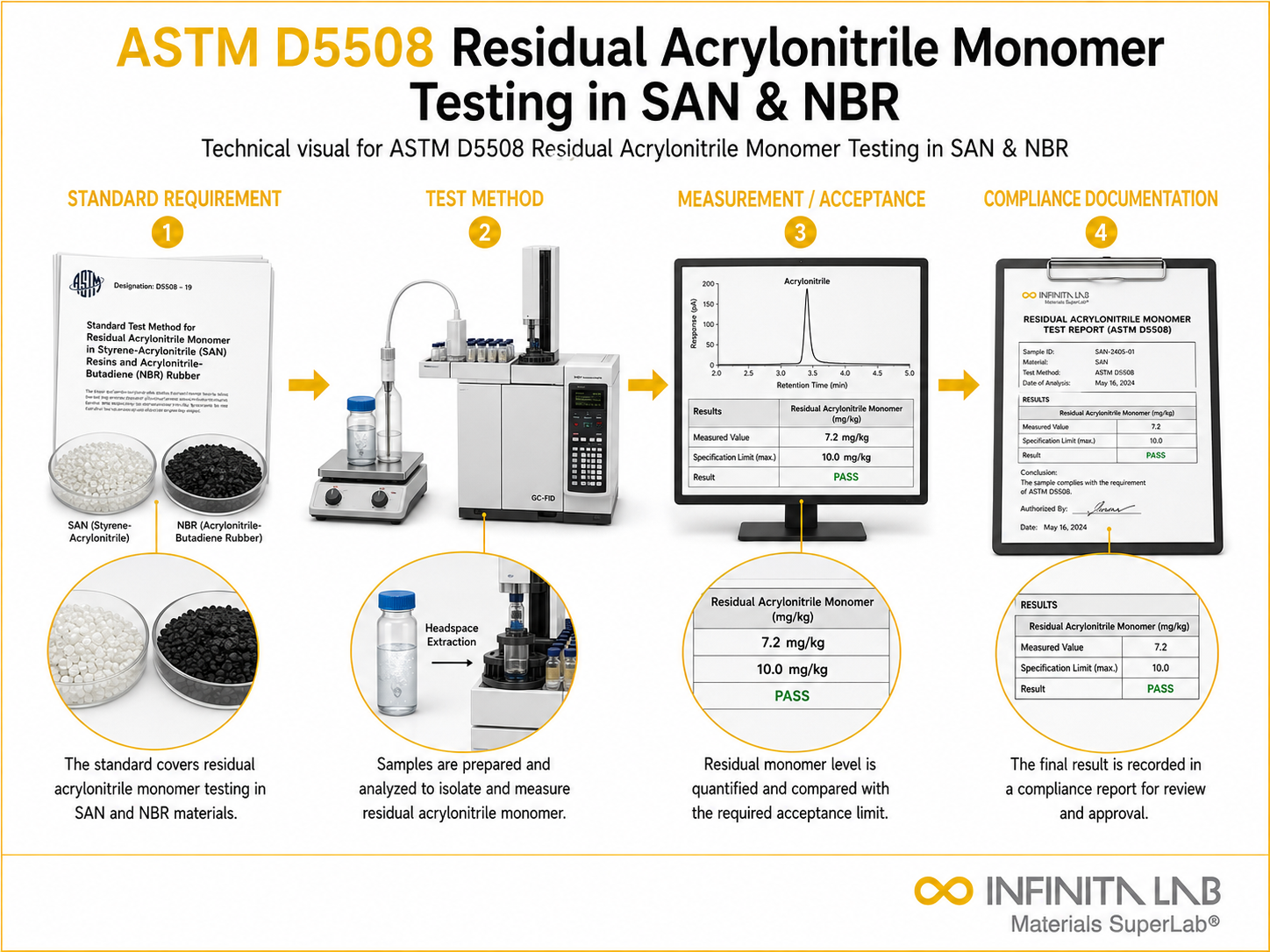
The ASTM D5508 test method uses headspace-capillary gas chromatography (HS-CGC) to determine the residual acrylonitrile (RAN) monomer in styrene-acrylonitrile (SAN) copolymer resins, nitrile-butadiene rubber (NBR), and rubber-modified acrylonitrile-butadiene-styrene (ABS) resins.
TRUSTED BY


Get ASTM D5508 compliant results — request your residual acrylonitrile SAN NBR testing quote
- Overview
- Scope, Applications, and Benefits
- Test Process
- Specifications
- Instrumentation
- Results and Deliverables
What Is ASTM D5508 Residual Acrylonitrile SAN NBR?
ASTM D5508 determines the residual acrylonitrile monomer present in styrene-acrylonitrile (SAN) copolymer resins and nitrile-butadiene rubber (NBR). It uses analytical techniques such as gas chromatography to detect and quantify trace monomer levels that may remain after polymerization.
This method is essential for ensuring material safety, product quality, and regulatory compliance. Residual acrylonitrile can affect mechanical properties, processing behavior, and environmental safety. Accurate measurement helps manufacturers control production processes and maintain consistent material performance.

Applications and Benefits of ASTM D5508 Residual Acrylonitrile SAN NBR Testing
Scope
ASTM D5508 covers the determination of residual acrylonitrile monomer in SAN resins and NBR materials. It focuses on quantifying trace monomer content using sensitive analytical techniques under controlled laboratory conditions.
- Applicable to SAN copolymers and NBR materials
- Measures residual acrylonitrile monomer content
- Uses gas chromatography-based analysis
- Supports safety and compliance evaluation
- Suitable for low-level impurity detection
Applications
- Polymer production quality control
- Rubber and plastic material evaluation
- Food-contact and safety compliance testing
- Chemical processing and monitoring
- Research and development of polymer systems
- Residual monomer analysis in manufacturing
- Product certification and validation
Benefits
Ensures low residual monomer content
Supports regulatory compliance requirements
Improves product safety and reliability
Enhances polymer performance consistency
Enables process optimization
Detects trace impurities accurately
Our ASTM D5508 Testing Procedure
Sample Preparation
Polymer sample is prepared and dissolved or extracted using a suitable solvent system.
1Extraction/Separation
Residual acrylonitrile is separated from the polymer matrix under controlled conditions.
2Chromatographic Analysis
Extract is analyzed using gas chromatography for detection and quantification.
3Result Calculation
Acrylonitrile concentration is calculated using calibration standards and detector response.
4ASTM D5508 Test Parameters and Requirements
| Parameter | Details |
|---|---|
| Method Type | Gas chromatography (GC) |
| Sample Type | SAN resins and NBR materials |
| Analyte | Residual acrylonitrile monomer |
| Detection Level | Trace-level sensitivity |
| Solvent System | Suitable extraction solvent |
| Detector | Flame ionization or equivalent |
| Output | Concentration of residual monomer |
| Temperature Control | Controlled GC conditions |


- Gas chromatograph (GC)
- Sample extraction system
- Analytical columns
- Detector (FID or equivalent)
- Calibration standards
- Analytical balance
- Data acquisition software
Equipment and Instrumentation Used for ASTM D5508 Testing
What You Receive: Test Report, Data, and Certification
- Residual acrylonitrile concentration
- Chromatographic data and peak analysis
- Material purity assessment
- Compliance evaluation report
- Detailed analytical report
- Observations and test conditions
ASTM D5508 Residual Acrylonitrile SAN NBR FAQs
ASTM D5508 is important because residual acrylonitrile can affect toxicity, odor, and regulatory compliance. Accurate quantification ensures materials meet safety standards, minimizes health risks, and maintains consistent product performance in styrene-acrylonitrile and nitrile rubber applications.
ASTM D5508 helps ensure product safety by detecting trace acrylonitrile monomer that may pose health or environmental risks. Monitoring and controlling these levels supports compliance with safety regulations and ensures materials are suitable for sensitive applications.
ASTM D5508 relies on gas chromatography to separate and quantify acrylonitrile monomer. The method provides high sensitivity and specificity, enabling accurate detection of trace levels even in complex polymer matrices such as SAN and NBR.
ASTM D5508 involves challenges such as efficient extraction of monomer, avoiding sample degradation, and maintaining analytical precision. Proper method control is required to ensure accurate recovery and detection of low-level residual acrylonitrile.
ASTM D5508 ensures consistent polymer quality by monitoring residual monomer levels across batches. This helps maintain uniform processing behavior, mechanical properties, and product performance in manufacturing operations.
Why Choose Infinita Lab for Residual Acrylonitrile SAN NBR Testing?
At the core of this breadth is our network of 2,000+ accredited laboratories across the USA, offering access to over 10,000 testing methods and analytical services. From advanced materials characterization (SEM, TEM, RBS, XPS) to mechanical, chemical, environmental, biological, and standardized ASTM/ISO-compliant testing, we deliver unmatched flexibility, specialization, and scale. You are never limited by geography, facility, or methodology — Infinita Lab connects you to the right expertise and testing solution, every time.

Looking for an Accredited Partner for ASTM D5508 Residual Acrylonitrile SAN NBR Testing?
Send query us at hello@infinitalab.com or call us at (888) 878-3090 to learn more about our services and how we can support you.



Request a Quote
Submit your material details and receive testing procedures, pricing, and turnaround time within 24 hours.
 Quick Turnaround and Hasslefree process
 Confidentiality Guarantee
 Free, No-obligation Consultation
 100% Customer Satisfaction
