


ASTM D5452: Aviation Fuel Particulate Contamination Testing Services
Accredited ASTM D5452 aviation fuel particulate contamination testing from Infinita Lab, performed to the exact standard requirements - accurate, reproducible results with full documentation for compliance, R&D, and quality control programs.
TRUSTED BY


Get ASTM D5452 compliant results - request your aviation fuel particulate contamination testing quote
- Overview
- Scope, Applications, and Benefits
- Test Process
- Specifications
- Instrumentation
- Results and Deliverables
What Is ASTM D5452 Aviation Fuel Particulate Contamination?
ASTM D5452 is the standard test method used to determine particulate contamination in aviation fuels through laboratory filtration, giving the industry a quantitative benchmark for fuel cleanliness before that fuel is loaded into an aircraft fuel system. Developed under ASTM Subcommittee D02.J0.05, the method addresses a concern that sits at the intersection of safety and performance: solid particulate matter suspended in jet fuel can build up on fuel filters, restrict flow, and interfere with the reliable operation of pumps, valves, and fuel-metering devices. Aircraft fuel systems run on tight tolerances and depend on uninterrupted delivery, so even modest contamination can become an operational risk – which is why objective measurement matters at every stage of the supply chain.
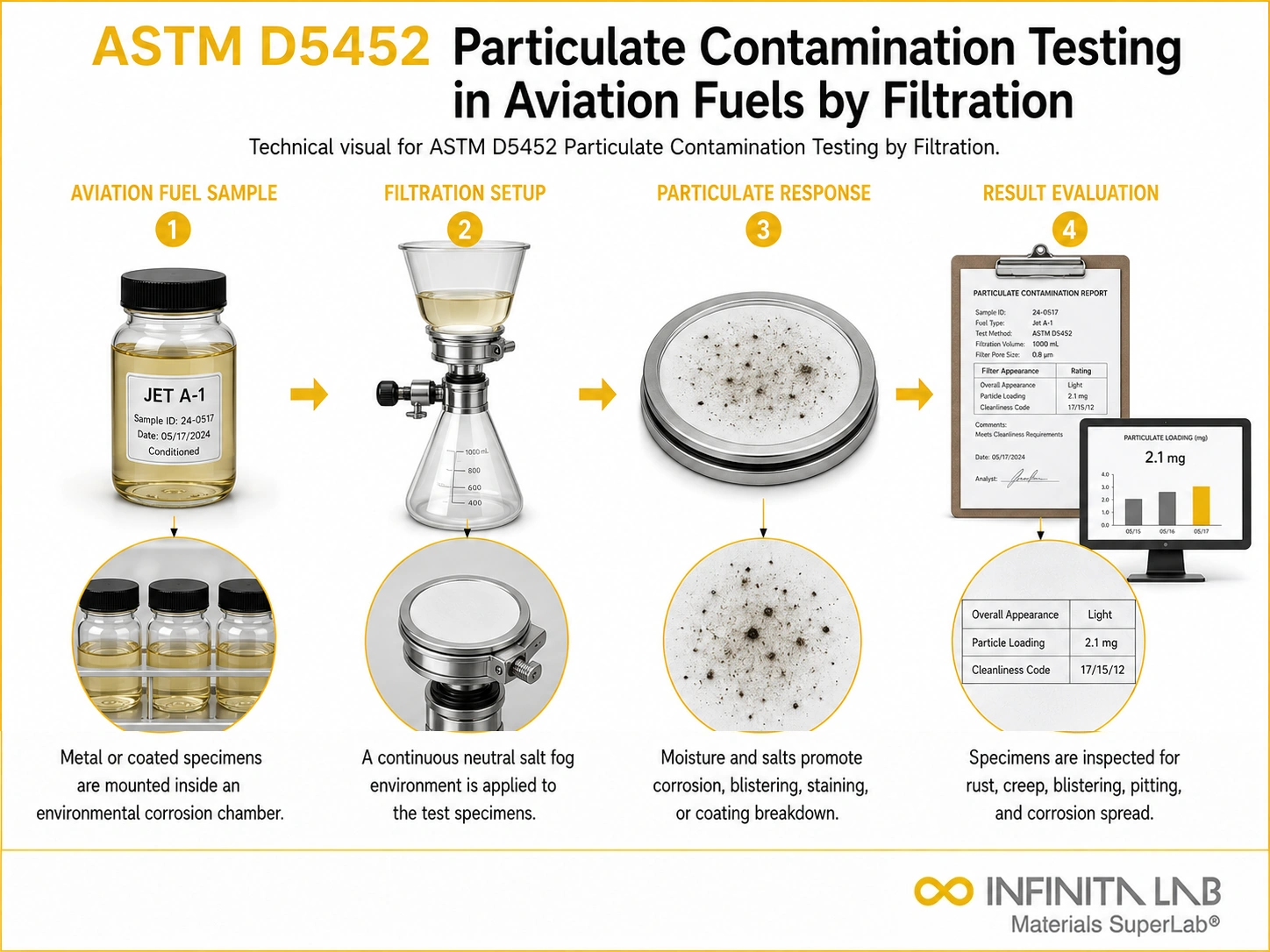
The procedure starts with a representative aviation turbine fuel sample, collected and handled to keep external particulate contamination to a minimum, then passed through a pre-weighed membrane filter under vacuum. A parallel control membrane is filtered alongside it to account for any background particulate the filtration system or handling process might contribute so that the isolated contamination can be attributed specifically to the fuel sample. Once filtration is complete, both membranes are conditioned and weighed, and the mass of particulate residue on the test membrane – corrected against the control – is calculated gravimetrically. Results come out as milligrams of particulate matter per liter of fuel, giving everyone a standardized figure to compare at any point along the distribution chain.
Infinita Lab connects organizations across the aviation fuel supply chain – refiners, fuel handlers, airport fueling operators, and aircraft maintenance providers alike – with accredited laboratories equipped to run ASTM D5452 testing accurately and efficiently. Clients get reliable, defensible contamination data without managing multiple lab relationships, so that fuel quality decisions can move forward with confidence and without delay.

Applications and Benefits of ASTM D5452 Aviation Fuel Particulate Contamination Testing
Scope
ASTM D5452 covers the determination of particulate contamination in aviation fuels using laboratory filtration techniques. It quantifies solid contaminants in fuel samples under controlled conditions.
- Applies to aviation turbine fuel samples delivered to a laboratory for particulate contamination analysis.
- A gravimetric procedure is established for quantifying solid particulate matter present in aviation fuel.
- Fuel samples are filtered through membrane filters under vacuum to capture suspended solid particles.
- A control membrane must be used to correct for particulate contribution from the filtration system and handling process.
- Membrane filter media of a defined pore size and diameter are specified for capturing fine particulates.
- Conditioning, drying, and weighing procedures are defined for before and after filtration.
- A calculation method is provided for expressing contamination results as mass per unit volume of fuel.
- Fuel sampled at various points in the distribution system – refineries, terminals, and airports – falls within scope.
- Dissolved contaminants, water content, and microbiological contamination are not addressed by this method.
- Comparison of contamination results against operational or contractual fuel cleanliness expectations is supported.
Applications
- Verifying aviation turbine fuel cleanliness before fuelling operations at airports and other delivery points.
- Particulate levels can be monitored during fuel storage, handling, and pipeline transfer operations.
- Quality control programs at refineries and fuel blending or distribution facilities rely on this testing.
- Airport fuelling operations use it to confirm that fuel meets cleanliness expectations before aircraft delivery.
- Suspected contamination events or reports of filter plugging within fuel handling systems can be investigated.
- Routine surveillance testing across fuel distribution and storage infrastructure is supported.
- Aircraft maintenance providers and fuel system operators turn to it when troubleshooting suspected contamination issues.
Benefits
- An objective, standardized measurement of particulate contamination in aviation fuel is provided.
- Filter plugging and related operational disruptions in fuel systems become easier to identify and prevent.
- Informed decision-making regarding fuel acceptance, rejection, or further handling is supported.
- Contamination data can be compared consistently across different sampling points and time periods.
- Meeting internal quality specifications and industry expectations for fuel cleanliness becomes more manageable.
- Overall aviation fuel system reliability and operational safety benefit as a result.
Our ASTM D5452 Testing Procedure
Sample Preparation
A measured volume of aviation fuel is collected under clean and controlled conditions.
1Filtration Step
Fuel is passed through a pre-weighed membrane filter to capture particulate matter.
2Drying and Weighing
Filter is dried and reweighed to determine the mass of collected contaminants.
3Result Calculation
Particulate contamination is calculated based on weight difference and sample volume.
4ASTM D5452 Test Parameters and Requirements
| Parameter | Details |
|---|---|
| Sample Type | Aviation turbine fuel |
| Method | Membrane filtration and gravimetric analysis |
| Output | mg/L particulate contamination |
| Filter Type | Pre-weighed membrane filter |
| Sample Volume | Defined volume for accuracy |
| Drying Conditions | Controlled temperature |
| Contaminant Type | Solid particulate matter |


- Vacuum Filtration Assembly – draws the fuel sample through the membrane filter and retains suspended particulate matter for analysis.
- Membrane Filters – capture particulate residue from the fuel sample and serve as the medium for gravimetric measurement.
- Analytical Balance – measures membrane mass before and after filtration with the precision required for accurate contamination calculations.
- Filtration Funnel – holds and directs the fuel sample onto the membrane surface during the filtration step.
- Filtration Vessel – contains the fuel sample and supports the filtration assembly throughout the test.
- Petri Dishes – store and protect membranes during conditioning and between weighing steps.
- Conditioning Chamber – stabilizes membrane moisture content under controlled conditions before weighing to help ensure consistent, repeatable mass readings.
Equipment and Instrumentation Used for ASTM D5452 Testing
What You Receive: Test Report, Data, and Certification
- A detailed test report presenting particulate contamination results in milligrams per liter (mg/L) for the submitted fuel sample.
- Test and control membrane weights used in the gravimetric calculation are documented in full.
- The applicable ASTM D5452 method revision is referenced throughout the report.
- Sample identification and handling information ties the reported results back to the submitted fuel sample.
- Supporting data is suitable for internal quality records, contractual compliance documentation, or regulatory recordkeeping.
- Laboratory personnel remain available for clarification, follow-up questions, or retesting arrangements as needed.
ASTM D5452 Aviation Fuel Particulate Contamination FAQs
ASTM D5452 is used to determine particulate contamination in aviation fuels by filtering the sample and measuring collected solids. It ensures fuel cleanliness, which is critical for safe and efficient aircraft engine operation.
ASTM D5452 helps identify solid contaminants that can clog filters, damage fuel systems, and reduce engine efficiency. Maintaining low contamination levels is essential for aircraft safety and performance.
Factors such as sample handling, filtration conditions, and weighing accuracy influence results. ASTM D5452 requires strict control to ensure reliable measurements.
ASTM D5452 measures only solid particles and does not detect dissolved contaminants or water content in fuel. Additional tests may be required for comprehensive analysis.
Yes, ASTM D5452 allows comparison of contamination levels across different fuel samples, supporting quality assessment and monitoring.
ASTM D5452 measures particulate contamination in aviation turbine fuel through laboratory filtration. A fuel sample is vacuum-filtered through a preweighed membrane, and the collected particles are weighed to determine contamination per unit volume.
Why Choose Infinita Lab for Aviation Fuel Particulate Contamination Testing
When your Aviation Fuel Particulate Contamination results have to hold up - for compliance, a customer audit, or an engineering decision - ASTM D5452 accuracy and an unbiased third-party report matter more than price. Infinita Lab routes your ASTM D5452 aviation fuel particulate contamination testing to ISO/IEC 17025-accredited U.S. partner labs with hands-on method experience, so you get defensible data, transparent reporting, and turnaround times built around your project deadline - not ours.

Need ASTM D5452 Aviation Fuel Particulate Contamination Testing You Can Rely On?
Send query us at hello@infinitalab.com or call us at (888) 878-3090 to learn more about our services and how we can support you.



Request a Quote
Submit your material details and receive testing procedures, pricing, and turnaround time within 24 hours.
 Quick Turnaround and Hasslefree process
 Confidentiality Guarantee
 Free, No-obligation Consultation
 100% Customer Satisfaction
